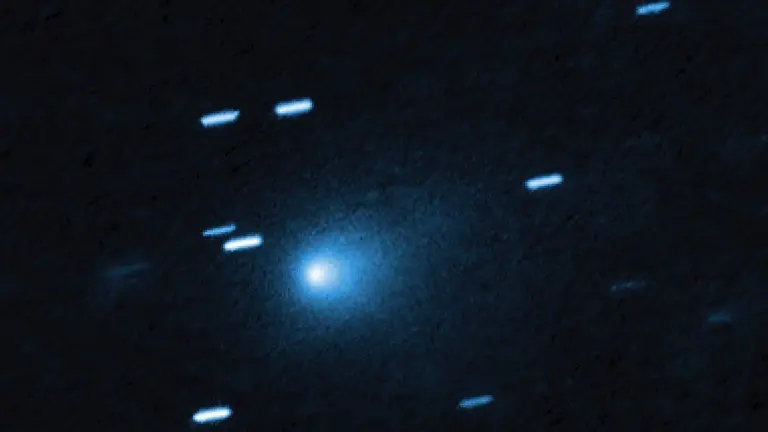
This week, the interstellar comet 3I/Atlas made its closest approach to the Sun as it passed through our Solar System, reaching a distance of about 130 million miles (about 1.4 AU) from the star king.
According to its trajectory, it is expected to reach its closest approach to Earth on December 19 at a distance of about 167 million miles (about 1.8 AU). It poses no danger to our planet or to others in the solar system.
3I/Atlas is the third known object outside our solar system to be found passing through our celestial neighborhood, NASA explains. It has been classified as interstellar due to the hyperbolic shape of its orbit, meaning it does not move in a closed fashion around the Sun.
A scan of its orbit shows that “the comet came from outside our solar system,” according to NASA.
The approach of this stellar object aroused the curiosity of many scientists and the general public. Astronomers from all over the world are studying the size and physical properties of the comet. It will be visible again from December, when it will reappear in the sky.
Comet 3I/Atlas is traveling at about 130,000 miles per hour, the fastest speed recorded for an object outside the Solar System. According to the European Space Agency, it is estimated to be billions of years old, and this fact is determined by its amazing speed, which suggests that it has been “wandering through space for a long time.”
It is likely that the comet lost mass as it approached the Sun, as its frozen gases were turned into vapor by the heat of our star, carrying dust and ice into space.
NASA/ESA/CSA James Webb Space Telescope observations of the coma, or “halo,” surrounding the comet show that as the comet heated up, it emitted carbon dioxide, water, carbon monoxide, carbonyl sulfide, and water ice.
The comet was first observed on July 1, 2025 by the Asteroid Collision Early Warning System (ATLAS) telescope in Rio Hurtada, Chile.
Its name is explained as follows: the number “3” before “I” means that the comet is the third of its kind. The first letter indicates the category to which the comet belongs; in this case the “I” stands for “interstellar”. And the word “ATLAS” refers to the program that controls the telescope that first discovered the comet.