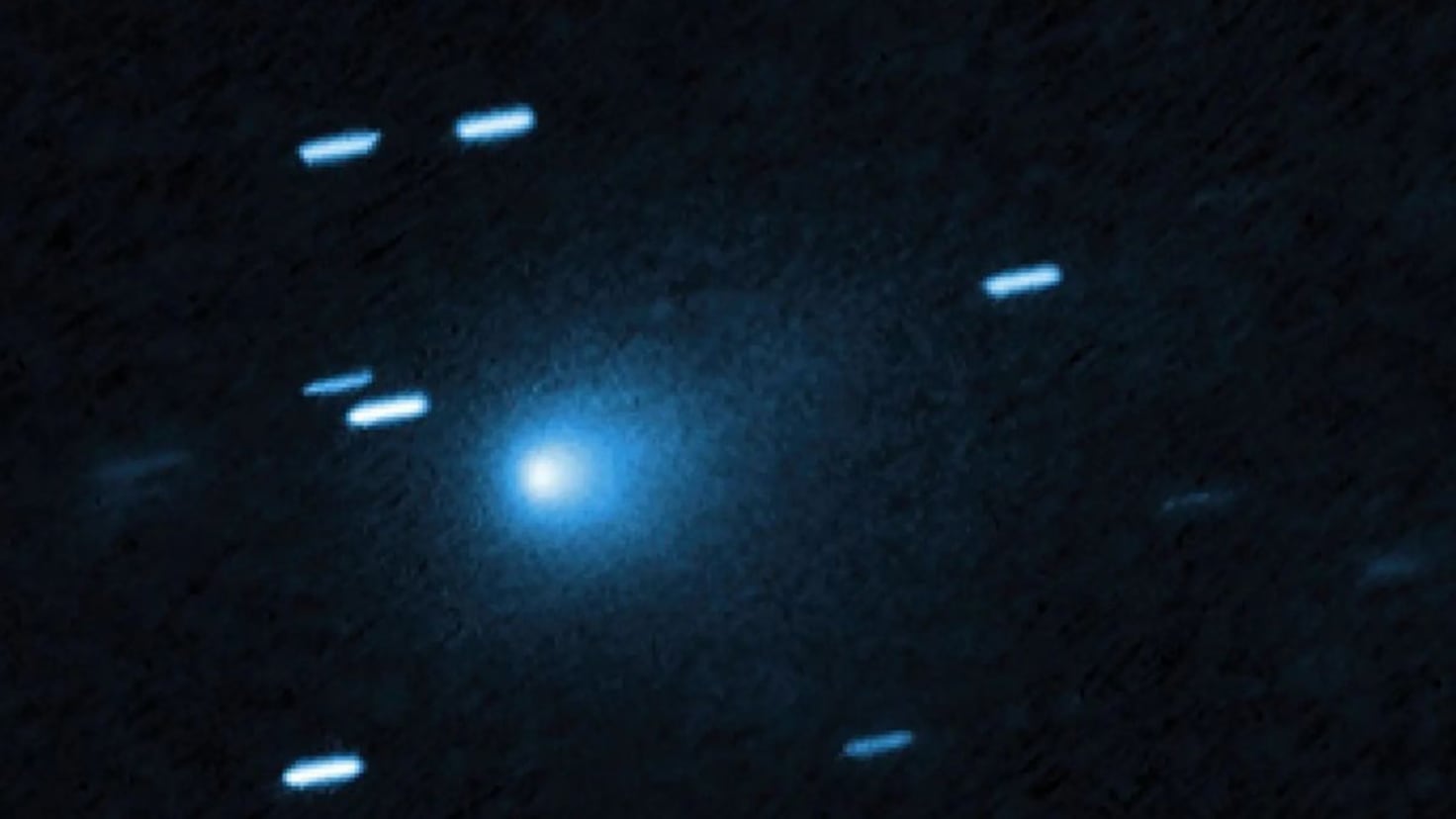
When astronomers discovered 3I/ATLAS last July they thought it would be another interstellar guest with oddities like Borisov or Oumuamua. But they didn’t think it would be so embarrassing. This comet arrived with a desire to put on a big show. First, because It is huge: from 10 to 30 kilometers of corethe largest we’ve seen comes from another star system. Second, because moving at a speed of more than 210,000 km/has if he was in a hurry to return home. And third, because he just did something that made scientists scratch their heads: changed its trajectory, but gravity has nothing to do with it.
In theory, comets are docile: they follow a curve marked by gravity, like cars without steering wheels on a cosmic highway. But 3I/ATLAS decided to go off the rails. Because what? The official explanation is as follows “Rocket Effect”: When the Sun heats the ice, the comet ejects gas and dust, and this jet pushes it around a bit. Until then, everything is fine. The amazing thing is the magnitude of the thrust. To justify the change, should have lost a sixth of its mass in a few weeks. And here the incredible happens: this gas cloud is not there.
Imagine you have a car that weighs 1000 kilograms and to change lanes you need it to lose 160 kilograms in a few days. Here’s the thing about 3I/ATLAS: to explain the deviation, it had to throw itself out millions of tons of ice and dust. And when a comet does, it shows: a huge cloud forms around it, like a bright aura that can be seen even with modest telescopes. But the most powerful instruments – including James Webb – did not detect the volume of gas that should accompany such a loss of mass. It’s like being told that your car has lost 160 kilograms, but it is intact and there are no parts lying on the road.
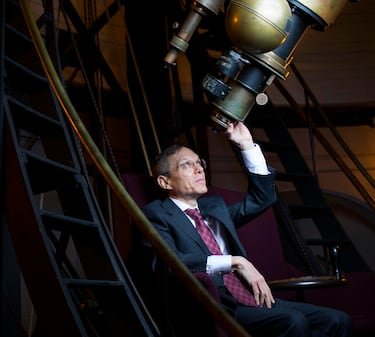
That’s why scientists are worried. Avi Loeban astrophysicist who never bites his tongue clearly said: “If this cloud doesn’t appear in December, traditional physics will run out of excuses”. Loeb has already had arguments with `Oumuamua, suggesting that it may be alien technology. Now back to this: “I’m not saying it’s a ship, but if we don’t find an explanation, we’re going to have to look for unusual solutions.”.
Meanwhile, the comet continues to deliver rarities. I watched it in July anti wheeltail pointing toward the Sun, as if defying cometary logic. In October, when it touched perihelion, the closest point to the Sun, became the blue of our starwhich the comet had not done before. And just in case the show wasn’t on, its brightness suddenly skyrocketed, as if someone had turned the volume all the way up. The spectra show emissions dominated by carbon and traces of ionized nickel, which has never been seen in comets in the Solar System. What does that mean? That it formed in an environment very different from our own, perhaps on the icy edge of another star system.
The debate is submitted
On the one hand, there are those who see a secret in every piece of information. “The non-gravitational acceleration is too great to be explained by outgassing”Loeb insists. Others point to an exotic composition: “If there is more CO₂ than water, the dynamics may be different”they say from the Max Planck Institute. And there are those who ask for peace: “There is no evidence of artificial movement. Most likely, we are seeing natural processes that we still do not understand well.”says NASA. For them, the cloud may appear later, or the ejected material may be invisible at certain wavelengths. In short: a mystery, yes, but with its feet on Earth. Most astronomers consider it to be a natural comet, albeit one with little-known processes. As Karen Meech, a veteran researcher of interstellar objects, concluded: “Science doesn’t need aliens to be exciting”.
And now what? The next chapter is coming November 11when he can be seen again before dawn. But there is a key date December 19when it reaches its closest point to the ground: 269 million kilometers. On that day, we will know if a cloud of gas will appear to confirm the natural hypothesis… or if the mystery will become bigger. As one JPL researcher put it almost wistfully: “This comet teaches us that the universe still has surprises in store”.
Related news
There are no judges in space, but 3I/ATLAS simply broke the rules. If we don’t see this cloud in December, get ready: science will have to rewrite the textbook. And when that happens, that comet will be far away, headed for a place from which it will never return. Its orbit is hyperbolicmeaning that after this fleeting step it will disappear into deep space. If we don’t reveal its secrets now, they will be lost forever.
Your opinion matters! Comment on articles and subscribe to ours for free newsletter and to information notices in Art application or channel WhatsApp. Looking for licensed content? press here