The third interstellar object we’ve discovered in the solar system continues to get people talking. As 3I/ATLAS moves away from the Sun and becomes visible again through telescopes, its every move creates a tsunami of speculation. And there are still weeks of new observations ahead.
Data that gets people talking. The news, which has set the most eccentric theories on fire, is that the comet experienced a small but statistically significant “non-gravitational acceleration”. Something other than the gravitational pull of the Sun and planets pushed 3I/ATLAS forward.
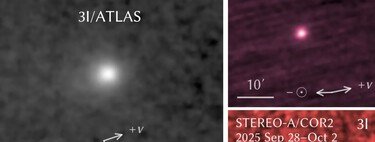
It happened on October 29 last year. ALMA data, analyzed by NASA JPL engineers, show that the object deviated “by four arcseconds in right ascension” from the path it would have followed if it were only affected by the Sun’s gravity.
The most likely explanation. The news has given free rein to those trying to see a “technological signature” in everything an interstellar object does. However, the most likely explanation is not that 3I/ATLAS is an alien craft: there is a purely natural alternative that astronomers are well aware of.
The object’s deflection, equivalent to ten times the Earth’s radius per month, is consistent with the natural acceleration that occurs in highly active comets as they pass the Sun: the sublimated ice acted as a propellant.
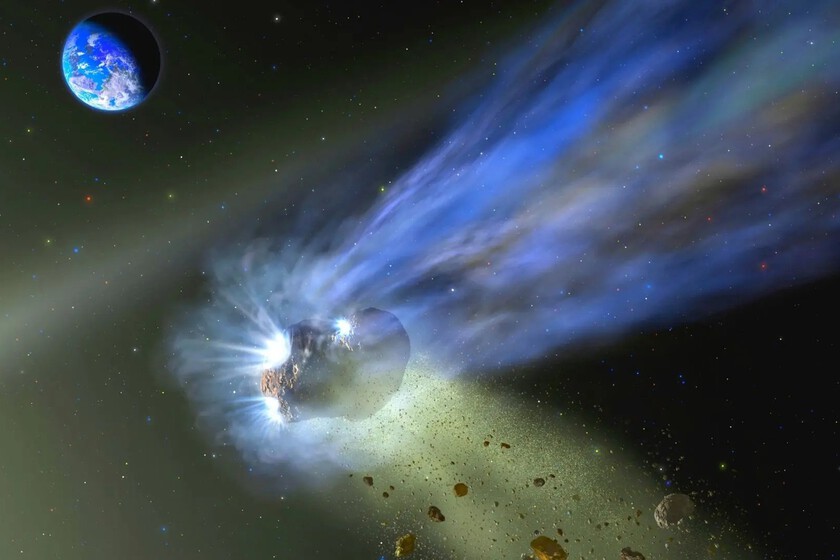
Ice rockets. The physics is simple: as a comet approaches the Sun, solar radiation heats its core. The ice on its surface (water, carbon monoxide, or carbon dioxide) does not melt, but changes directly from solid to gas, a process known as sublimation.
This gas rushes out into space through fissures or active zones on the surface, forming jets. According to Newton’s third law (action-reaction), these gas jets act like small rocket engines, pushing the comet’s nucleus in the opposite direction and changing its orbit.
That’s why it shines so brightly. Another recently discovered anomaly in 3I/ATLAS is that it became extremely bright earlier than expected and in an intense blue hue.
According to a previously published study on arvix.org, the change corresponds to a brightness dominated by gas emission, demonstrating that 3I/ATLAS is an extremely active comet that turned on its sublimation engines on its approach to the Sun and began degassing material at a breakneck pace.
Avi Loeb is not convinced. The controversial Harvard University cosmologist did his own calculations to determine how much mass 3I/ATLAS would have to lose to produce esa specific acceleration and found that it must have lost at least one-sixth of its total mass.
Given that the 3I/ATLAS mass is estimated to be at least 33 billion tons, the comet should have lost 5.5 billion tons of gas and dust ejected into space in a few weeks, which should cause us to observe an extremely bright cloud of gas and dust around it in the coming weeks.
The key point. 3I/ATLAS will pass the closest point of its orbit to Earth on December 19. From a distance of 269 million kilometers, the International Asteroid Warning Network and the Hubble and James Webb Space Telescopes will observe in detail.
They will have the last word. If they see a colossal cloud of gas, we’ll close the deal: 3I/ATLAS is a natural comet, albeit one of the strangest and most active we’ve ever seen. If they see nothing, the mystery of the interstellar visitors will only increase.
Image | NASA / SOFIA / Lynette Cook
In Xataka | It changed from a supposed alien ship to a comet. Now 3I/ATLAS surprises again with another possibility