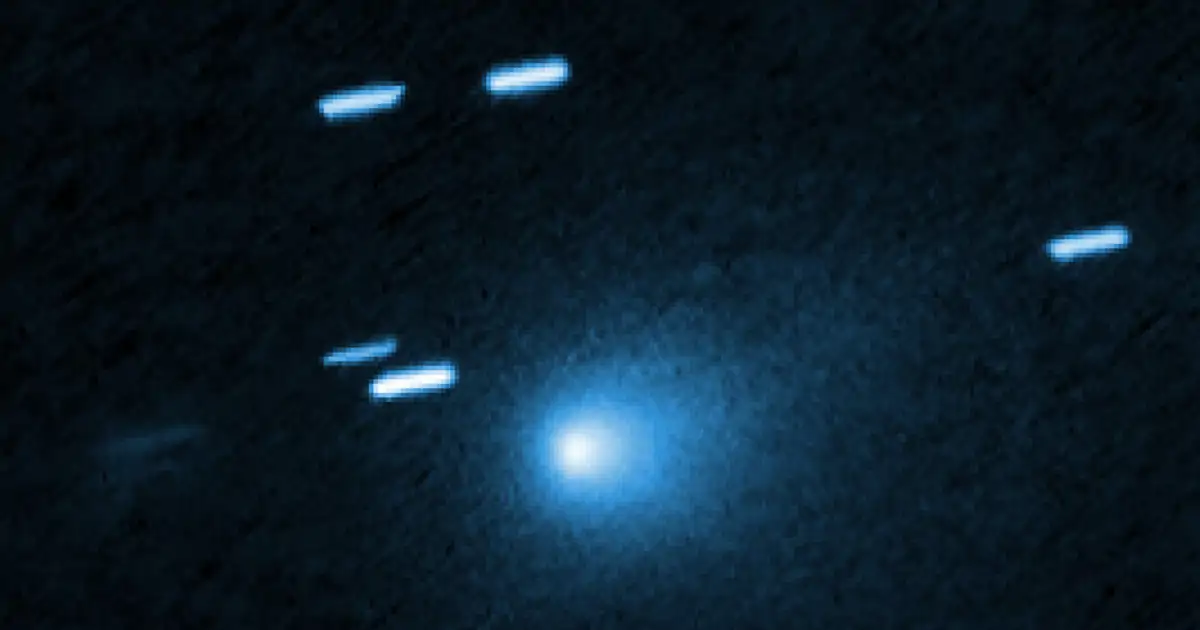
Since Earth’s collision warning system detected a strange comet on July 1, 2025, many people believe they are living in a science fiction movie. But the comet 3I/ATLAS This is a reality in a few days will reach the closest point to the planet Earth.
It is not customary to monitor such visitors. This For the third time in history, an object from outside our solar system has been discovered. Hence its name 3I/ATLAS. Its interstellar origin is determined by the hyperbolic shape of the orbital path. His speed is at least 221,000 kilometers per hour has never been registered before for the visitor. It moves so fast that it is not limited by the Sun’s gravity and is headed deep into our Solar System.
What else is unknown about 3I/ATLAS
With all this new features It’s no wonder that the observations of astronomers and the information that accumulates week after week excite the admiration of space enthusiasts. It has not yet been officially confirmed how big it is, but in NASA estimates that the maximum is “several” kilometers in diameter..
“They are absolutely amazing. Every planet, moon, asteroid, comet and life form in our solar system has a common origin. But interstellar comets are real aliens that hold clues to the formation of worlds far beyond our own,” explains the European Space Agency (ESA).
Observations have confirmed that it is active and consists of an icy core and a coma, a bright cloud of gas and dust, so it can be classified as a comet rather than an asteroid. It was formed billions of years ago and when it was discovered a few months ago, it was 670 million kilometers from the Sun, within the orbit of Jupiter.
however, its orbital path was approaching to reach its maximum approach to Mars on October 3 (30 million kilometers) and art a record of proximity to the Sun (210 million kilometers) happened on October 30.
How will the 3I/ATLAS journey continue
On its journey, which NASA says will continue into interstellar space, there will be a moment of maximum proximity to our planet:
“It will approach Earth approximately 270 million kmthat is, approximately 1.8 times the distance between the Earth and the Sun. During maximum approach, it will be on the other side of the Sun. It does not pose any danger to our planet or any other planet in the solar system,” explains the ESA.
that day will take place on December 19, 2025a a historic opportunity so that science can gain new knowledge about this strange guest, who has already become one of the main characters of the year. Between November and December better viewing conditionsgiven the geometric arrangement and greater brightness.
Nivel Global the next campaign will be heldwhich will distinguish fame Teide and Roque de los Muchachos observatoriesin the Canary Islands.
In the last few days, Avi Loebcontroversial astrophysicist and Harvard professor, accuses NASA of ‘covering up images’ this would be the key to a better understanding of 3I/ATLAS. It should be recalled that the US space agency has been shut down since October 1, and the US is experiencing the longest shutdown in its history.