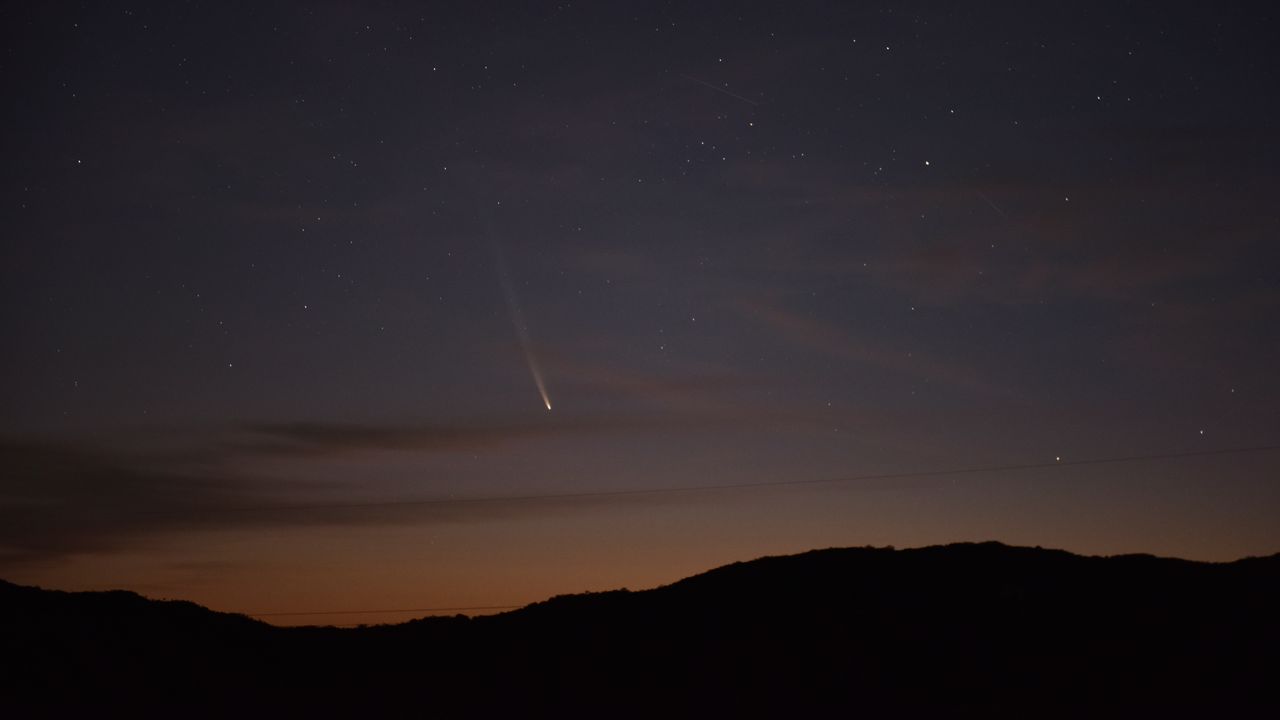
The newly discovered comet C/2025 K1 Atlas, nicknamed “the other Atlas”, although overshadowed by the glory of Comet 3I/Atlas, has revealed an unusual sight. The new images show it at perihelion, the point of its closest approach to the Sun, where it became a bright golden streak after surviving a close encounter with our star that many experts believe spelled its end.
Comet C/2025 K1 Atlas was discovered in May 2025 by astronomers from the Asteroid Last Collision Alert System (ATLAS). and reached perihelion on October 8, arriving just 50 million kilometers from our star. Distance according to Living scienceexceptionally low: it is four times closer than comet 3I/Atlas could be at its perihelion on October 29. And it was the excitement caused by this latest comet, discovered in July by the ATLAS astronomers, that revealed that C/2025 K1 had remained unobserved.
Although C/2025 K1’s orbit is extremely elongated and originates from the Oort Cloud, the outermost region of the Solar System, it is not considered an interstellar comet. For a comet to be considered “interstellar,” it must have a distinctly hyperbolic orbit and originate outside the Solar System, as was the case with Oumuamua, discovered in 2017.
More Atlas comments
Because of such a short distance, or rather, the strong gravitational force of this close encounter, many experts believed that comet C/2025 K1 Atlas would not have survived perihelion, but rather would have disintegrated. However, amateur astronomer Dan Bartlett was the one who realized that the comet had survived. On October 29, when 3I/Atlas reached perihelion, it captured a photo of C/2025 K1 from June Lake, California, showing a comet with a characteristic golden glow and a long tail.
“This comet was not supposed to survive perihelion on October 8. But it survived, and now it has a red/brown/gold color, which is rarely seen in comets,” Bartlett told Spaceweather.com. A unique color that has also been observed by at least two other photographers in California and Arizona.
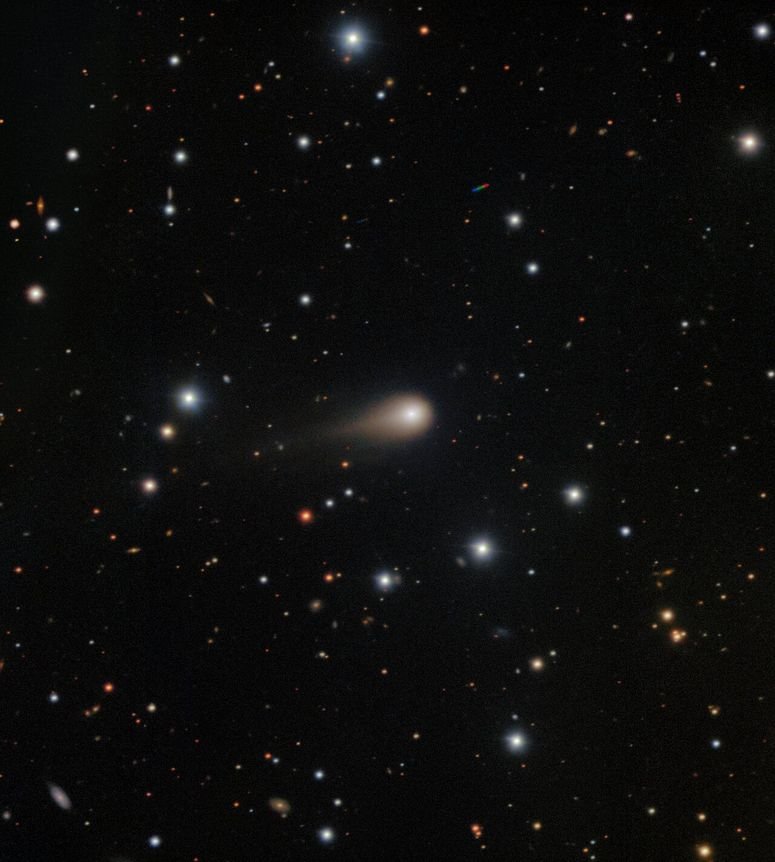
Astronomers and conspiracy theorists debate the origin of this non-gravitational acceleration of the 3I/Atlas interstellar object. This is what you should know.
Color C/2025 K1 Atlas
According to Spaceweather.com, most comets are green and sometimes blue. This is because in sunlight the gases turn green from diatomic carbon and blue from ionized carbon monoxide. So the chemistry of this Oort Cloud comet is particularly strange: It lacks the carbon compounds normally found in comets, according to a blog post Telegram astronomer David Schleicher of the Lowell Observatory.
“All carbon species are unusually low,” the expert writes. Apparently, by subtracting the green and blue colors, you get gold, although it is not yet explained why.
“The comet is very strange at magnitude 9,” Bartlett says, noting that it will be visible until early December with an ordinary telescope aimed at the border between the constellations of Virgo and Leo before dawn.
The article was originally published in WIRED Italy. Adapted by Alondra Flores.
( tagsToTranslate ) space