
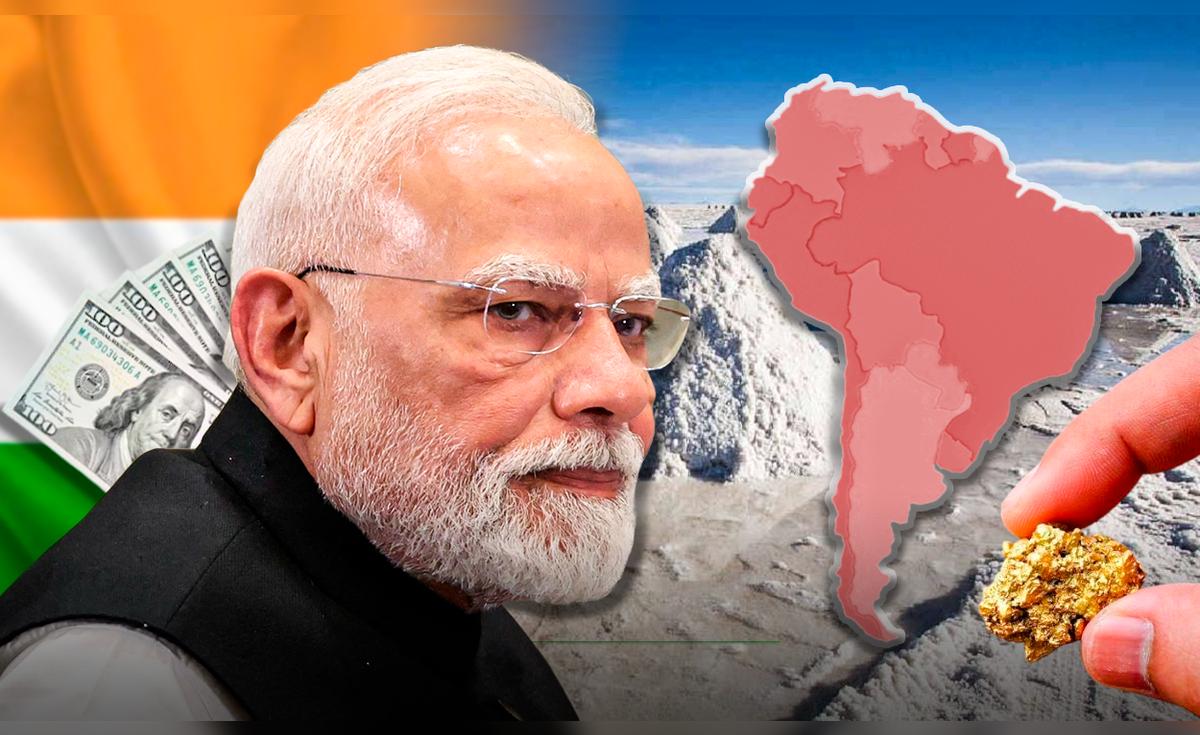
India has stepped up its search for critical minerals such as copper, gold and lithiumresources are needed to sustain economic growth and the transition to clean technologies. These three metals are at the center of global strategies related to renewable energy sources, electrification of transport and technological development, and Latin America is becoming a strategic supplier thanks to its vast natural reserves and leadership in world production.
Traditionally dependent on imports, the Indian nation continues to seek to diversify its products access to raw materials outside of conventional markets, which has fueled the growth of overseas investments and agreements to secure these resources. This trend is reflected in the interest of Indian companies in participating in projects for the exploration and exploitation of important minerals, especially in Latin American countries with a high concentration of these metals, according to ECLAC.
Which Latin American country is India targeting for copper, gold and lithium?
Peru has established itself as one of India’s top destinations of interest in the region, mainly due to its vast mineral extraction potential. Eight Indian companies, both public and private, have recently expressed interest in investing in mining and energy projects in the country, focusing on key metals such as copper, gold and lithium. This news was confirmed by the government of Peru on its website.
Representatives of these companies requested technical meetings during 37th PERUMIN Mining Conventionwith the aim of gaining a comprehensive understanding of a portfolio of 67 Peruvian projects at various stages of technical and geological development and exploring strategic alliances. Peru is considered an attractive partner due to its position as one of the world leaders in copper production, as well as a new portfolio of lithium projects.
India’s gradual rapprochement with Latin America: between China and the US
India’s strategy in Latin America is characterized by a gradual and pragmatic approach aimed at strengthening economic ties without direct confrontation with other global actors. Unlike China, which has established a deep economic and diplomatic presence in the region, and the United States, which has a renewed interest in maintaining its influence, India maintains a more modest but growing presence, focused on key sectors such as important minerals and energy.
This approach is based on expanding the diversification of its trade relations and investing in resources that ensure its energy and technological security, using the potential of the resource-rich countries of Latin America. India’s participation in multilateral platforms such as BRICS also reinforces this approach, offering a framework for cooperation based on multilateralism and joint development.
For China, which already dominates much of the world’s mining and processing of important minerals, India’s progress represents an additional competence rather than a direct challengealthough it forces Latin American countries to balance their ties with both Asian giants.
In the case of the United States, its recent trade and tariff policies have encouraged Asian economies to diversify their partners, promoting India’s presence in new markets. These dynamics may partially displace traditional US investment in the region, or at least change competitiveness in key sectors.
Other Latin American countries on India’s radar
Argentina stands out as another key country on India’s agenda, especially because of its rich reserves lithiumone of the main sources of modern batteries. Indian officials have shown interest in strengthening mining, energy and technology cooperation with Argentina through memorandums of understanding and joint exploration to ensure critical supplies for the energy transition.
Brazil is also an important strategic partner not only because of its economic size, but also because of its role in multilateral platforms such as BRICS and its diversified natural resources. The increase in investment between India and the nation of Brazil is aimed at consolidating a wider commercial exchange that goes beyond minerals and covers the industrial, agricultural and energy sectors.


