
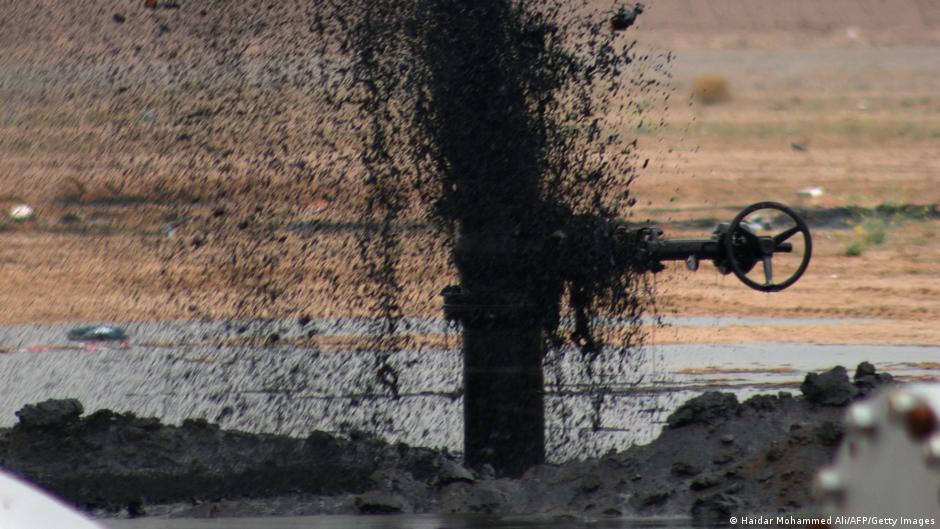
“Peak oil” began to instill fear in politicians, companies and consumers alike, as the inevitable moment when the world would extract the last drops of black gold from the bowels, like a straw at the bottom of a milkshake.
The idea was popularized in the 1950s by geologist M. King Hubbert, who warned that oil production in the United States would follow a bell-shaped curve and inevitably peak as fields mature and decline.
In recent years, climate change has turned the narrative on its head. Instead of fearing shortages, the debate now focuses on when demand will peak as the shift to electric vehicles and other clean energy moves.
At the same time, political opposition – from delaying the ban on internal combustion engines to cutting subsidies for electric cars – casts doubt on the real speed of this shift away from fossil fuels.
Experts are divided on when demand will fall
There are two opposing views on when global oil demand will begin to decline.
The International Energy Agency (IEA), which is based in Paris and represents major consuming countries, predicts that demand will stabilize at about 102 million barrels per day by 2030.
In yours World Energy Outlook 2025published last month, the IEA expects governments to meet ambitious energy and climate targets.
OPEC takes the opposite view. In its latest long-term report, the producer group predicts that demand will continue to rise for decades and will not peak before 2050, when consumption will be close to 123 million barrels per day by mid-century.
However, both organizations share a fundamental concern: supplies are becoming increasingly difficult to maintain. OPEC believes that strong demand growth justifies continued investment to ensure sufficient supplies for decades. The IEA, on the other hand, offers a more cautious forecast.
The “business as usual” scenario returns
Under pressure from the Trump administration, the IEA reinstated its current policy scenario, abandoned in 2020, which is based on existing laws and observed trends well below climate ambitions.
This scenario suggests that supply growth will slow after 2028 as non-OPEC sources such as the US, Brazil, Guyana and Canada decline. This would make supplies increasingly dependent on OPEC countries in the Middle East, such as Saudi Arabia, the United Arab Emirates and Iraq.
If climate commitments are not met, demand could rise to 113 million barrels per day in 2050, the IEA warned.
For Franziska Holz, deputy director of DIW Berlin’s energy, transport and environment department, the resumption of this conservative scenario is “positive” because it shows that the world is “not on the right track with climate goals” and is not replacing fossil fuels in the energy matrix fast enough.
Holtz quipped that “the Americans probably didn’t intend it” when they insisted on restoring the most cautious scenario.
New oil discoveries are at an all-time low
As for Peak oilboth organizations point to the same structural risk: oil supplies are not self-sustaining. Mature fields are shrinking rapidly, and without continued investment, production from existing fields will fall by about 8% annually, the IEA warned last month.
Huge amounts of new production are required just to keep world supplies stable. However, most of the spending is on compensating for the decline of aging fields rather than adding significant new volumes.
With discoveries at record lows and an increasing reliance on shale and deepwater wells that are quickly depleting, the oil sector is racing faster and faster to stay where it is.
Physicist Antonio Turiel, researcher of St Peak oil in CSIC, claims that growth fracking In the United States – the engine of growth outside OPEC – it is already nearing exhaustion. The best drilling locations in the Permian Basin, in Texas and New Mexico, are already being exploited, and the rate of decline is accelerating.
“After 15 busy years, we are coming to the end of the road fracking”Turiel told DW about it. “We can maintain the mirage for another year or two, but then the decline will be incredibly rapid.”
Upcoming peak production?
Turiel believes that the world is approaching a Peak oil much earlier than most agencies are willing to admit. It indicates that 80% of oil fields “have already exceeded maximum production”.
Apart from shale, he adds, the world has become overly reliant on large, aging supergiant deposits for stability, and a decline phase will soon begin.
“Most likely, we will start to see a sharp annual decline – about 5% – even by 2030,” he said. “After that, for 20 years, you can expect to see a reduction in total production of about 50% each year.”
Turiel points out that an average of 3 billion barrels of oil have been discovered between 2020 and 2025, which is twelve times less than global consumption.
While OPEC does not provide a Peak oil and the IEA’s worst-case scenario predicts no earlier than 2050, Turiel’s calendar is convincing: “Very likely in 2027; in any case, by 2030. Even earlier, if unwanted geopolitical problems arise.”
(gg, ju)


