
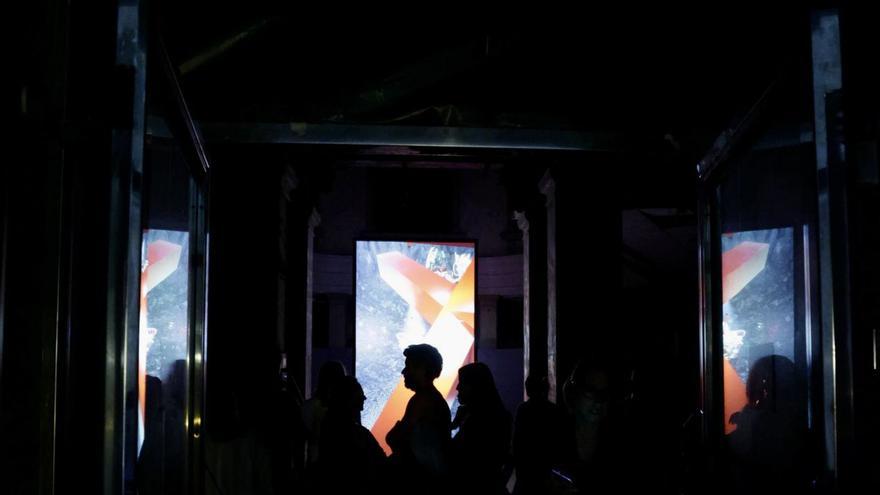
A mysterious figure stands in a chaotic landscape. He walks, stumbles, gets up. She sits, thinks, feels, smiles, mutates, talks to herself. The environment shines or darkens, is created or destroyed, is constantly changing. Action or concept word bubbles create interaction. Avatar of the show “The subject changes”LEV (Visual Electronics Laboratory) festival proposal for White night and creativity of the Austrian team To departtraveled through his metaverse and left in awe those who approached the old Banesto building, which was a dystopian scene of ruins and technology from seven in the afternoon until two in the morning.
“It presents the problem of an avatar that is suffering and is almost a living figure, because it has problems that are related to the real world, physics, gravity, stress, that is, things that happen to us as humans,” explains Nacho de la Vega, director of LEV. The hero of the audiovisual installation pays homage to the protagonist of Neal Stevenson’s 1992 sci-fi novel Snow Disaster: Hiroaki Hiro is a pizza delivery boy in the real world, but a samurai prince in the metaverse and is considered the “first avatar” in history. “In the future, we will all use ours and the Internet will be in 3D. Depart discusses this figure of a lost identity that we will have in an as yet unknown world,” says de la Vega.
One of the distinguishing characteristics of Subject Changes is that it is a real-time generative digital work, meaning the software is programmed so that the events experienced by the avatar are always different and never repeated. For example, the “spheres of thought” that surround him have a certain attraction, making him wonder and ask things like “where am I?”, “what am I?” or “what is the reason for my existence?” “Other times they don’t make such sense, that’s the beauty of randomness,” the director emphasizes. Aesthetics, action and environment also feed off each other in this “algorithmic cocktail”, although there are some basic parameters, just like in reality.
“Just as our world is changing and we are constantly adapting, the avatar suffers the same. It’s also a bit of Sisyphus because he faces challenges and starts the journey all over again,” explains Cristina de Silva, director of the LEV Festival. , from where they try to “open a window” to the digital world to society from an artistic point of view.
Last year they already held an exhibition at the Matadero in Madrid, where they showed several meta-universes that arose in the times of covid, when we could not interact. “This installation opened the exhibition, and the representation of the avatar seemed perfect to us, so we wanted to recreate it for White Night,” concludes De Silva.


