
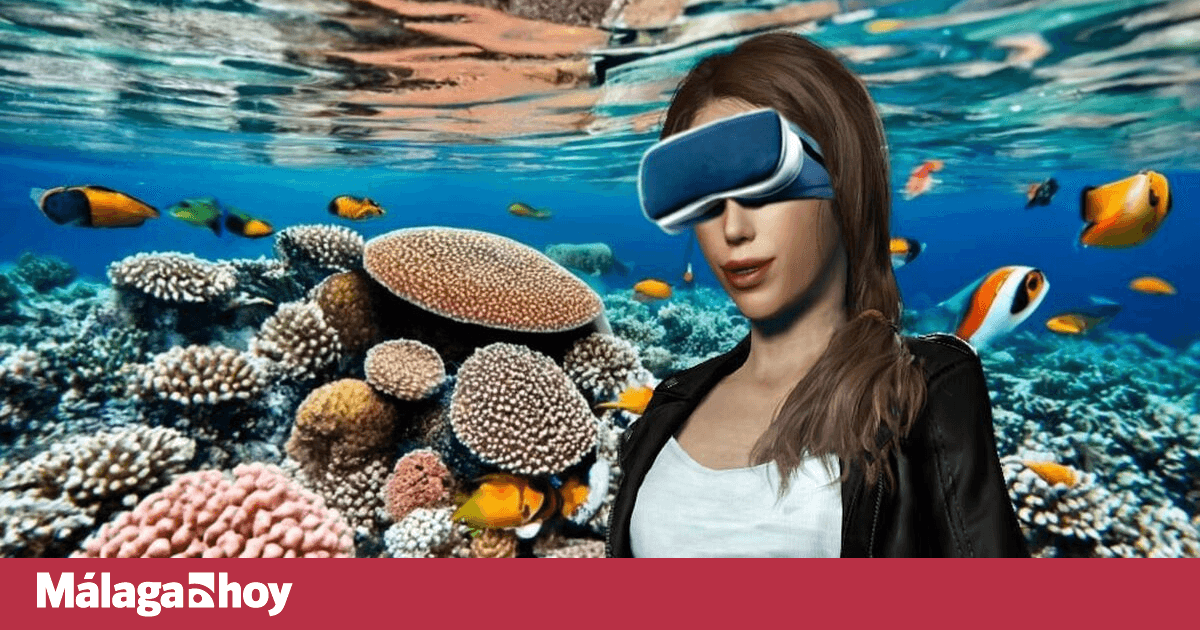
A few days ago, a conference was held at the Les Roches Auditorium in Marbella on the possibilities of incorporating new technologies into various professional fields. This time, the focus was on the use of virtual reality for tourism purposes, such as in space and underwater.
This technology is a way of creating a simulated experience that allows a person to experience situations that are very close to reality. Therefore, it can be used for a wide variety of purposes, such as research, education, entertainment or tourism.
There are projects that will soon be able to see the world, such as the one that a Spanish company called Halo is proposing in 2025. It may seem far away, but that date is only 18 months away, when they will be sent to people who choose this service, at an altitude of 25 to 40 kilometers above the earth’s surface in a capsule, from where you can admire the views thanks to the installation of panoramic windows and glasses supplemented realities that provide you with additional data so as not to lose detail in this unique experience.
And apart from what may seem eccentric or something for the richest pockets, it still represents a path to technological progress that in the medium to long term improves the quality of our lives.
However, we need to show the differences between the currently available resources to carry out these activities. On the one hand, we have virtual reality, and on the other, augmented reality. Both allow you to recreate situations where immersion is at its best, enriching the experience. The first is perhaps the most familiar to readers, as it has had the most opportunities to be featured in countless feature films. It is based on creating a digital world separated from the physical one, while the other focuses its work on adding digital elements to the real world.
While virtual reality requires special devices, such as a helmet or glasses, which are able to isolate the person from the surrounding reality, augmented reality does not depend on these technological resources, as it relies on the physical plane and can be used on a mobile phone. devices or tablets. Another difference is manifested in the areas of application. Just as virtual reality is mainly used in the activities we mentioned above (entertainment, education), there are other possibilities such as simulation and therapy. In the same way, augmented reality is mainly used in culture, commerce or industry.
In fact, researchers from Hong Kong and China recently presented an alternative to make virtual reality experiences more inclusive. These would be millimeter generators with built-in paraffin, which at the same time would be part of wireless VR glasses. They could be used in non-leisure activities, such as educational or recreational activities. It represents the most immediate present and potential of these tools that go beyond playing with the latest update of the trendy video game.
Another example of the incorporation of these technologies is the use of virtual reality in situations such as health care, and this is the Military School of Health, where these devices are used as another resource for learning. The variety of possibilities that this technology gives you, where you can practice what you have learned in the theoretical classes, is endless, since the graphical representation is no more complicated than what it would be to capture these situations every time in a physical environment with all that it entails.. Focusing on the tourism aspect, it should be said that it is a way of traveling without leaving your home using devices that give you the ability to see, hear and feel the sensation of being somewhere else.
Another example of the incorporation of these technologies is the use of virtual reality in a scenario such as healthcare. The Military Health School uses these devices as another learning resource. The variety of possibilities that this technology gives you, where you can practice what you have learned in the theoretical classes, is endless, since the graphical representation does not add complexity when it comes to capturing these situations in a physical environment with all that entails.
Focusing on the tourism aspect, it should be said that it is a way of traveling without leaving your home, using devices that allow you to see, hear and feel yourself in another place.
The benefits of implementing virtual reality in tourism are very diverse. First of all, it saves time and money, with all that that entails. You avoid crowds and health risks like spreading the virus because the world is so globalized. So that you can enjoy these places in peace and safety. You can reach remote or hard-to-reach places, areas, buildings and venues that are temporarily closed for various reasons. At the same time, you can use these destinations at any time of the year, including the present, the past, and even the future. Information and data, as well as curiosities specific to the selected location, can also be obtained to enhance the virtual travel experience.
However, we wouldn’t be remiss if we didn’t point out the not-so-positive aspects of travel. Everything in its proper measure is healthy, but when taken abusively, it can lead to detachment from reality and thus to losing track of time, and at the same time it can cause various obstacles to healthy socialization later on. You may experience side effects such as dizziness, nausea, headaches, eye strain, health problems due to lack of movement or excessive exposure to artificial light. In addition, it is necessary to have the devices for this practice, with the financial costs that this may represent, as well as maintenance and possible technical failures.
Despite this, virtual tourism is an experience that is gaining popularity and becoming an increasingly acceptable option among travelers. However, a complete replacement is not possible, as it is simply another option when doing this activity, as there are things that only real experience can provide. Therefore, the ultimate goal would be to be able to bring them together, and this is a goal that must be achieved since they are understood as complementary.


