Steam Deck This is the device that consolidated Linux as an operating system for video games, not only because it is a well-rounded product, but above all because of the relative success it has managed to achieve. All the technological details related to the console have been known for a long time, but they were recently updated by Alberto García, an employee of Igalia, at the Open Source Europe Summit held in Bilbao. The conference also served as a reminder of the parts Valve, Igalia and others are contributing to improving the Linux desktop.
Although it may surprise some, Steam Deck is nothing special on a technological level. On the one hand, it’s an x86 mini PC with a hybrid console layout that implements an AMD APU and is capable of running Windows. for another, The operating system is the GNU/Linux standard which uses common components such as the Linux kernel, systemd, mainstream inside the world.
The first thing that Alberto Garcia reminds us of is that SteamOS 3, the operating system that comes pre-installed on the Steam Deck, is based on Arch Linux, although Valve doesn’t seem to follow the parent distribution’s high update rate. Its announcement two years ago caused some surprise, as previous versions of SteamOS were based on Debian.
The first component mentioned by Alberto was Proton, which is nothing more than a re-implementation of Wine to make it easier to run Windows video games on Linux. this It has two built-in renderers that translate Direct3D instructions to Vulkan: DXVK and VKD3D-Proton. The former is responsible for versions 9, 10 and 11 of the Microsoft API, while the latter does the same for version 12, which, like Vulkan, is derived from the failed Mantle.
Garcia mentions that CodeWeavers and Valve are working together on Wine development, which is fine given the interests of both companies. The former uses what is practically a hard core of Wine developers, with the leader at the helm, while the latter aims to offer the best compatibility for running video games compiled for Windows on Linux.
An important detail about Wine is that it is not actually an emulator, but a re-implementation of the Windows API, which is responsible for translating Windows system calls into other ones that Linux understands. Therefore, the applications do not run in an emulated way, but run natively.
The second important part of SteamOS 3 is this graphics stack. In this regard, the system uses a standard for Linuxthat is, the kernel driver for GPU operation and power and temperature management, and Mesa for OpenGL and Vulkan support. Coming from the core, we have AMDGPUwhich is official open source but relies on proprietary software to unleash its full power, while for OpenGL it’s RadeonSIwhich is official, and Vulkan is supported by RADVcommunity-sourced and developed primarily by Valve.
As for HDR support, there is nothing surprising as it is planned to be supported via Gamescope, the compositor used for SteamOS 3’s gaming session and supported by Wayland. Another interesting detail is the lack of a standard API that allows you to report a GPU problem to userspace when restarting said component.
With a purpose improve the situation with GPU reboots, the goal is to standardize on the following fronts: how the Direct Rendering Manager (DRM) reports GPU crashes to userspace, how userspace (Mesa) drivers handle crashes, and what compositors should do after a reboot. Better handling of GPU reboots can minimize the chance of having to reboot the entire operating system in the event of a failure on this front.
SteamOS 3 is an immutable operating system, so its Btrfs file system is a high share read-only. Updates use an A/B mechanism at least similar to that of VanillaOS, and there are two main ways to install apps: the Steam client, through which you can get games and stuff from there, and Flatpak for the desktop. applications and other game clients.
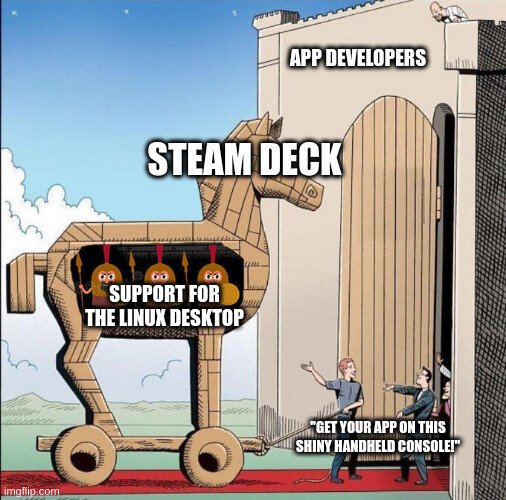
Flatpak at the moment is unknown and appears lThe primary way to install graphical applications on legacy operating systems such as Silverblue, Kinoite and openSUSE MicroOS/Aeon/Kalpa, but surprisingly, Alberto Garcia picked up a post posted by Cassidy James at Mastodon, which shows that Flatpak is served through a trojan horse called Steam Deck. Although the message was delivered more as a joke than anything else, it is no less true that there is some truth in it.
Cassidy mentioned not only Flatpak, but also the freedesktop standards. We are coming along the same line XDG Portal for desktopframework that allows secure access to system resources outside of isolation (sandbox) applications. The XDG Desktop Portal, which can be said to power XDG Portals, is closely related to Flatpak, though not exclusively so. Also related to Wayland and PipeWire and is one of the components that allow you to capture the desktop from a Wayland session with OBS Studio.
XDG portals define D-Bus interfaces for accessing files, opening URIs, screenshots, and accessing configurations. However, it has the disadvantage that its APIs are implemented through backends specific to each desktop, making it difficult to support different desktop environments.
And those are the most interesting parts of Alberto Garcia’s Steam Deck review. As we said, technologically there is nothing extraordinary about it, but this device made a sector that was very marginal in terms of market share, and the use of Linux is a novelty in a segment where Windows has been practically the only system running for two decades.