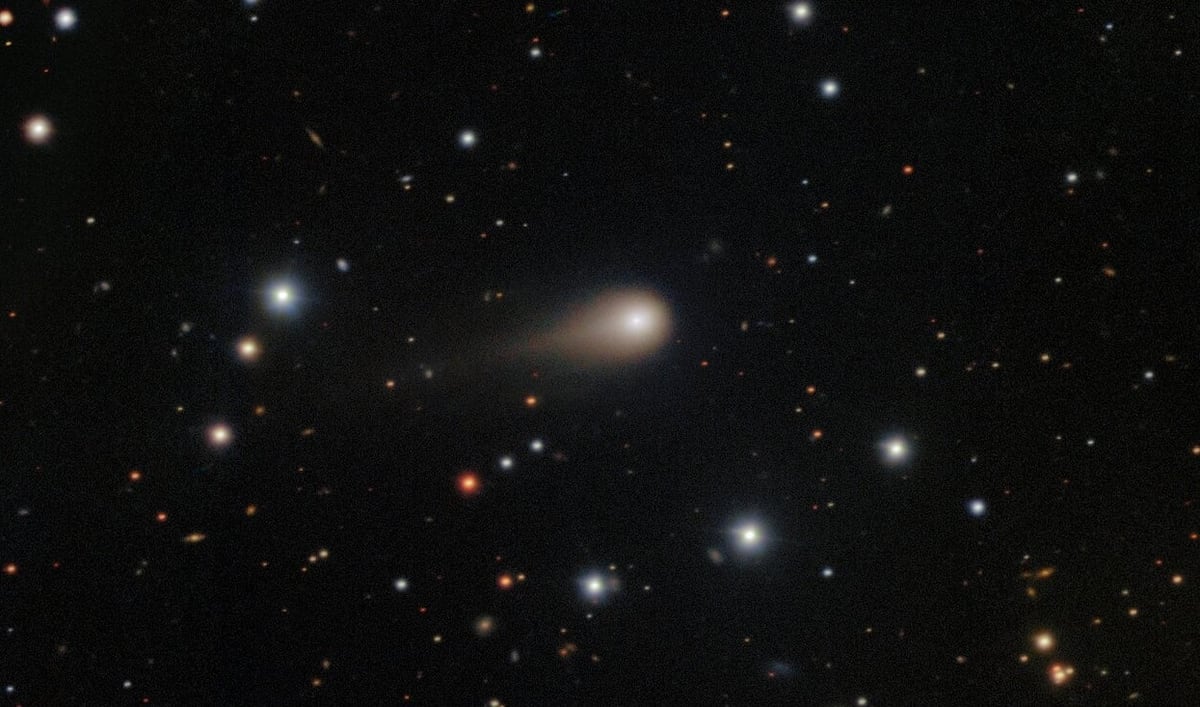
Spectacular hypotheses spread more easily than actual scientific facts, especially if they come from a voice with some prestige. That’s what happened with comet 3I/ATLAS, discovered last July from the Asteroid Collision Warning System (ATLAS) observatory in Rio Hurtado, Chile, which became the subject of a wave of speculation on social media after Harvard astronomer Avi Loeb suggested it could be an alien craft. For experts, they are nothing more than meaningless ideas. According to Michael Coopers, an astrophysicist at the European Space Agency (ESA), there is nothing in what has been seen to indicate that this is anything other than a celestial body of interstellar origin; with chemical characteristics that are unusual, yes, but explainable.
“If we really could find other civilizations, comets would not be the way to do it,” explains Kuypers, who emphasizes that the special feature of 3I/ATLAS lies in its origin: “It is an object that did not form in our solar system, but in another point of the galaxy,” he emphasizes. Although its exact place of origin is unknown, astronomers know that it is an interstellar traveler: a fragment of another planetary system that, after billions of years in space, is now crossing ours.
But experts were most surprised by the unique composition. Unlike most comets in the Solar System, which are composed mostly of frozen water, other ices, and dust, 3I/ATLAS has an unusually high ratio of carbon dioxide (CO₂) to water. According to Coopers, this feature may indicate that it formed in a colder environment than its parent system, where volatile elements could have accumulated at lower temperatures. Although this could also be due to the effect of his route.
Another distinctive feature is the abundance of metallic nickel. Although the reason is not yet fully understood, this planetary scientist emphasizes that this finding may provide clues about the diversity of other planetary systems. “These objects allow us to see firsthand what star systems outside our own look like,” Kupers explains.
An unusual composition
Unlike the distant and limited snapshots captured by telescopes, interstellar objects such as this one bring with them physical material from their very ancient worlds (3I/ATLAS is thought to be probably 3 billion years older than the Solar System). Only two other such visitors have been discovered so far: 1I/’Oumuamua in 2017 and 2I/Barysau in 2019, and each has offered a different piece of the puzzle about how planets and comets form around other stars.
In his latest hypothesis, Avi Loeb — a 63-year-old Israeli-American physicist and professor at Harvard University — suggested that 3I/Atlas will perform a navigation maneuver when it reaches the closest point to the center of our planetary system in late October (almost 200 million kilometers from Earth) and, being a ship with an alien crew, will launch probes in the direction. planets revolving around the sun.
Elena Maniavakas, an astronomer at the Space Telescope Science Institute (STScI) in Maryland, rejects any suggestion that Comet 3I/ATLAS is related to alien technology. For these ideas to make even the slightest sense, he notes, preconditions and extraordinary conditions must be met. “First, that life exists elsewhere in the universe; secondly, that it is reasonable; third, that it has developed a civilization with technological capabilities similar to those of a space agency; and, finally, that it knows about the existence of the Earth and decided to send a ship here,” the Spanish scientist explains in detail.
According to Manyavakas, the chances of all of these happening at the same time are virtually zero. On the other hand, the scientific explanation that it is an interstellar comet is much simpler and agrees with Kuypers’ words: 3I/ATLAS has unusual characteristics, but are consistent with what is expected of an object traveling from cold and distant regions of the galaxy. “It’s much more likely that we’re seeing a comet of some kind rather than an alien spacecraft. In fact, that would be the most unlikely possibility of all.”
In the past, Loeb has already argued that Oumuamua, with its elongated and slightly irregular shape, could be an extraterrestrial solar sail or the remains of an artifact created by an alien civilization. He based his hypothesis on the fact that Oumuamua, fleeting and the first of its kind, had no comet tail and that the evidence suggested that it was unusually bright; He developed these ideas in a popular book that was translated into several languages and criticized by the scientific community.
The protection protocol is not activated
The announcement of the international observation campaign 3I/ATLAS, which is promoted by the International Asteroid Warning Network (IAWN), almost coincided in time with the statements of the astronomer Loeb. The coincidence of both news was enough to unleash a wave of extravagant theories on social media. Some publications have even claimed, without any evidence, that NASA has activated a supposed planetary defense protocol against a visit from an interstellar body.
The campaign, scheduled for November 27 and January 27, is a conventional science initiative designed to study objects with unusual trajectories or compositions. According to IAWN, a network coordinated by the United Nations and made up of space agencies and observatories around the world, the goal is to improve the accuracy of calculations of the comet’s position, velocity and chemical composition. This is not a defensive maneuver, but an opportunity to deepen our knowledge of a unique visitor.
“The first thing is to listen to the scientists,” says Manyavakas. “We are based on evidence, not wishful thinking. The idea that an intelligent civilization sent a ship here may sound appealing, but it is infinitely unlikely.’ Despite this, he notes the interest the phenomenon is generating. “The important thing is that astronomy continues to fascinate people. Not because of aliens, but because it helps us understand our place in the universe.”