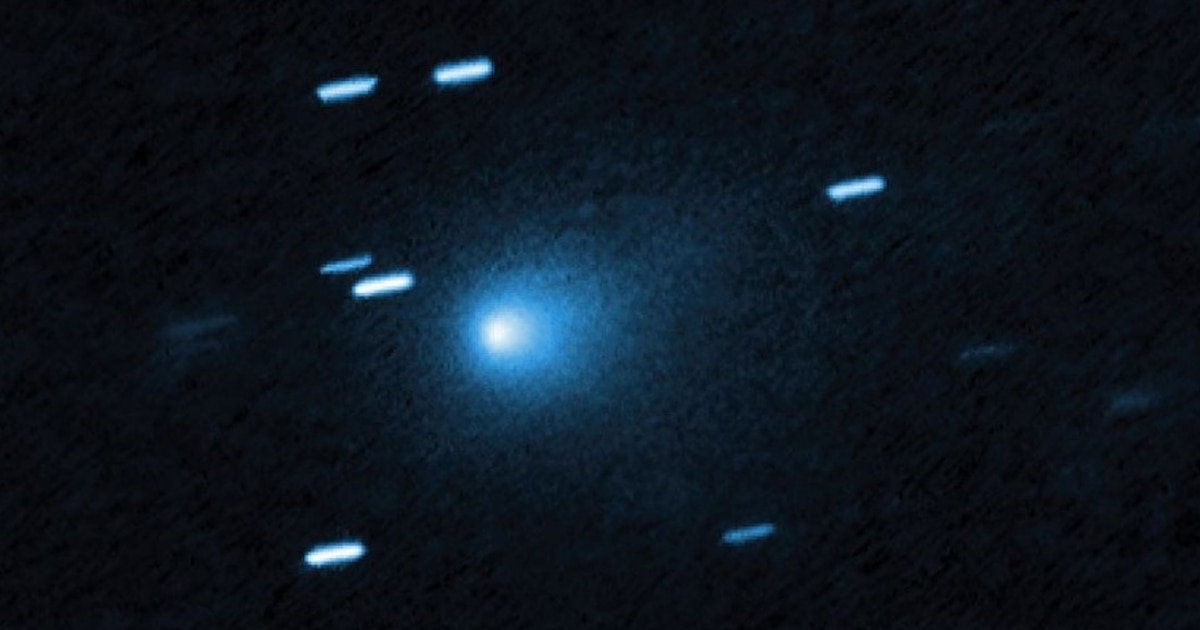
He a comet 3I/ATLAS was again visible from Earth after passing behind the Sun, and it did so with an unexpected characteristic: a faint blue color instead of the classic bright green, which did not appear in previous records.
This detail, which began as a suspicion among researchers analyzing orbital images, has been revealed a new stage in the study of the interstellar guest which offers a unique scientific opportunity.
Reappearance of a comet during its passage through ours Solar system started the stage of more accurate observation from ground-based telescopes, after several months when its position prevented observation from the surface of the planet.
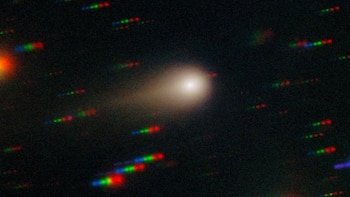
3I/ATLAS is the third interstellar object identified while passing through the solar system, after 11 p.mOumuamua y 2I/Borisov. is moving at a speed of more than 210 thousand kilometers per hour and follows a hyperbolic trajectory, meaning it will not be captured by the sun’s gravity.
Its passage is unique: it came from another star system, and once it completes its convergence, it will leave our cosmic surroundings and never return. Astronomers believe it may be more than 7 billion years old.which makes it a body older than the solar system itself.
The first records of the comet within a year showed a nucleus estimated to be about 20 kilometers in diameter. Its size, added to its mass of more than 33,000 million tons, makes it the largest interstellar object observed clearly by now. For this reason, scientific teams decided to follow it in detail from the moment it entered the inner part of the solar system.
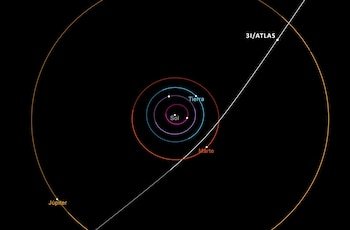
The comet reached its closest point to the Sun between October 29 and 30. when it was 1.36 AU from the star, just inside the orbit of Mars. During this period, the position of the Sun obscured the view from Earth, but researchers tracked using space telescopes and orbital simulations.
Once it reappeared in the Northern Hemisphere sky, astronomers confirmed that it was still structurally stable and that it was brighter than expected.
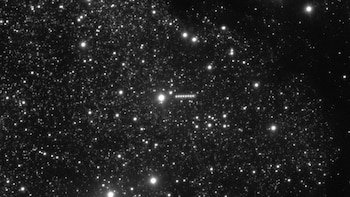
Researcher Tichen Zhangof the Lowell Observatory, was one of the first to photograph the comet after its reappearance. He stated: “All you need is a clear sky and a very low eastern horizon. It won’t look very impressive, it’s just a blob, but it will be an increasingly visible point over the next few days.”
This phrase caused excitement in the scientific community, because even this weak signal symbolized something unusual: the restoration of visual contact with a fragment of another star system.
The comet also flew close to Mars on October 3, about 28 million kilometers from the Red Planet. It will then continue on its way to the outer region of the solar system. It will come within 270 million kilometers of Earth in late December and later make a close flyby of Jupiter before returning to deep space.
The NASA He stressed that it does not pose any threat to our planet. The value of 3I/ATLAS is in what it contains, not in its proximity. Astronomer Laura Nicole Driessen explained a key aspect: “Comet 3I/ATLAS may be the oldest thing we’ve seen in our solar system.
Our solar system formed 4.6 billion years ago, while recent studies show that a comet 3I/ATLAS may be over 7 billion years old or older.’ According to the expert, her analysis offers a direct window into the early chemical stages of the galaxy.

The element that caused the most confusion was color. The first observations showed it with a reddish tintprobably due to the presence of dust ejected during its initial approach.
Later he seems to have acquired a the green hue is possibly generated by carbon dioxide molecules or cyanide in your coma. However, a recent reappearance after perihelion or closest approach to the Sun, a light and persistent blue color is exhibitedunexpectedly for a body of known composition.
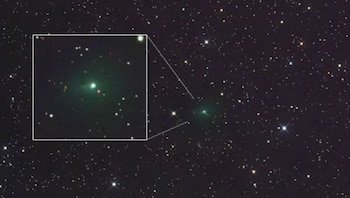
Researchers attribute this possible coloration to the release of gases such as carbon monoxide or ammonia.
These compounds reflect sunlight differently than normal dust from comets in the Solar System. However, until now, the final confirmation requires additional observations. The biggest question arises because a blue tint would indicate temperatures and processes that do not easily correspond to the object’s distance and mass.
Teacher Avi Loebof Harvard University said: “We have a report showing that the object became much brighter than expected, much brighter than any previous comet in the Solar System, as it approached the Sun.”
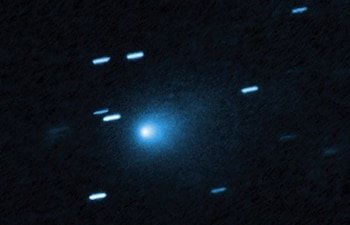
He also noted: “Also, the color of the object is blue, bluer than the Sun, which is very strange for ordinarily, when there is dust around an object, it must turn red.’
These claims have fueled theories linking the comet to non-human technology. Presence of “anti-tail” — the dusty structure facing the Sun, rather than away from it, confirms these assumptions. Some researchers have offered unusual interpretations: “If the object is an alien spacecraft decelerating, then the antitail would be evidence of a ‘braking’ maneuver.”
However, the scientific community maintained a cautious stance. Astronomer Driessen quoted a phrase attributed to Carl Sagan: “Extraordinary claims require extraordinary evidence.” And he added that the immediate attribution of this phenomenon to extraterrestrials will prevent understanding of its true origin and scientific value.
Modern chemical measurements have shown a composition that differs from traditional comets. It found an unusually high proportion of carbon dioxide and a staggering level of nickel compared to other elements, with very little iron.
This imbalance suggests that the body formed under physical conditions different from those of the Solar System. Its place of origin may be in the ancient regions of the Milky Way, where extreme temperatures and molecular densities have given rise to unusual chemical configurations.
Meanwhile, observatories around the world are preparing new monitoring campaigns. NASA has included interactive tools for citizen observation, and researchers are awaiting high-resolution images taken by the Mars Orbiter, which could reveal details about the texture and distribution of dust on its surface.

Comet 3I/ATLAS will continue to move away in the coming weeks. Its visit will be brief in astronomical terms, but what it will leave behind will be long-lasting: data to reconstruct the chemical history of the galaxy and, perhaps, clues to understanding how worlds formed.
For now, its blue tone remains without a definitive explanation. And in science, open questions are often more valuable than certainty.