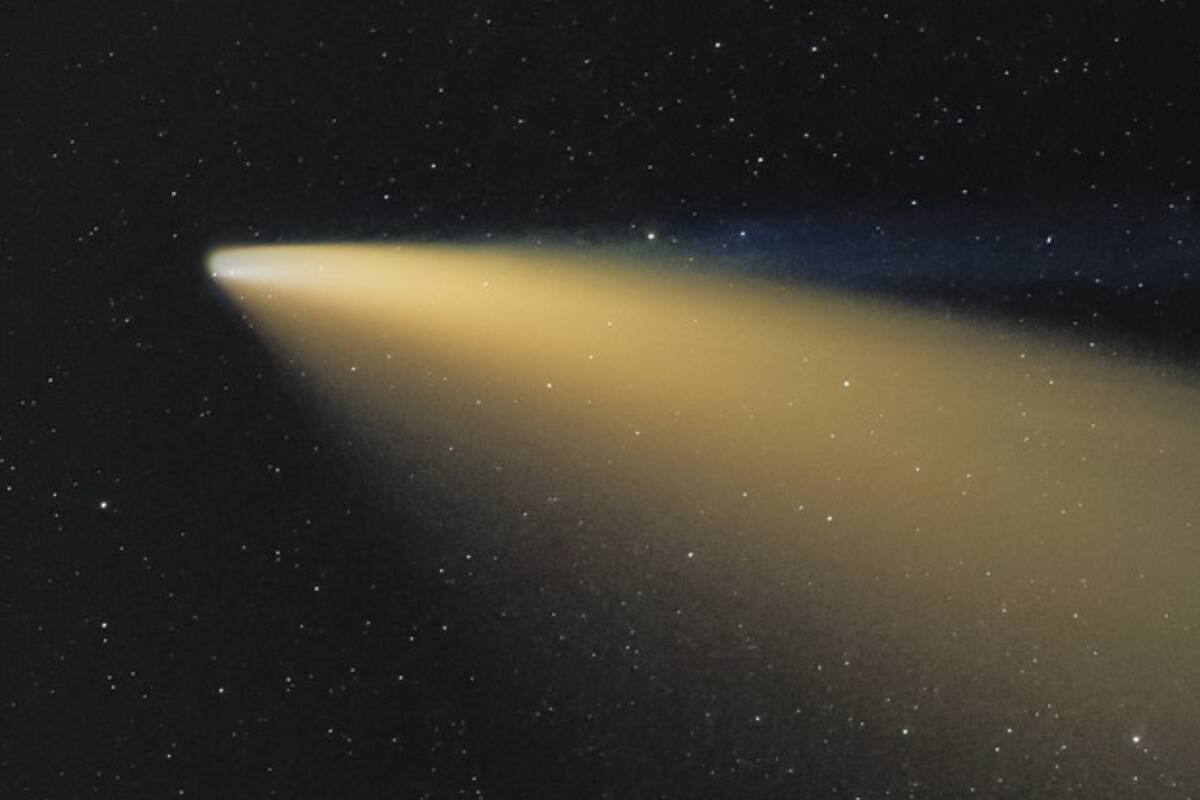
October 29 interstellar comet 3I/ATLAS It crossed the perihelion and began its approach to the closest point to the Sun. Specialists assured that after two days it arrived in this region of our solar system. Thanks Lowell Observatory’s Discovery Telescope In Arizona, specialists managed to take a photo of a celestial body after crossing the star. This is the second image after the first Hobble telescope accepted on July 21.
As it approaches its closest point to the Sun -by 1.4 astronomical units, or 210 million kilometers-the comet disappeared from the field of view of terrestrial telescopes and space probes because it was on the hidden side of the star relative to Earth. Now it has begun its journey to our planet, and American Observatory postdoctoral researcher Qicheng Zhang, He assured that amateurs can see its light halo from small telescopes.
“All you need is a clear sky and a very low eastern horizon. It won’t look very impressive, It’s just a blemish, but it will become more noticeable in the coming daysZhang told the magazine Living science.
3I/ATLAS is the third interstellar comet discovered so far that has crossed our planetary system. According to the latest results, Its trajectory is unusually flat and straight, and it travels at a speed of 210,000 km/h.
On October 28, an expert noted in a scientific study that Comet 3I/ATLAS experienced a rapid increase in brightness before perihelion, creating a bluer than the Sun. This was highlighted as a logical response “emissions of gas that make up a significant fraction of the visible luminosity nearby when approaching a star”.
For the specialist, the Lowell Discovery telescope is the largest of all that can point to the horizon and the coordinates where the comet is located, which, according to what has been found, From our point of view, this celestial body is moving northmoving away from the northeastern horizon.
The last picture was taken when the celestial body was about 16 degrees from the Sun (5 degrees above the horizon) and announced that perhaps another astronomer or amateur had taken the photo, since with an ordinary telescope of good range it could be ascertained, though no other is yet known..
3I/ATLAS will be more visible with Earth on December 19when it reaches the closest point to our planet, at a distance of 270 million kilometers. This will be an excellent opportunity for its structure and composition to be thoroughly investigated before it disappears from the face of the universe.