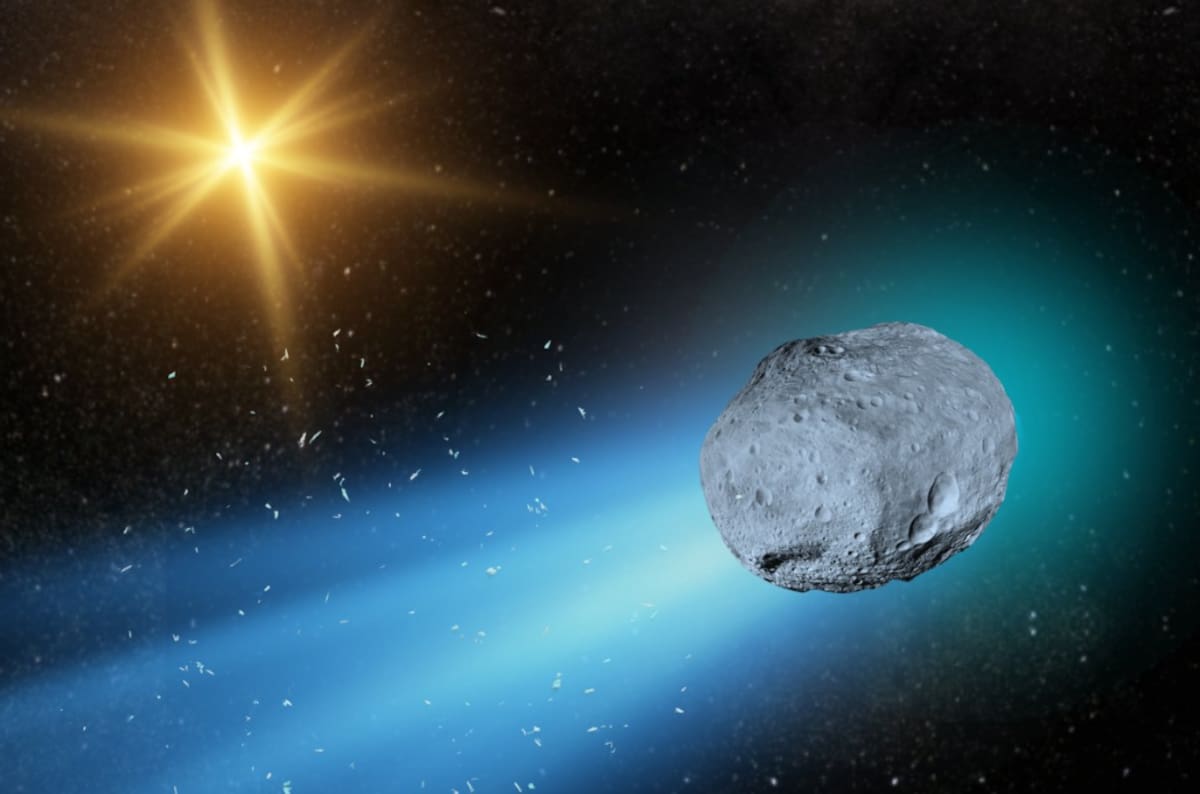
NASA has announced the exact date when Comet 3I/ATLAS will make its closest flyby of Earth. This event, expected by the scientific community, will take place on Friday, December 19when the celestial body is located 270 million kilometers of the planetthe shortest distance recorded so far. According to the space agency, this value is equivalent to 1.8 times the distance between the Earth and the Sun.
between Art November 2 and 25, 2025he Explorer of Jupiter’s icy moonsowned by the European Space Agency (ESA), will analyze the interstellar object using a number of specialized instruments. Recent images released by the US space agency and other scientific organizations show in detail part of its structure made up of dust and gas, raising new questions about its composition.
He Niels Gehrels Swift Observatory NASA has determined the availability hydroxyl gas (OH)chemical fingerprint of water inside comet 3I/ATLAS. Professor of Physics from Auburn University in the USA, Dennis Bodewitsexplained: “When we detect water, or even its faint ultraviolet echo, OH, in an interstellar comet, we are reading a note sent from another planetary system“.
He hydroxyl gas (OH) This is a key element for identifying the presence of water in interstellar space. This molecule is created when the sun’s ultraviolet rays split water molecules (H₂O) on hydrogen atoms and hydroxyl radicals.
The discovery could change our understanding of planet formation. According to astrophysicists, each molecule of this comet acts as a chemical message that travels through time. In this sense, they argued that “evidence that organic matter and water can form and even be stored outside the Sun“.
Recent research published in Journal of Astrophysical Letters (The Astrophysical Journal Letters) confirm this chemical feature. Specialists from the National Aeronautics and Space Administration concluded that “such early degassing can be caused by the heating of small ice grains on the surface of the comet nucleus by solar radiation, even at great distances.”