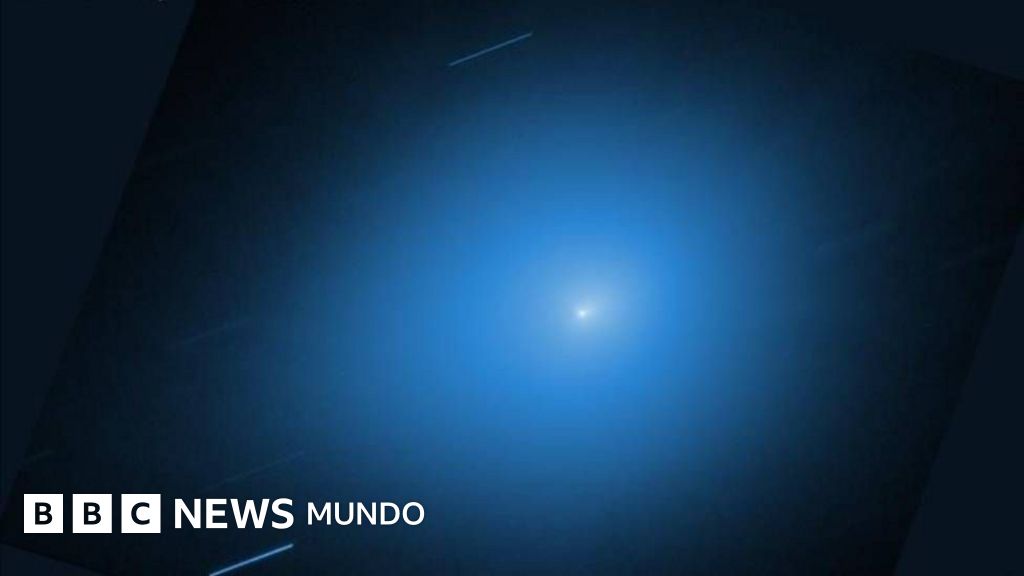
image source, NASA, ESA, STScI, D. Jewitt (UCLA). Procesamiento J. DePasquale (STScI)
Reading time: 6 min
This is our third interstellar visitor, and since it was discovered in the sky, it has caused all kinds of speculation among the public.
Because of the US government shutdown for more than 40 days, NASA was unable to report or release images of the mysterious object. In that period, they even said that it was an extraterrestrial ship.
Finally, when the government shutdown ended in late November, NASA held a press conference and put the rumors to rest.
“We really want to find signs of life in the universe,” said NASA Deputy Administrator Amit Kshatriya. “But 3I/ATLAS is a comet.”
Unlike asteroids, comets are composed of ice and dust.
As they approach the Sun, the ice and dust begin to evaporate, and when viewed through a telescope, the comet appears blurry or has a tail, the space agency explains.
3I/ATLAS formed in another star system and was somehow ejected into interstellar space.
It moved for millions or even billions of years until it recently reached our solar system.
“3I/ATLAS isn’t just a window into another solar system, it’s a window into the deep past, so deep that it predates the formation of our Earth and Sun,” said Tom Statler, NASA senior scientist for small solar system bodies.
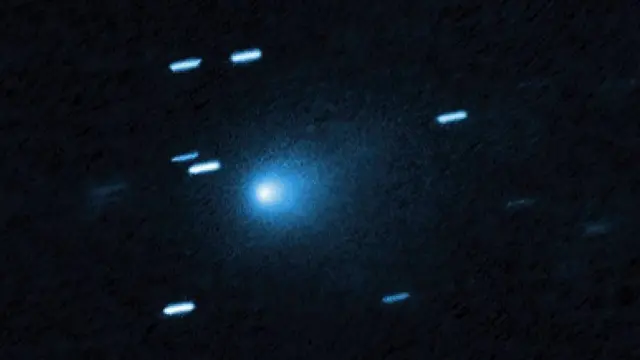
image source, NASA, ESA, David Jewitt (UCLA); Image processing: Joseph DePasquale (STScI)
Why is it called 3I/ATLAS?
NASA notes that comets are typically named after the person or team that discovers them, in this case the ATLAS research team.
The NASA-funded Asteroid Terrestrial Impact Latest Alert System (ATLAS) telescope in Rio Hurtado, Chile, was the first to report sightings of the comet to the Minor Planet Center on July 1, 2025.
The “I” in the name stands for “interstellar,” meaning that this object came from outside our solar system. And “3” because it is the third known interstellar object.
“Oumuamua, discovered in 2017, was the first object of its type, and the second was 2I/Barysau, which was spotted in 2019.
Scientists know that the comet originated outside the solar system because observations of its trajectory show that it is moving too fast to be constrained by the Sun’s gravity, and follows what is known as a hyperbolic trajectory.
In other words, NASA adds, its orbit does not follow a closed path around the Sun. It simply passes through our solar system and will continue its journey into interstellar space, never to be seen again.
Is it a danger to Earth?
NASA clarified that there is no risk of 3I/ATLAS colliding with Earth.
Although the path of the comet passed inside the orbit of Mars, it is now moving away from the Sun and will not come close to our planet at all.
At its closest, 3I/ATLAS will still be very far from Earth, almost twice the distance from the Sun.
This will happen on December 19, 2025, when the comet will be about 1.8 AU (about 270 million kilometers) from our planet.
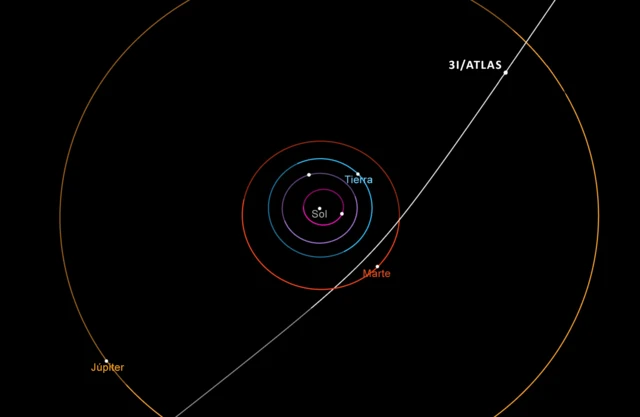
image source, NASA/JPL-Caltech
How big is it and how fast is it moving?
Astronomers still don’t know exactly how big 3I/ATLAS is. But based on observations of the Hubble space telescope, they note that the diameter of its core is at least 440 meters and no more than 5.6 km.
When the comet was discovered orbiting Jupiter, it was traveling at about 221,000 kilometers per hour, according to NASA.
Since then, 3I/ATLAS has continued on its planned trajectory. Pulled by the Sun’s gravity, its speed increased, reaching 246,000 kilometers per hour at perihelion, at its closest approach to the Sun.
Now, as a comet moves away from the Sun, the speed of the comet decreases, and as it leaves the Solar System, it will travel at the same speed as it entered.
What is known about its composition?
Scientists say that 3I/ATLAS has probably traveled through interstellar space for a long time.
Based on the speed at which it was moving when entering the solar system, scientists believe that the comet originated in a very ancient planetary system.
Until now, 3I/ATLAS has behaved exactly as a comet should, heating up near the Sun and releasing water and carbon dioxide, but it also has unique characteristics, Space.com explains.
The researchers found, for example, a higher-than-usual ratio of carbon dioxide to water compared to typical comets in the Solar System, as well as gas unusually rich in nickel compared to iron.
The dust around the comet also exhibits unusual properties, suggesting that its grain size differs from that of other comets.
“We’re still learning the questions we need to ask. And that’s certainly the scientific process in action,” Statler said.
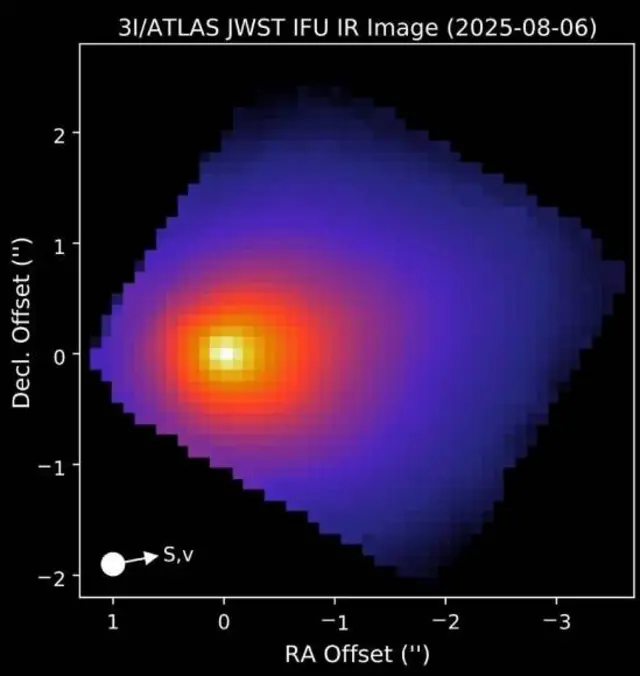
image source, NASA/James Webb Space Telescope
How can it be observed?
When it was discovered, 3I/ATLAS was on the opposite side of the Sun from Earth, so observing it was a challenge for NASA.
The space agency used instruments available from more than 20 missions that worked together to track the interstellar comet, each from a different vantage point.
Statler compared the effort to watching a baseball game from different locations in a stadium with flagship telescopes and smaller spacecraft trying to track the same fast-moving target.
“Everybody has a camera and they’re trying to take a picture of the ball,” he said. “No one has perfect vision, and everyone’s cameras are different.”
In October 2025, the comet passed behind the Sun and can now be observed from Earth again.
NASA reports that 3I/ATLAS is visible in the predawn sky even with a small telescope and will be visible by spring 2026.

Subscribe here to our new newsletter to receive a roundup of our best content of the week every Friday.
And remember you can get notifications in our app. Download the latest version and activate them.