Published
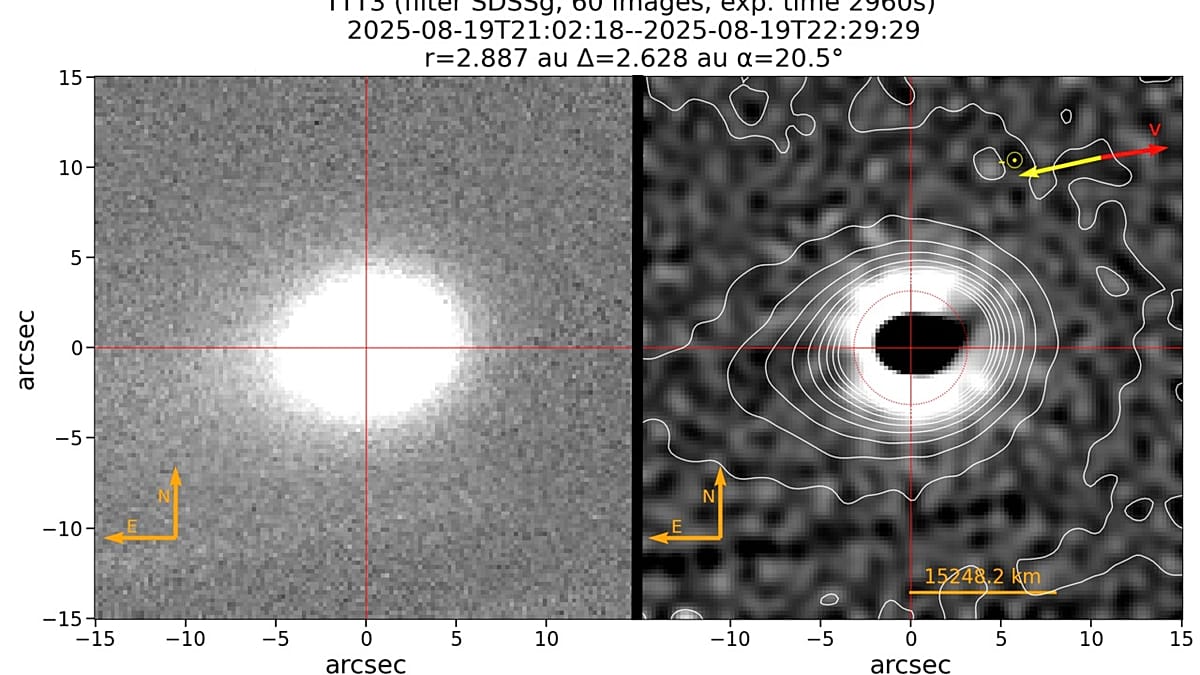
The two-meter twin telescopes located in Tenerife have achieved what no one has done before: to photograph the stream of gas and dust coming out of an interstellar comet. We are talking about 3I/ATLASdiscovered last July, when it was already traveling through the depths of the solar system.
The study, published in the journal Astronomy & Astrophysics, was led by Mikel Serra-Riccart of Light Bridges, along with Javier Licandro of the Canary Islands Astrophysics Institute and Miguel R. Alarcon. During 37 nights from July to September analyzed the structures of the comet’s coma using advanced processing techniques.
The interesting thing about the opening is not just that you saw a jet plane. The team noticed it the jet did not remain staticbut he wavered on the pattern. This periodic modulation allowed us to calculate that the nucleus of the comet rotates around itself each time 2 to 5 p.mwhich confirms previous measurements made in July by the same telescope.
“3I/ATLAS is an extremely normal interstellar comet,” explains Serra-Ricard. Although hailing from another planetary system, Its behavior is similar to that of comets as we know them. The detection of the jet allows a direct comparison with the mechanisms of activity observed in comets of the Solar System.
A visitor who is already saying goodbye
3I/ATLAS was initially detected by the ATLAS system in Chile on July 1, 2025. It is the third confirmed interstellar object after ‘Oumuamua (2017) and 2I/Barisov (2019). The journey is more than that 245,000 km/h and follows a hyperbolic orbit that will return it to interstellar space.
The Hubble telescope took pictures of the comet on July 21, when it was 365 million kilometers from Earth, showing a drop-like dust envelope. This is evidenced by observations The diameter of its core can be from 440 meters to 5.6 kilometers.
This Friday, December 19, the comet approached the Earth, flying about 270 million kilometers. It has already reached its perihelion – the closest point to the Sun – on October 29 at an altitude of 203 million kilometers, about the height of the orbit of Mars.
Japan’s XRISM mission observed the comet for 17 hours in late November and detected X-ray emission extending up to 400,000 kilometers from its nucleus. This is the first time X-ray emission from an interstellar comet has been recorded.after unsuccessful attempts with two previous visitors.
Material from another world
The 3I/ATLAS study offers a unique window into understanding how comets form in other planetary systems. “The characteristics of jets in such a body provide a unique opportunity to study the physical behavior of a pristine object that formed in another planetary system,” says Licandra.
Spectroscopic analysis of the James Webb telescope revealed data on its chemical composition. Webb’s infrared spectroscopy can detect compounds such as water, carbon monoxide, carbon dioxide, and ammonia in the comet. The full results of these observations are expected in early 2026.
The 3I/ATLAS observing campaign involves unprecedented international cooperation. In addition to TTT, more than a dozen NASA missions – including Hubble, Webb, Lucy, Psyche, and several Martian rovers – kept an eye on the interstellar visitor. The European Space Agency and Spanish research centers such as Gran Telescopio Canarias are also involved.
Now the comet It is finally moving away from the solar system. will not return. But the data collected during those months will continue to be analyzed for years to come, providing insights into the building blocks of other worlds and the diversity of the universe beyond our cosmic neighborhood.