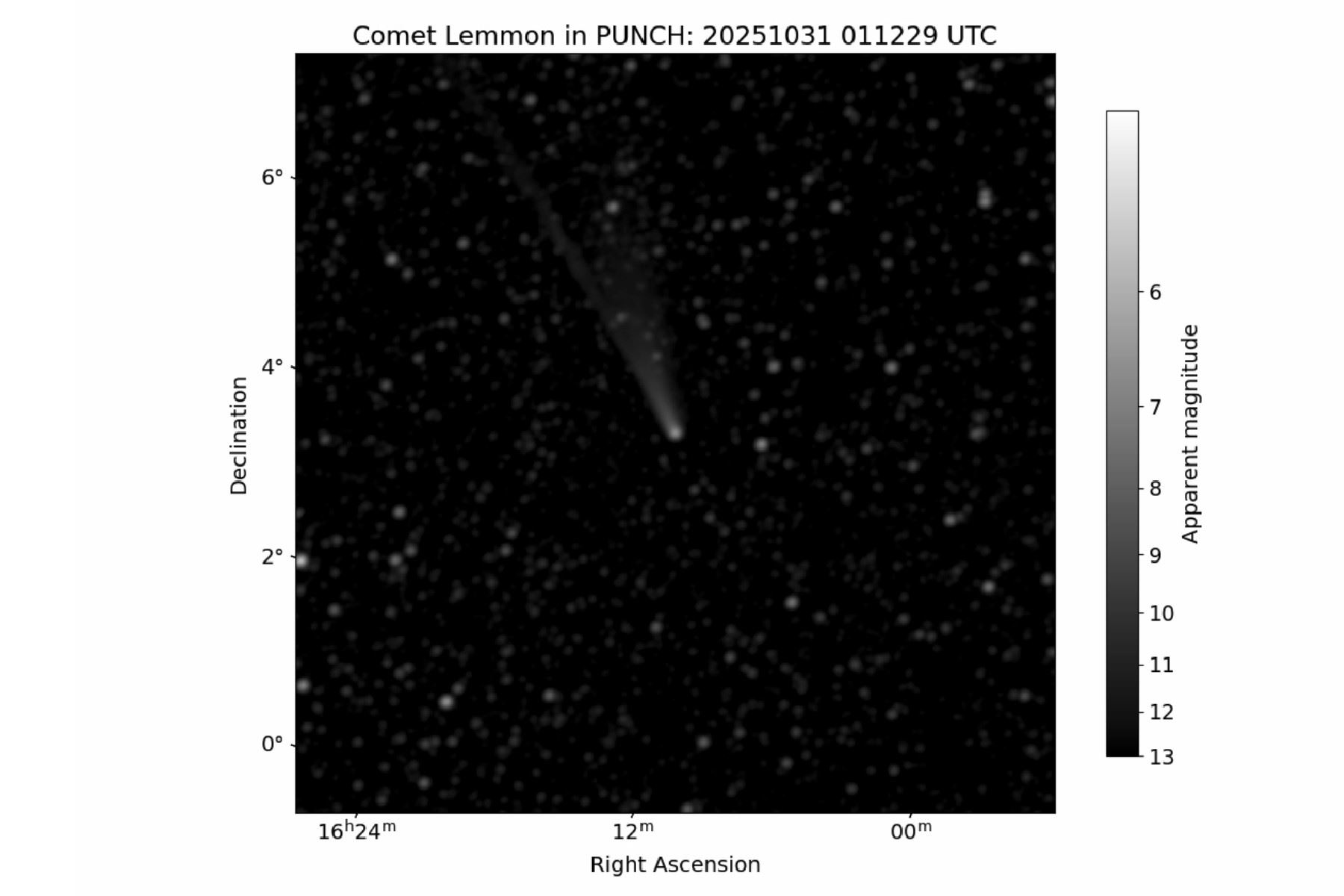
The comet, discovered in January 2025 by NASA’s Mount Lehman telescope in Arizona, appeared in PUNCH pictures from October 22.
In late 2025, when Comet Lehman (C/2025 A6) approached the Sun and shone brightly in Earth’s night sky, NASA’s Earth-orbiting mission closely observed it. It’s PUNCH (Polarimeter for Coronal Heliospheric Unification), a suite of satellites designed to study the Sun’s interactions with the nearby space environment, which has captured amazing images of a comet crossing the field of view.
A video created from these images — taken between October 22 and November 12, 2025 — shows the comet moving against a background of stars. Beyond the visual spectacle, the images show how the comet’s tail is changing in real time under the influence of the solar wind: the stream of charged particles constantly flowing from the Sun.
During two particular events, November 1 and 4, Comet Lehman’s tail is dramatically altered by solar flares. In both cases, the queue is fragmented or shortened, but forms again in the following days. These observations provide a unique opportunity to analyze how the Sun affects objects traversing the inner Solar System.
A key mission to understand the solar space
PUNCH is a four-satellite NASA mission that monitors the solar wind and its evolution from the solar corona to interplanetary space. Tracking Comet Lehmann served as a “natural tracer” of the Sun’s behavior, allowing us to visualize the effects of its activity on celestial bodies passing through the Solar System.
Currently, the comet is still visible in PUNCH images, although it is gradually fading as it moves away from the Sun and Earth. It is expected to disappear from the mission’s field of view by mid-January 2026.
The PUNCH mission is managed by the Southwest Research Institute, based in San Antonio, and its operations are conducted from Boulder, Colorado. NASA manages the project through the Goddard Space Flight Center on behalf of the agency’s Science Mission Directorate in Washington.
Published: 12/21/2025