
Virtual world – PIKIST.COM
MADRID, October 9 (EUROPA PRESS) –
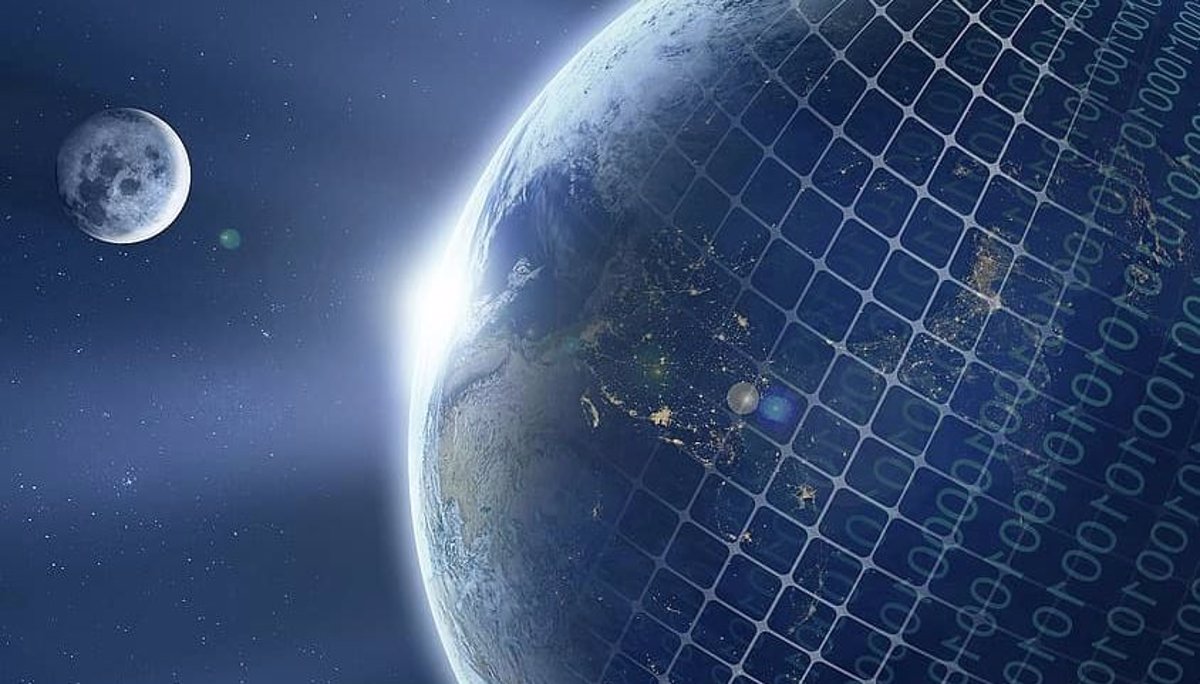
A University of Portsmouth physicist investigated whether a new law of physics could support the oft-debated theory that We are just characters in a developed virtual world.
The simulated universe hypothesis suggests that what people experience is actually an artificial realitymuch like a computer simulation in which they are themselves constructs.
The theory is popular among several famous figures, including Elon Musk, and in the field of science known as information physics, which suggests that Physical reality is fundamentally made up of bits of information.
Dr. Melvin Wopson previously published research that suggests that information has mass and that all elementary particles (the smallest known building blocks of the universe) store information about themselves, much like we have human DNA.
In 2022, he discovered a new law of physics that can predict genetic mutations in organisms, including viruses, and help assess its possible consequences.
It is based on the second law of thermodynamics, which states that entropy (a measure of disorder in an isolated system) can only increase or remain the same.
INFODYNAMICS
Dr. Wopson expected that entropy in information systems would also increase over time, but when studying the evolution of these systems it was clear that it remained constant or decreased. It was then that he established the second law of information dynamics, or infodynamics, which could significantly influence genetic research and the theory of evolution.
new article, published in AIP Advancesexplores the scientific implications of the new law for other physical systems and environments, including biology, atomic physics, and cosmology.
Dr. Wopson from the University’s Faculty of Mathematics and Physics said this is a statement: “I knew then that this discovery had far-reaching implications for several scientific disciplines. Next, I wanted to test the law and see if I could further support the modeling hypothesis by moving it out of the realm of philosophy and into mainstream science.”
Key results include:
– Biological systems: the second law of infodynamics challenges the traditional understanding of genetic mutations, assuming they follow a pattern driven by information entropy. This discovery has major implications for fields such as genetic research, evolutionary biology, gene therapy, pharmacology, virology, and pandemic monitoring.
– Atomic physics: the article explains the behavior of electrons in multi-electron atoms and provides information on phenomena such as Hund’s rule; which states that the term with the highest multiplicity has the lowest energy. Electrons are organized in a way that minimizes their information entropy, shedding light on atomic physics and the stability of chemicals.
– Cosmology: The second law of infodynamics is shown to be a cosmological necessity, with thermodynamic considerations applicable to a universe in adiabatic expansion proving its validity.
“The paper also provides an explanation for the prevalence of symmetry in the universe,” explained Dr. Wopson. “The principles of symmetry play an important role in relation to the laws of nature, but until now there has been little explanation as to why this might be so. My findings demonstrate that high symmetry corresponds to the lowest state of information entropy, which potentially explains nature’s proclivity for it.
“This approach, in which redundant information is removed, resembles the process in which a computer removes or compresses unnecessary code to save storage space and optimize power consumption. And as a result, he supports the idea that “we live in a simulation.”
Dr. Wopson’s previous research shows that information is a fundamental component of the universe and has physical mass. He even claims that information may be the elusive dark matter that makes up nearly a third of the universe. which he calls the principle of equivalence of mass, energy and information.
The paper argues that the second law of infodynamics supports this principle, potentially supporting the idea that information is a physical entity equivalent to mass and energy.
“The next steps to complete these studies require empirical testing“One possible way would be an experiment I designed last year to confirm a fifth state of matter in the universe (and change physics as we know it) using collisions between particles and antiparticles,” he says.


