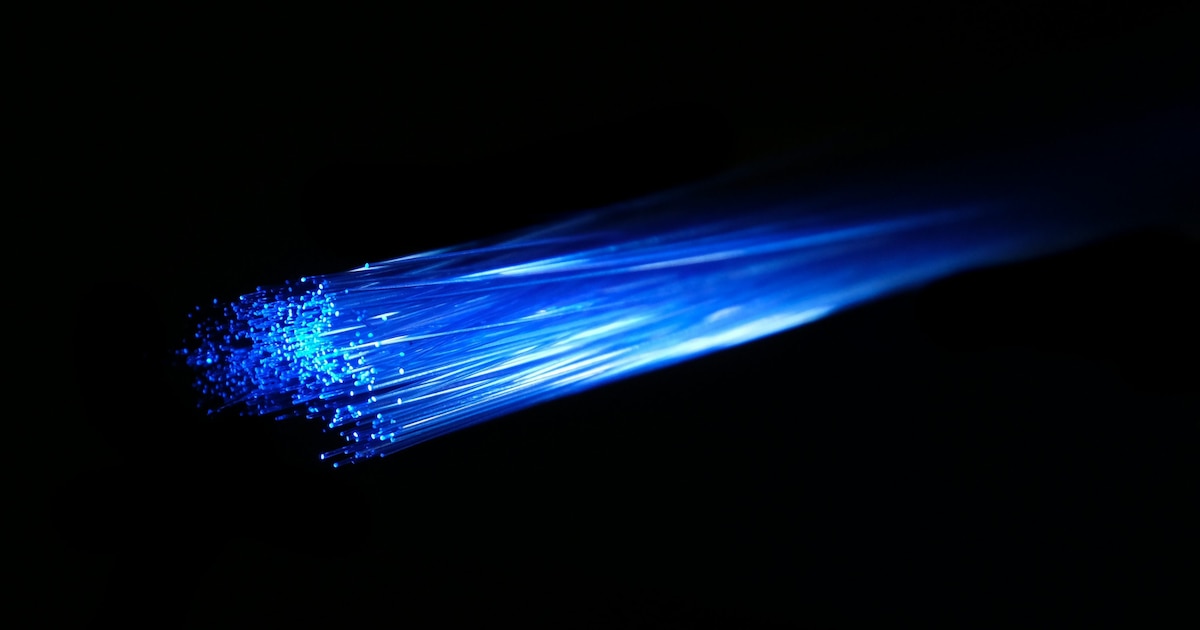
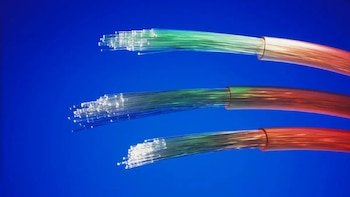
The next revolution in Internet Can arise with A loose fiber. A team of researchers at Southampton University has developed a new transmission system based on channels full of air rather than the kernel of the solid glass that dominates Current Optical Cables.
Allowing light to travel through the air, design minimizes energy loss And significantly improves the efficiency of long -distance data, overcoming the restrictions of traditional fiber.
In ordinary fibers, approximately Half the signal is lost every 15-20 kilometerswhich causes frequent renters to enhance and broadcast information. However, the hollow design is a safe distance for transmission without losing half the light, spreading up to about 33 kilometers.
“If new technology allows you to lower one in two -three repetition buildings, a very significant cost savings are achieved”Francesco Paleti said, the chief author of the study, published in the Photony Nature magazine.
But promotion not only away: these new fibers have the opportunity to transport more than 1000 times more power transfer As for conventional fibers and allow the signals a much wider range of waves. This includes the transfer of one photon of visible light, decisive for quantum communication.
The combination of high power and compatibility with new technologies makes this development appropriate milestone for both modern telecommunications and the Internet of the future.

Although hollow optical fibers are not completely new – they have already been used in specialized supplements at the data center where the speed is crucial – they have never been practical and affordable on large scale. The main reason is that the easy traveling is almost 45% faster through the air than glassproviding the immediate benefits of speed.
However, high expenses and technical complexity deprived them of the mass market.
Paleti and his team They have perfected the design for over ten years. The key lies in innovative architecture: five small cylinders, each of the two cylinders, associated with a larger cylinder, forming the main structure.
This accurate position ensures that only certain waves lengths enter the central canal and avoid leaks of light, keeping the impulses strongly limited. “We really believe it may be transformational”said Paleti.
The most difficult step was to reach a large large -scale production without disturbing the careful geometry of the channels. Unlike the usual procedure, in which the solid glass melts and stretches, the equipment begins with a glass preparation with a diameter of about 20 centimeters, with already built -in holes. During stretching to microscopic sizes (about 100 micrometers), hollow cameras are pressured to maintain the exact shape.
Marketing is already going on. EpubionThe new company that arises from Southampton will be responsible for getting this new fiber. MicrosoftWhich company acquired in 2022, confirmed the great interest of the industry in the potential of this innovation.
If the fiber turns out to be durable and profitable, Telecommunications systems Not only faster and economic, but will also be ready to support the next wave of quantum communication.
TRYISE NORTEPExperimental physics at the University of Insbrush, emphasizes the relevance for the quantum community: today the high cost of these fibers has prevented experiments even in the laboratories. “We hope that the production of scale can significantly reduce prices in the future,” says Nortup, opening the door in an era where the Internet overcomes all barriers known to this day.