In its plan to cover everything with artificial intelligence, Google is integrating Gemini into its entire catalog. What application could be improved with a dose of intelligence? Twins to the kitchen. And Google Maps is one of the applications that is in the spotlight: Google is planning a more accurate and understandable navigation. Because it’s easier to say “Turn at the next pharmacy” than “Take the fourth exit.”
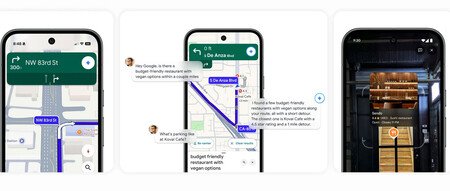
Better interaction with the application. The new plan presented by the company offers the arrival of Gemini on different layers of Google Maps. From asking for directions to point-to-point guidance while navigating, Gemini offers a reorientation in how you use the map app.
While we learned yesterday that we’ll soon have intelligent lane changing, today we woke up to four new features already on their way to Google Maps. These will appear in our programs over the next few months.
Google Image
Real attractions. A big improvement offered by Gemini is the identification of links to help the driver make decisions. How many times have we counted streets because the sat nav told us to take the fourth? With the help of artificial intelligence, the instructions will be more understandable.
Google explains how Gemini works as a landmark identifier:
“Gemini does this by analyzing up-to-date and comprehensive Google Maps information about 250 million locations and matching it with Street View images to select the most useful landmarks visible from the street; so that the instructions are accurate and really helpful“.
On paper, Google is proposing a major change in map navigation, from a general link to a specific and point-to-point. In the absence of testing this new intelligent guidance system, it appears to be an advance that is as useful as it is obvious.
More Gemini related news. Smart Routes is just one of the Gemini-related changes we’re planning to bring to Google Maps. The other three are:
- Interaction with natural language. We can turn on the microphone and ask Google Maps what we need using our words. “Find me the nearest restaurants that serve sushi”, “take me to a parking lot where parking is free”… Gemini will analyze the request and solve it without leaving Google Maps.
- Use your camera and Google Lens to identify locations. We can ask Maps what’s in the restaurant we’re pointing the camera at, for example. Or what year the building in front of us was built: Gemini will know what we’re asking for and give us all the details.
- Active notifications. If Google Maps already warned about traffic jams and incidents before the start of the planned trip, with Gemini such activity will be more accurate and effective.
- Submit incidents using voice. With Waze already introducing Gemini to report road incidents, these AI interactions are finally coming to Google Maps. For example, you can say, “I just saw a car crash on the road.” Gemini will understand the words and automatically activate the incident.

First in the USA. As is usually the case with all AI-related news, Google will bring the changes to US users first. They will be rolling out to mobile apps over the next few months. Some of them will also appear in Android Auto.
Cover Image | Ivan Linares
In Xataka Android | I checked out Gemini as a performer, assuming he would do well. And, it turns out, he did it better