
Write a job offer. Make a selection and screen the resumes you receive. Conduct an initial interview with the selected candidates to see if they fit the position and your personal skills with the company culture. In the case of those who have joined, inform them of the policies and rules that govern the company and make up the day-to-day life of the company. Answer any questions about corporate procedures that you may have as a new employee.
Human resources (HR) departments are faced with many tasks that may seem repetitive in some cases. It is therefore not surprising that nine out of ten HR managers in Spain believe that in 2030 HR in their companies It should be more nimble and less bureaucratic. Something in which technology has a lot to say.
However, according to a report by the Institute for the Future of Work (which was presented at an event organized by the Human Resources Management Association – CentRHO), in some companies the HR department understands technological advances more as a tool to standardize and control the processes that must be performed, more than as a tool to increase value and develop organizational capabilities.
However, reality shows that if used correctly, tools such as artificial intelligence or virtual reality can (not without certain risks) streamline the HR function and add value to both the department itself and the company as a whole.
Automate tasks
Therefore, undergo a virtual reality interview after you answer a few questions from a chatbot and the fact that the same virtual agent welcomes us to the company and we can ask him all the questions about the business policy – these are some of the real use cases that are happening.
In fact, companies like Jobandtalent or Prosegur already use these technologies for the selection and recruitment of personnel.
“Jobandtalent invested heavily in hiring call center operators to communicate with candidates and decided to hire GUS services to automate their processes. By activating WhatsApp as the main communication channel for candidates, he managed to reduce this investment by 36%, hiring only enough operators to provide additional support to those candidates who require special control in their processes,” he says. for La Razón Ignacio Diego , CEO of Gus Chat (a company that develops artificial intelligence tools and chatbots).
“Similarly, by automating all the repetitive queries that would normally be answered by an operator on the phone, it was able to reduce call rates by 42%,” says this manager, adding that the company also saw message open rates above 85%, yes as WhatsApp is an application that users already know well and that they view several times throughout the day.
Contract with RV
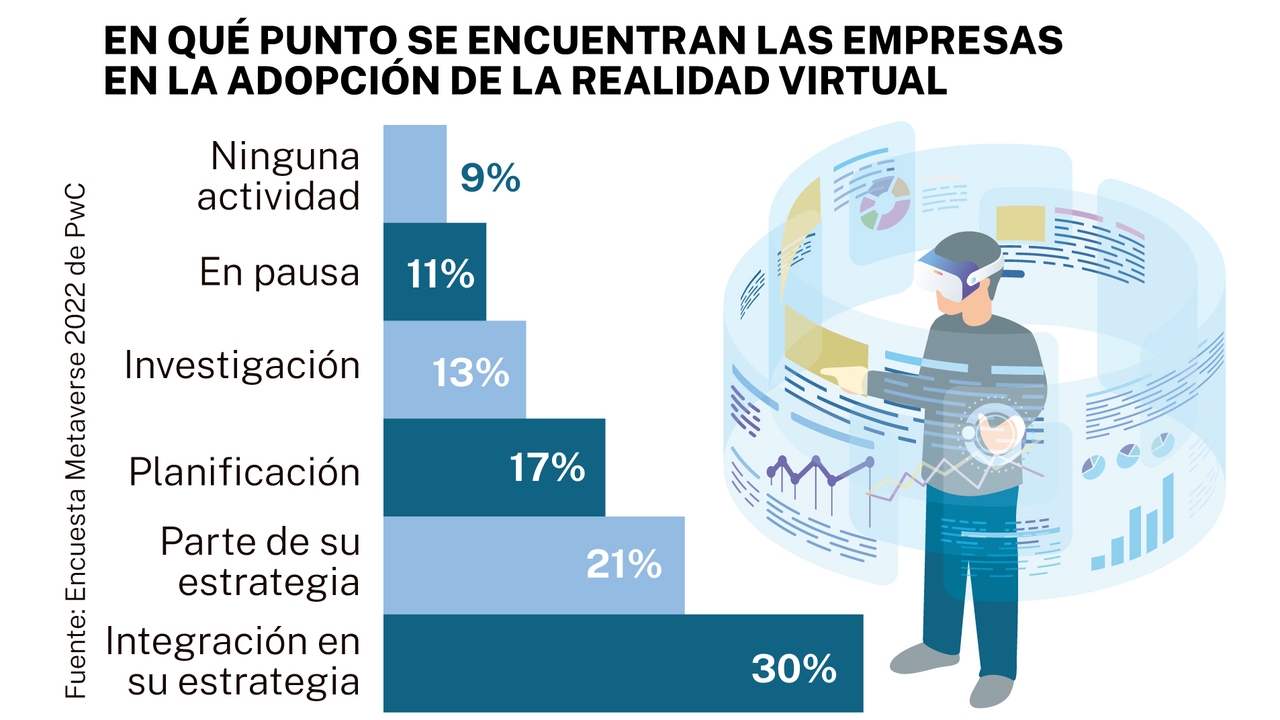
So far, many industries and companies are using virtual reality (VR) to teach occupational safety and technical issues. But VR can be just as effective for teaching leadership, interpersonal skills, or other human interactions (so-called soft skills). Does it have advantages over traditional face-to-face or e-learning methods?
“We believe that virtual reality applications in recruitment are gaining momentum and may become a standard tool in the future. The main reason is that VR offers a a unique and effective way to assess and develop communication skillswhich are increasingly valued in today’s work environment,” says Alberto Marcos, Zero Latency Business Development Manager EMEA.
This is achieved by practically recreating day-to-day scenarios in which candidates face specific challenges and issues as players. “A participant reacts and reacts in a natural, almost innate way to certain situations in which we as observers can analyze leadership skills, teamwork, communication, listening, logical reasoning or results orientation, among others.” , detailed Moreno, is responsible for evaluation and transformation at Wyser.
Marcos assures this editorial team that virtual reality allows for the simulation of real-world work situations “in a safe and controlled way that helps employers make more informed hiring decisions.” So, “as technology continues to improve and costs continue to come down, it’s likely that we’ll see a increasing use of VR applications in recruitment processes“.
No wonder Moreno believes that “innovation in talent management seeks to create creative as well as effective offerings that meet the needs of organizations,” so that technology solutions “act as agents of change that truly add value.”
This is not a joke
The trend seems clear. Santiago García, co-founder of the Future for Work Institute, assures that this does not sound like an anecdote, but “there are many reasons to believe that the use of generative artificial intelligence during interviews and selection will be increasingly intense.”
This expert list some benefits to do so, for example, speed, efficiency and scalability to analyze, review more applications and assess the suitability of candidates in less time, make predictions about the potential success of a candidate in a particular position and, “if programmed correctly , “Artificial intelligence-based tools can minimize human biases that may arise in face-to-face interviews, thus offering a more objective selection’.
Garcia thinks so too These technologies can adapt and constantly learn to adapt to both the needs of the company and the market situation.oy offers instant feedback to facilitate “a more fluid and personalized interview, adapting to the candidate’s responses and behavior in real time.”
Keep being HR
However, Garcia also cautions that using these tools can carry risks, such as causing harm the hiring process “seems impersonal, which may affect the candidate’s perception of the company” or bias mentioned above. “They can perpetuate or even reinforce existing biases in the data they are trained with” and make companies less diverse and, “therefore, reduce the richness of an organization’s ideas, which can be especially problematic in an environment where diversity of thought is important for innovation. It’s “Relying solely on technology can cause companies to overlook valuable candidates “They don’t meet the strict criteria, but they can be a great addition to the team,” Garcia emphasizes.
“While AI can offer valuable tools for hiring new employees, human judgment remains indispensable. The challenge, from my perspective, is to achieve the best combination of technology and human solutions, combining the best of both worlds,” adds Garcia.
An opinion supported by Ignacio Diego, who recommends human observation to ensure a positive experience. The first filters are done by chatbots, but “every process is monitored by recruiters in a personalized way. A bot can’t do interviews, for example,” he explains, adding that These bots “have not arrived to replace humans, but rather provide support to allow HR staff to focus on more complex tasks.” and companies can hire more qualified staff.
Testing software skills
Until recently, the use of VR in the company focused on training technical skills: flight simulators, safety procedures, operation and maintenance of equipment, etc. But it is increasingly being used to teach soft skills. According to the results of a recent PwC study, employees who received VR training learned faster, were more confident, had a greater emotional connection to the content, and were more focused.
In addition to being more economical, HR departments can also identify different profiles in work teams using these technologies.: those who are bolder and take risks, compared to those who adopt a more conservative profile.


