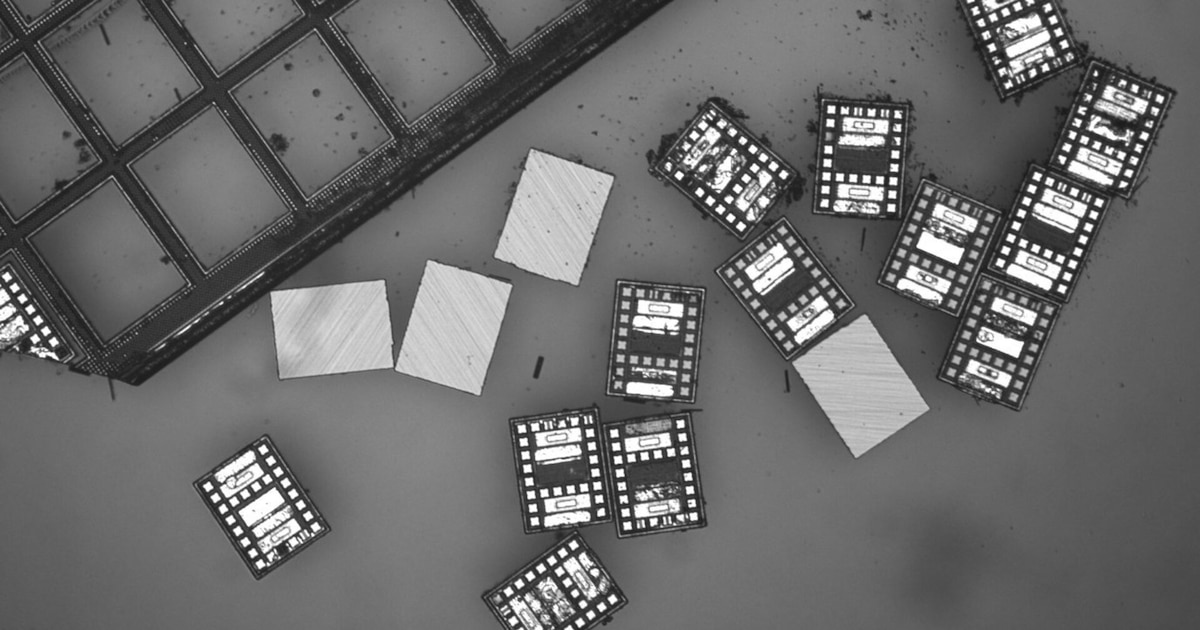

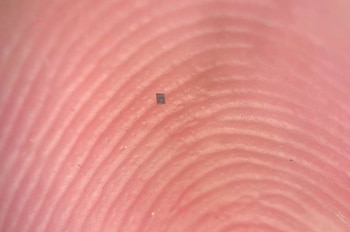
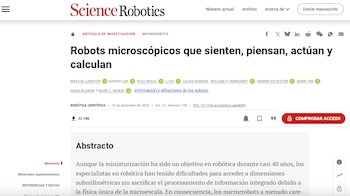
A team of researchers from the University of Pennsylvania and the University of Michigan managed to break the physical barriers of miniaturization robotics. They have developed an autonomous robot so tiny that it can sit on the crest of a fingerprint and still be able to perceive its environment, process information and move without assistance.
This advance is redefining what was thought possible in micro-scale robotics by combining computing, memory, sensors, communication and locomotion functions in a single device.
The microrobot, according to its creators, It is the smallest programmable and standalone built to date. Its roughly 210-by-340-micrometer, 50-micrometer-thick body is designed to operate in fluids, move and perform tasks in environments where gravity and inertia are no longer relevant and where forces such as viscosity and drag prevail.
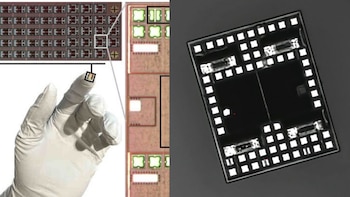
The key to this progress lies in the ability to integrate all the necessary systems into a single autonomous platform. Unlike previous developments that relied on external teams to process information or make decisions, This robot can run digital algorithms and change its behavior according to what it detects in its immediate environment.
The main challenge to achieve this level of miniaturization was overcoming physical and energy limitations. To do this, the research team designed the robot’s electronic architecture from scratch, which is less than a grain of salt. Using a 55-nanometer CMOS process and subthreshold digital logic, they managed to keep power consumption within 100 nanowatts.
This efficiency enabled the integration of photocells, temperature sensors, control circuits for actuators, an optical receiver for programming and communication, and a processor with memory.
Moving a robot This is particularly innovative. Instead of motors or moving parts, it uses electric fields to induce current in the fluid around it, moving without parts susceptible to wear or failure.
According to researchers, robot creates its own “river” to move forward, a minimalist and efficient solution on a microscopic scale. Even the communication is ingenious: collected data, such as temperature, is transmitted through sequences encoded in the robot’s own movements.
The team also demonstrated that several of these robots can synchronize and act in groups, forming collective patterns similar to schools of fish. This ability to work together opens up possibilities for distributed tasks, where each unit contributes from its local position.
With constant LED light on their solar cells, these microrobots can operate autonomously for months, although currently available memory limits the complexity of programmable tasks.
The possibilities of this platform are extensive. The researchers believe that these microrobots could evolve into general-purpose applications that operate in complex environments and without direct human control.
The horizon of use includes from biomedicine -where they could interfere with body fluids- to the research and monitoring of inaccessible environments. However, the team acknowledges that this development is only a first step: the leap into practice will depend on future improvements in power, memory and the complexity of integrated intelligence.
Locomotion of a robot refers to the set of mechanisms and processes that enable it to move or move in its environment.. Depending on its design and purpose, a robot can use different means of locomotion, such as wheels, legs, tracks, locomotion, or even microscopic systems that mimic biological movements.
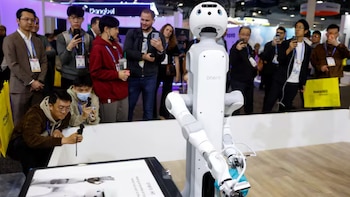
In the case of very small robots such as micro robotsmovement is usually based on interaction with small physical forces, the use of magnetic or electric fields, or through flexible structures that respond to external stimuli.
The primary purpose of robotic locomotion is to enable the device to move forward, backward, turn, or avoid obstacles, ensuring that it can perform its tasks efficiently and autonomously. The choice of the locomotion system depends on the environment, the size of the robot and the function it has to perform, being a key area in the development of robotics and advanced miniaturization.