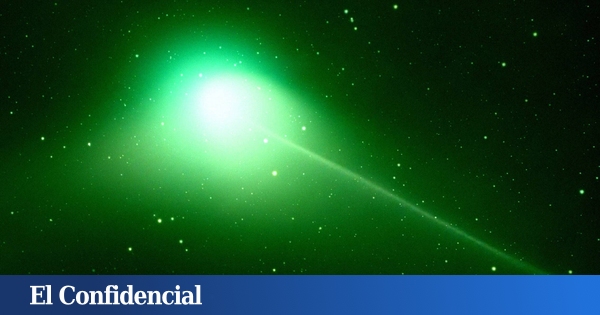
Reports from the Minor Planet Center ( here ) and NASA’s Jet Propulsion Laboratory ( here ) have just been released new data on the 3I/ATLAS interstellar object after it passed through perihelion on October 29, 2025. The new data covers the period from October 31 to November 4.
Compared to previous data obtained between 5 and 8 October, it appears that 3I/ATLAS increased its brightness about 5 times in the green band centered at a wavelength of 0.464 micrometers.

YOU MAY BE INTERESTED
Jesus Diaz
The value of Art non-gravitational acceleration It fell by a third compared to the value announced on October 29. This decline is within the range of uncertainty. The net detection is now more robust at 3.7 standard deviations.
The non-gravitational acceleration was measured at the current perihelion distance, which is 1.38 times the Earth-Sun distance (defined as an astronomical unit or “au”), equivalent to 206 million kilometers from the Sun. It has two components in the 3I/ATLAS orbital plane, but does not detect components perpendicular to this plane. The measured components — parameterized according to the inverse square law depending on the distance from the Sun — have the following values, normalized to the heliocentric value of 1 AU:
- A from radial acceleration Sun 1.1×10⁻⁶ u.a. per day in the square.
- A transverse acceleration relative to the direction of the Sun 3.7×10⁻⁷ ua per day squared.
Based on conservation of momentum (as discussed here), it is easy to show that 3I/ATLAS had to lose a measurable fraction of its mass to gain this non-gravitational acceleration through the rocket effect. As I deduced, the fraction of mass lost during perihelion t is: t(a/v)*, where v is the velocity of the gas ejected from the surface of the core and the non-gravitational acceleration given by 3I/ATLAS.
The perihelion transit time is the ratio of the perihelion distance of 203 million kilometers to the perihelion speed of 68 kilometers per second, which gives a result for t of about 1 month. The non-gravitational acceleration is reported to be 94 kilometers per day squared at perihelion. A combination of these values means that 3I/ATLAS has lost a fraction of its mass is equal to:
Approximately 13% divided by v in units of 300 meters per second,
where a value of v of approximately 300 meters per second corresponds to the characteristic thermal velocity of molecules at the 3I/ATLAS surface temperature near perihelion. this emission rate would be the maximum value expected for a natural comet, meaning that 3I/ATLAS should lose more than 13% of its mass near perihelion if it is considered to be a natural object. However, a high-tech rocket engine can release gas through the exhaust at a much higher velocity, thus reducing the amount of mass loss required. The significant brightness and blue color of 3I/ATLAS near perihelion (as reported here) could be a sign of cometary mass loss and CO+ emission (as discussed here) or a hot engine with much less mass loss.
This contrast provides clear evidence of the nature of 3I/ATLAS in the coming weeks. If 3I/ATLAS is a natural comet, It must be surrounded by a massive gas cloud containing at least 13% of the original mass of the core. This cloud should be much more apparent than between July and September, when 3I/ATLAS did not show any non-gravitational acceleration (based on an analysis of 4022 data points from 227 observatories). Spectroscopic observations of this new massive coma by the Webb telescope in December will allow us to infer the composition of the interior of 3I/ATLAS, not just its “skin.”
However, unless 3I/ATLAS is enveloped in a much more massive gas cloud after perihelion than it was in previous months, then its recent non-gravitational acceleration should be due to cause other than comet evaporation.
Anomalies reported so far by 3I/ATLAS include:
- They are retrograde trajectory It is located within 5 degrees of the ecliptic plane of the planets around the Sun with a probability of 0.2% (see here).
- During July and August 2025, he showed a a jet directed towards the Sun (anticola), which is not an optical illusion due to geometric perspective, unlike known comets (see here).
- Its core is approx a million times more massive than 1I/ʻOumuamua and a thousand times more massive than 2I/Barysau, while moving faster than both, all with a probability of less than 0.1% (see here and here).
- They are the arrival time was set exactly placing it tens of millions of kilometers from Mars, Venus and Jupiter and being unobservable from Earth at perihelion with a probability of 0.005% (see here).
- Your gas plume contains much more nickel than iron (as found in industrially produced nickel alloys) and a nickel to cyanide ratio that is orders of magnitude higher than all known comets, including 2I/Barysava, with a probability of less than 1% (see here).
- Your gas plume contains only 4% water by weight, the main component of known comets (see here).
- Shows an extreme negative biasunprecedented for all known comets, including 2I/Barysava, with a probability of less than 1% (see here).
- It came from a address matching “Wow Signal!” radio with a difference of 9 degrees, with a probability of 0.6% (see here).
- near perihelion, brightness increase faster than any known comet and was bluer than the Sun (see here).
- exhibit a non-gravitational acceleration that requires the evaporation of one-sixth the mass its mass (as calculated here), but previous images after perihelion show no evidence for this yet.
This morning I received the following email from Australia:
“Dear Professor Loeb,
I am writing to let you know that I have really enjoyed your posts and posts on 3I/ATLAS. But I’m not writing to you about 3I/ATLAS or any of its various anomalies that have been observed so far – I’m sure you regularly receive many messages from various quarters on this subject! Rather, I am writing to express my strong solidarity with your position on the current state of scientific thought, which I must say is in complete agreement with my own. I’m not an astronomer or a physicist, but I like to study and think about all the advances in science, crossing disciplinary boundaries, including my own, which turns out to be the application of software computing to business decisions. This spirit of wonderful curiosity is what led me to learn more about 3I/ATLAS and the astronomical observations/speculations that have been building up around this event in recent months.
What I find in your views on this subject, of course, only to the extent that I can follow given my rather rudimentary knowledge of the underlying theories and models, is a very refreshing and bold step to climb above the imposed walls in which current scientific thinking seems happy to remain confined. I think that these walls, unfortunately, have been and continue to be imposed, not necessarily by the consensus of the global scientific community as a whole, but rather by certain well-heeled groups and pressure groups within that community, often with interests that may not be purely intellectual in nature. In my forthcoming book, Brainmaker: The Coevolution of Human and Synthetic Intelligence, I draw a somewhat similar parallel between today’s “scientific lobbies” and the Church of the Middle Ages. Of course, it is well known that scientific thinkers and astronomers such as Galileo who offered alternative views (eventually vindicated by the correct ones) were severely persecuted because their views conflicted with those of the Church at the time. I believe (and fear) that science is increasingly positioning itself as a kind of organized religion, and the scientific lobbies have come to resemble the high priests of the ancient temples. When dissenting ideas sprout outside of what these pressure groups consider normal, they tend to encounter resistance, ironically comparable in destructive ferocity to that faced by defenders of scientific knowledge like Galileo from the Church. Perhaps the only real difference is the replacement of physical persecution with intellectual persecution: the systematic denigration of radical ideas (and their purveyors) often through “ad hominem” and deception attacks and calls for intellectual banishment from the so-called mainstream.
That you always seem to be able to deflect all such attacks, veiled or direct, with extraordinary poise and elegance, and a rigorous intellectual rebuttal, is something I have come to greatly respect and admire. While I certainly don’t consider myself to be on your intellectual level (not even close), I would be honored to hear from you and perhaps one day have the opportunity to exchange thoughts with you on this rather unfortunate current state of science and its potential impact on the future of our species.
I thank you for taking the time to read my email (among the hundreds you must receive and read regularly) and I will be delighted and honored if you reply.
Sincerely,
Sukanto
— — — — — — — — — — — — — — — — — — — — —
Dr. Sukanto Bhattacharya
Deakin University
Victoria 3220, Australia