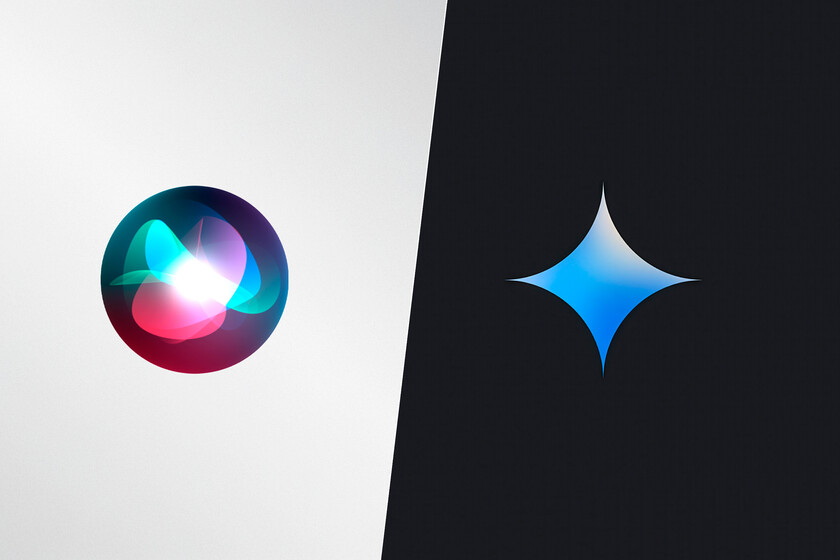
In the midst of the rise of artificial intelligence with increasingly sophisticated voice assistants such as ChatGPT or Perplexity, Siri is starting to show the passage of time too clearly. It doesn’t always understand what we’re asking of it, and it often stumbles as soon as we deviate from a few predetermined patterns. Between backfired promises, internal tensions and leadership changes, Apple seemed to be losing ground in one of the most crucial technology races of the decade. And while it’s too early to tell if it can change that dynamic, the company just took a big step by making a big decision: entering into an alliance with one of its big rivals.
Agreement with Google. The Cupertino-based company has signed a multi-year collaboration with the search giant, thanks to which the next generation of so-called Apple Foundation models will be based on the Gemini models and the search giant’s cloud technologies. Subsequent Apple Intelligence features will be built on this technical foundation, including a more personalized Siri coming “this year.”
With privacy at the center. The statement added that despite this change, the system will continue to operate on devices and on its Private Cloud Compute platform, adhering to its privacy standards. Apple insists that the operational heart of Apple Intelligence does not leave the home.
It all starts with WWDC 2024. There, Apple presented Apple Intelligence as a great answer to the rise of generative artificial intelligence and put Siri at the center of this strategy, promising a much deeper understanding of personal context, the ability to “see” what is on the screen, and link actions between programs. In practice, this meant that the assistant should be able to interpret and act on emails, messages, meetings or files without having to switch from one application to another. It was a leap in ambition, much bigger than the traditional Siri.
From promises to reality. At the end of 2024, Apple publicly maintained this pace. In a press release in December, it was confirmed that the most advanced Siri capabilities will arrive “in the coming months”, at the same time as the launch of other parts of Apple Intelligence, such as Image Playground or Genmoji. In the same context, Apple again talked about personal context awareness, seeing what’s on the screen, and “hundreds of new actions” within and between native and third-party apps.
Three months later, in March 2025, the tone changed. In an official statement to Daring Fireball, the blog of the legendary Jon Gruber, the company acknowledged that some of these features will take longer than expected and went on to talk about a “more personalized” Siri coming “over the next year.”
WWDC25. It’s June 2025, and that year at WWDC, Siri hasn’t shown a leap equivalent to the one hinted at twelve months ago. The lack of news eventually prompted Apple to issue a public explanation. Craig Federighi, director of software, and Greg Joswiak, head of marketing, addressed the issue in an interview after the event.
Federighi explained that Apple had “version 1” of the new Siri in the works from December 2024 to spring 2025, but they decided to stop it, judging that it would not meet customer expectations or the company’s internal standards during that period.
Management changes. Ultimately, the Siri jam went from product to org chart. In March 2025, Bloomberg and Reuters reported that Apple removed Siri from John Gianandrea’s domain and put Mike Rockwell, an executive associated with Vision Pro, in charge, reporting to Craig Federighi.
The move signaled that Apple wants the software to regain direct control over the assistant during a period of delays and internal pressure. A few months later, on December 1, 2025, Apple officially announced that Gianandrea would step down, serve as an advisor, and retire in the spring of 2026, with Omar Subramanya as the new VP of AI reporting to Federiga.
In the end, it all comes back to the same thing. The company now includes a more personalized version in its upcoming roadmap after months of working with the calendar. The announced alliance changes the technical framework to achieve this, but does not eliminate the acid test. Actual usage, when users start asking complex things from their iPhone or Mac, will determine whether Apple can catch up in the never-ending race.
Images | Apple | Google
In Xataka | Google has found a way to monetize its artificial intelligence: adding ads while shopping without leaving