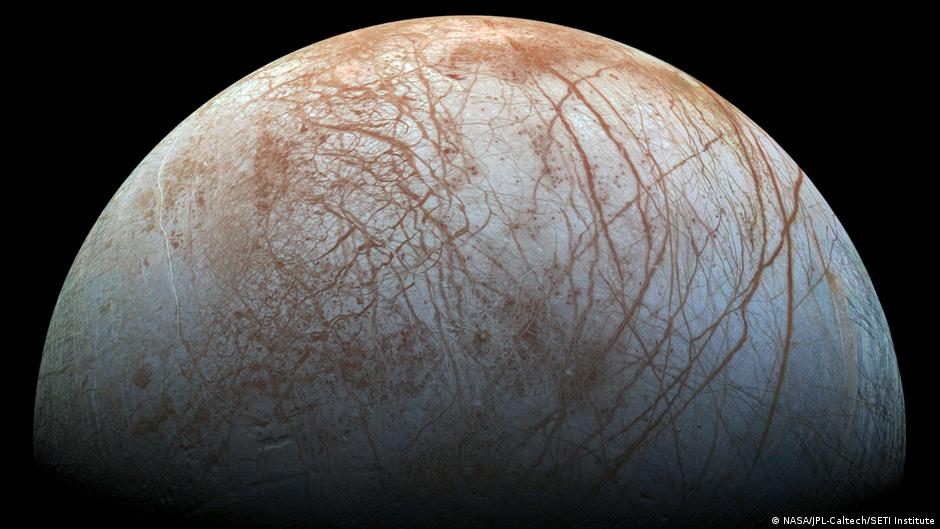
Europa, one of Jupiter’s moons, has for many years been one of the most promising places in the solar system to search for life beyond Earth because of the existence of a vast subsurface ocean beneath its frozen surface.
However, a new study is published in Nature Communications
The importance of the ocean floor for life
The work analyzes the potential for tectonic and volcanic activity on Europa’s ocean floor, processes that on Earth allow rock and seawater to interact, producing the nutrients and chemical energy necessary for life.
Life on our planet is thought to have originated billions of years ago around hydrothermal vents on the ocean floor, a dynamic, energy-rich environment. However, Europe may lack similar structures.
“On Earth, tectonic activity, such as faulting and faulting, exposes fresh rock to the environment, where chemical reactions—primarily with water—produce compounds like methane that can be used by microbial life,” explains lead author Paul Byrne, a planetary scientist at Washington University in St. Louis.
A lot of resistance to keep the bed alive
After modeling the internal conditions of Europa’s satellite, the researchers concluded that the rocky base would be mechanically too strong to support life.
The ocean floor “will not contain large tectonic structures such as long ridges or deep trenches. Most likely, there will be no volcanoes, no seamounts, and no hydrothermal activity,” says co-author Christian Klimczak, a geologist at the University of Georgia.
Without this tectonic activity, Byrne adds, “these reactions are more difficult to establish and maintain, making Europa’s ocean floor a difficult environment for life.”
Dimensions and structure of the Europa satellite
Europa, the fourth largest of Jupiter’s 95 officially recognized moons, is about 3,100 kilometers in diameter, making it slightly smaller than Earth’s moon.
Its ice sheet is believed to be 15 to 25 kilometers deep, and beneath it lies an ocean 60 to 150 kilometers deep.
Although its diameter is about a quarter of Earth’s, its salt water can hold twice as much water as all of Earth’s oceans combined.
Keys to occupancy
Despite the new limitations, this body has three factors considered essential for life: liquid water, organic chemistry, and energy.
“The underground ocean of Europe satisfies the first requirement. We have identified organic compounds in the outer layer of ice on this moon, and it is likely that these compounds are also present in the ocean. So that’s the second requirement. And Europa’s peculiar orbit means that Jupiter creates tidal heating in Europa—the third requirement,” Byers elaborates.
Gravitational influence of Jupiter
Jupiter’s intense gravity affects its many moons in different ways. Io, the innermost, is the most volcanically active body in the Solar System due to the extreme tidal forces that generate internal heat. Europe, on the other hand, rotates at a greater distance.
“The effect of this tidal heating diminishes rapidly with distance, so while the warming is enough to prevent Europa’s ocean from freezing completely, it is not enough to tectonically deform the ocean floor,” explains Byrne.
What if he was more active in the past?
The study focuses only on current conditions on the moon Europa, but the authors do not rule out another scenario in the past.
“There is reason to think that Europa may have been much more geologically active in the past, albeit billions of years ago. So perhaps for a time this world was not only potentially habitable, but actually inhabited, before those conditions changed and the chemical energy needed for life was exhausted,” says Byrne.
Search for life with the Europa Clipper mission
In 2024, NASA launched the Europa Clipper mission, which includes sending a probe that will assess in 2031 whether the Moon has suitable conditions for life: “Although geology works in a similar way throughout the Solar System, each planetary body we have studied has demonstrated its own unique process. “Based on what we know about Europa, it’s still the best place to look for extraterrestrial life,” Klimczak says.
“I wouldn’t worry if we didn’t find life on this moon. I’m sure there is life out there somewhere, even 100 light years away. That’s why we’re exploring: to see what’s out there,” Byrne concluded in the statement released IFLScience.
Edited by José Urejola with information from Reuters, IFLScience and Nature.