
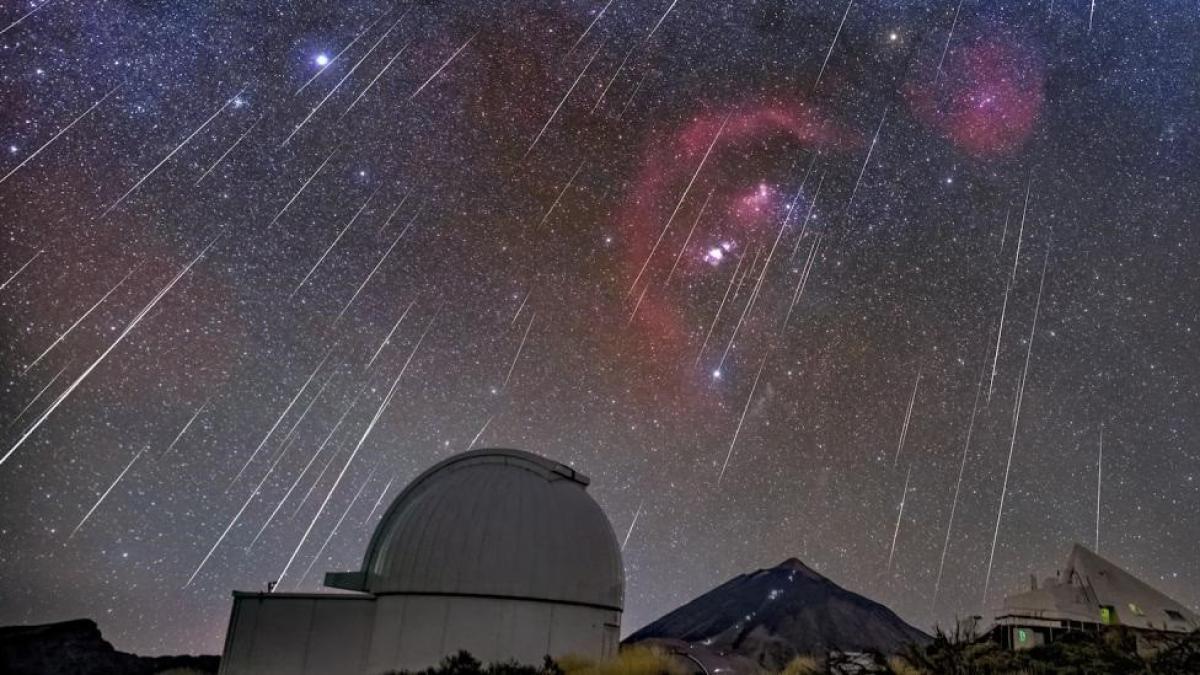
In astronomical jubilee calendars, December marks one of the most interesting times of the year due to the activity of the Geminid meteor shower, traditionally one of the best of the year due to the number of meteors (shooting stars) it produces.
According to estimates, the maximum number of luminous lines will reach its maximum during the night from Saturday to Sunday, especially in the early hours when the waning moon has not yet risen above the horizon. In perfect dark conditions and a completely clear sky, up to 150 shooting stars per hour could be observed.
Meteor showers are the result of large numbers of tiny pieces of material, usually left by comets, entering our atmosphere, rubbing up against the air and disintegrating to form meteor trails. But in the case of Gemini, the parent object is an asteroid, which is unusual because this type of object doesn’t break up as easily as comets.
cosmic dust
Comets are composed of a large amount of ice (frozen gases as well as water ice), which makes them very compact bodies. As they approach the Sun, they heat up in the innermost part of their orbit, and the volatiles that make them up evaporate, dragging dust particles with them.
When the Earth occasionally crosses the path of some of these objects, many of the fragments that have been ejected into space enter our atmosphere and break up due to friction, causing the phenomenon we know as meteor showers.
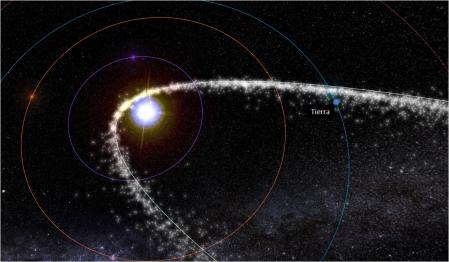
Earth’s orbit crosses that of asteroid 3200 Phaeton in mid-December, creating the Geminid meteors
However, the comet is not always responsible for these phenomena. In the specific case of the Geminids, it is an asteroid: 3200 Phaeton. A surprising circumstance, since these bodies, unlike comets, are generally much more compact and have less tendency to shed material.
Maximum
The Geminid meteor shower occurs every year from about December 4th to the 20th, just as the Earth passes the path of 3200 Phaethon (which completes one revolution around the Sun in about 524 days). Within this time range, the number of meteors increases statistically until it reaches a maximum, which by 2025 is expected to be reached on the night of December 13-14. From this peak of activity, the number of shooting stars begins to gradually decrease day by day.
The Geminids are traditionally one of the best meteor showers of the year, along with the Perseids in August (the famous Tears of St. Lawrence) due to the large number of meteors they produce. However, it is always very difficult to make quantitative predictions in this regard due to the various factors involved.
Thus, for example, there is not always a perfect match between the Earth’s orbit and the orbit of the object causing the phenomenon. In addition, there are many other variables that can contribute to or hinder the observer’s experience: dark sky conditions, the presence of the moon, and of course the weather.
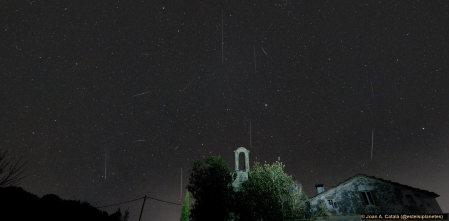
Meteors from the Geminid meteor shower captured within minutes in 2021
This year, some forecasts, such as those made by the National Geographic Institute, point to a maximum of 150 meteors per hour under ideal viewing conditions. These numbers should be interpreted with caution as theoretical advice.
Recommendations
As in the case of other astronomical phenomena, the choice of the place of observation turns out to be a decisive factor. It’s about getting as far away from city lights as possible, and if that’s not possible, preferably above street lights. Similarly, to ensure optimal dilation of the pupils, exposure to nearby light sources (including mobile phone screens) should be avoided.
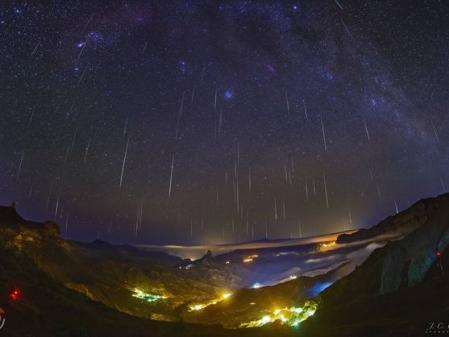
Spectacular composition of Geminids 2023, made from Gran Canaria
Meteors from a meteor shower can appear anywhere in the sky, so it is advisable to choose such places for observation from which you can see as much of the sky as possible and at the same time take a comfortable position that allows you to look vertically. Observing should be done with the naked eye, as the use of instruments such as binoculars drastically reduces the possibilities of meteor hunting.
This year’s Geminids coincide with the waning phase of the Moon. In particular, the moon won’t rise above the horizon until about three in the morning, which means the best time to see the shooting stars will be in the early part of the night.
Name
All meteors belonging to a particular meteor shower come from a particular point in the sky. This means that, although the luminous lines can appear anywhere in the firmament, if they are traced back in imagination, they all converge on what is called the radiant.
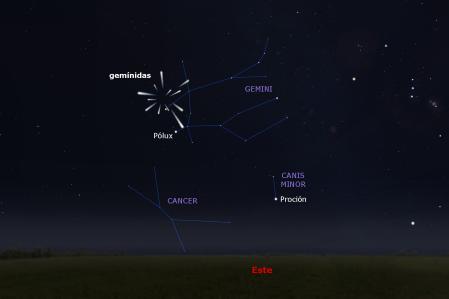
The radiant of Gemini is visually located near the star Castor, the second brightest in the constellation Gemini.
The radiant is precisely the place through which the tiny fragments that eventually create meteors enter the atmosphere. And it is the visual arrangement of the radiant that gives the name to each meteor shower. So the Geminids seem to come from a point in the sky that is in the constellation Gemini.
A mysterious object
There are various hypotheses that have been proposed to explain why an asteroid like 3200 Phaethon ejects material into space, as comets typically do. Some of these models consider the possibility that the object has suffered a collision in the past.
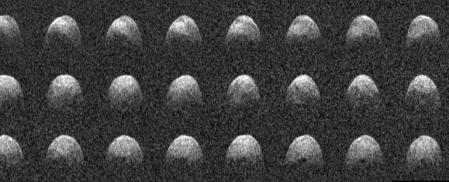
Images of asteroid 3200 Phaeton obtained by the Arecibo radio telescope
But in 2023, a study led by the University of Helsinki suggested that the composition of this asteroid could be similar to that of meteorites called CY carbonaceous chondrites, which are capable of releasing carbon dioxide, water vapor and sulfur when heated.
This scenario assumes that whenever the 3200 Phaeton approaches the Sun, its temperature could reach 750ºC. A process that would activate the evaporation of gases and, as a consequence, the expulsion of dust particles.


