

As 3I/ATLAS changes what we know about comets, new research challenges what we think we know about the origins of our solar system. A comprehensive analysis of data collected by the Gaia mission shows that our Sun was involved in the migration of stars away from the inhospitable center of the galaxy between 4000 and 6000 million years ago. This discovery not only reconfigures the narrative of our cosmic environment, but also offers an explanation for why Earth is in a zone far more favorable for life.
The spacewalk… massively
Our Sun did not always live where it is now. According to the researchers, it was born about 4.6 billion years ago, at least 10,000 light-years closer to the center of the Milky Way, a much denser, turbulent and dangerous region for the evolution of life. However, there was a problem: the observations revealed a huge rod-shaped structure at the center of the galaxy that functions as a “rotational barrier”. This phenomenon acts as a dynamical boundary, making it difficult for stars to move too far from the center.
To understand how the Sun managed to “overcome” this barrier, a team led by astronomers Daisuke Taniguchi (Tokyo Metropolitan University) and Takeji Tsujimoto (National Astronomical Observatory of Japan) decided to look for its possible companions: stars almost identical to ours. These “solar twins” have temperatures, surface gravities, and chemical compositions very similar to those of our star, making them valuable clues for reconstructing its past.
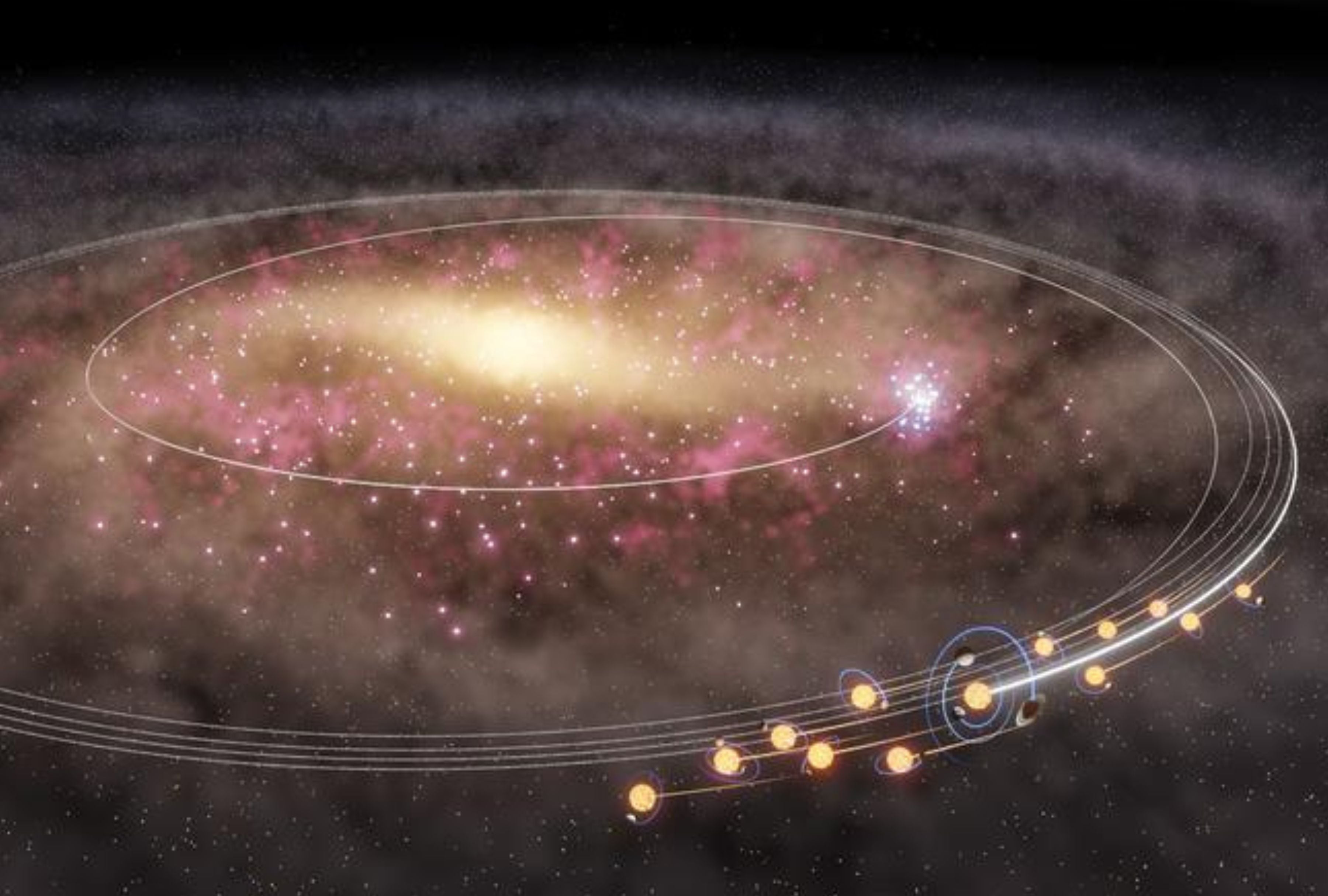
The massive migration of twin stars. Stars similar to our Sun form a mass migration from the center of the Milky Way that occurred between approximately 4,000 and 6,000 million years ago. (Photo: Image generated by El Comercio MAG with Copilot AI)
More than 6,000 twins to tell the story of the Sun
The team relied on the European Space Agency’s (ESA) Gaia mission, recognized as one of the most extensive star maps in history, which collected data on the positions and characteristics of approximately two billion stars. From this vast ocean of cosmic information, they created a catalog that includes 6,594 Sun-like stars, about 30 times more than had been documented in previous studies. They then made careful corrections for sampling bias, taking into account that some stars are more accessible to observation than others.
When they analyzed the age distribution of these stars, a clear signal emerged: a broad peak of solar twins between 4 and 6 billion years old, just the range that includes the Sun. Not only were they the same age, but they were also at the same distance from the galactic center. This coincidence is hardly the result of chance: everything points to the fact that our Sun moved as part of a massive migration of stars.
A galaxy under construction and a shelter for life
This result testifies not only to the journey of the Sun, but also to the Milky Way itself. If the central band were already fully formed, the karatation barrier would prevent such a large “escape” of stars from the center to the outer regions. The researchers propose another scenario: the bar was still forming when the migration occurred. In other words, the moment when the solar twins moved away from the center coincides with the stage at which the bar structure arose and rearranged the dynamics of the galaxy.
Also, there is a key clue to life as we know it. The center of the galaxy is a much more hostile environment: higher density of stars, more radiation, more supernova explosions. On the other hand, in the most distant regions – for example, where the solar system is now – relatively calmer conditions are created for the formation of rocky planets and for life to emerge and develop. According to the authors, the collective journey of the Sun and its twins may be one of the factors that allowed the Earth to find itself in a much more habitable galactic “neighborhood”.
Research behind discovery
The findings are based on two studies published in a specialized journal Astronomy and astrophysics. In the first, the team created a large catalog of solar twins with accurate estimates of their ages. In the second, he analyzed how these ages are distributed and what they mean for the Sun’s trajectory within the Milky Way.
Both works combine Gaia data with information from the infrared Two Micron All Sky Survey and were supported by institutions in Japan and Europe. Together, they offer a new narrative about our place in the galaxy: that we are not an isolated exception, but part of a great migration of stars that billions of years ago changed the fate of the Sun… and ultimately our fate.
This article was developed with the help of AI


