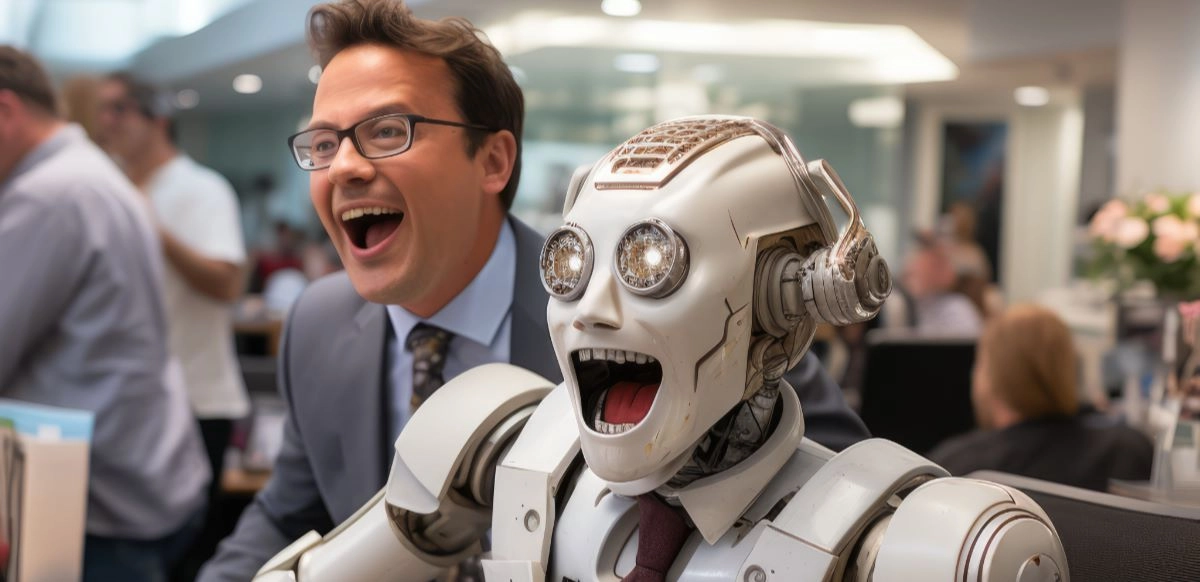
The artificial intelligence He progresses at an amazing speed: he writes complex texts, analyzes images, conducts conversations and even tries to tell jokes. However, a A recent study has shown that this supposed humorous ability is more limited than it seems. Researchers in Cardiff University and Ca’Foscari University of Venice concluded that language models can reproduce the structures of humor, but do not understand them.
Academic work—name The Pun Unintended: The Law Master and the Illusion of Understanding Humor– analyzed how different models react to puns, modified jokes and phrases that have deliberately lost double meaning.
They found that Even with the humor gone, the AI still classified these phrases as real jokes. In many cases, the model is even generated invented explanations to justify his answeras if he was trying to “keep a joke” even though he didn’t realize it.
These results reveal a major limitation: The models do not recognize humorous designs, but rather statistical patterns similar to humor. If these patterns remain, even as meaning disappears, artificial intelligence will become confused.
Humor requires something AI doesn’t have: human experience
Researchers emphasize that Humor is one of the most profound human phenomena in existence.. For a joke to succeed, the right words are not enough: they are necessary cultural context, shared memory, emotional sensitivity, rhythm, application and one intuitive reading of the right moment.
The I.ANo matter how difficult it is, He has no personal experiences and emotions. You don’t know if something is offensive, inappropriate, or just plain uncomfortable. Nor can it interpret gestures, silence, complicity between people, or the intent behind a comment..
Research highlights that lack of life experience does not allow models to process humor as a social tool. While people use jokes to break the ice, relieve tension, express indirect criticism, or evoke empathy, AI only detects text patterns. It does not understand hidden meanings or psychological games.
Weakness: Distinction between literalness and intention
One of the most compelling findings of the study is this models’ difficulty separating literal message from comic intent. Las People make this distinction automatically. because we understand implicit social rules, cultural references, irony, and even apparent contradictions.
AI, on the other hand, tends to mix these levels. If a sentence retains a certain structure typical of humor—such as a rhyme, an unexpected twist, or a double entendre—a machine can continue to interpret it as a joke, even if the double entender has been intentionally removed. For the authors of the study, it shows AI humor arises not from conceptual understanding, but from formal coincidences.
What does this mean for the future of AI-generated humor?
The development of conversational models has opened the door to friendlier assistants, bots that tell jokes, and platforms capable of producing mainstream humorous content. But the study warns about the risks of trusting AI in situations where humor requires sensitivity: customer service, education, emotional support or multicultural context.
In these scenarios AI can’t tell when a joke is offensiveif this inappropriate or if a comment should read with irony. You can also reproduce expressions that sound humorous without noticing hidden prejudices and stereotypes.
Despite this, the researchers admit it AI can be useful as creative support: trigger ideasto propose humorous structures or assistance in brainstorming processes. But his contribution should be understood as a tool of imitation, not as a form of authentic humor.
An open call for the next generation of models
Cardiff and Ca’ Foscari’s work raises a key question for the future of generative systems: Can AI truly understand humor? According to the authors, achieving this will require advances that do not yet exist: models that can integrate emotional information, interpret gestures, read tone of voice and understand social context with the depth that humans possess.
At the same time, the relationship of artificial intelligence to humor will remain paradoxical: it can imitate it very fluently, but it does not really know why something should be funny to us.