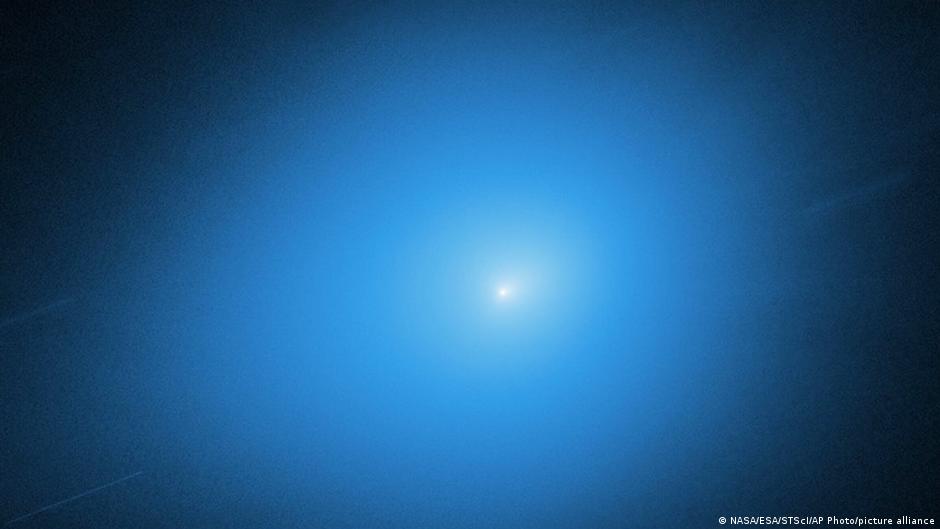
The interstellar comet 3I/ATLAS, which arrived from outside the solar system, will approach Earth on December 19 by approximately 270 million kilometers. Although it poses no danger – it will pass at almost double the average distance between Earth and the Sun – the timing will be key for its study.
The approach can be followed live on the Internet: the Virtual Telescope Project offers a free broadcast
Characteristics of an interstellar comet
According to NASA, despite some speculative theories, its characteristics – color, speed and trajectory – fully correspond to the characteristics of a comet.
This interstellar traveler could be “a kind of missing link, a pristine object that escaped from its planetary system billions of years ago,” Josep Maria Triga-Rodríguez, a researcher at the Institute of Space Sciences of Spain’s Superior Council for Scientific Research (CSIC), tells EFE.
In fact, it may be the oldest observed comet, even 3 billion years older than the Solar System, which is 4.6 billion years old, according to what astronomers estimate based on its trajectory, the European Space Agency notes on its website.
Discovered on July 1, when it was already orbiting Jupiter, 3I/ATLAS formed in another solar system and was somehow ejected into interstellar space. After a journey of millions of years, it has arrived in our neighborhood, but only in passing and will leave it, never to return.
It is the third known interstellar object to be observed, the first being Oumuamua, discovered in 2017, followed by 2I/Barysau in 2019. All of them hold the keys to the formation of other worlds far beyond our solar system.
Space telescopes study 3I/ATLAS
Since it was first spotted by the Asteroid Collision Early Warning System (ATLAS) telescope in Rio Hurtado, Chile, the comet has been studied by every means available.
The Hubble and James Webb space telescopes, the Tess satellite, the Mars Express mission, the Solar and Heliospheric Observatory (SOHO) or the Europa Juice probe on their way to Jupiter have turned their eyes and instruments on it.
The goal is to learn how it travels around our neighborhood and learn about its composition, which “opens a window into how planets form outside the solar system,” Geronimo Villanueva, a planetary scientist at NASA’s Goddard Space Flight Center, explains in the video.
As a result of these observations, a team led by Trigg has already published a study in the repository arXiv,
The most important discovery would be that the comet could have erupted icy volcanoes, a phenomenon called cryovolcanism, which would explain its increase in brightness as it approached the Sun at its closest distance, which occurred in October.
“What sets it apart from other comets is that it undergoes water alteration processes, which we usually call corrosion, when it becomes soaked with water and other volatiles,” says the astrophysicist.
By studying its luminosity as a function of distance from the Sun, it was possible to make sure that the comet “woke up from sleep almost at the distance at which we expected the water ice to start to sublimate effectively.”
Trigo notes that they continue to observe each night to learn from their behavior and how their gas and dust emission activity declines after passing perihelion.
How to observe a comet from the ground
270 million kilometers is too far to try to see the comet with the naked eye, although in the coming days it will be possible to observe it with medium-sized telescopes.
However, Trigo warns that “it’s not easy to see because it’s not very bright.”
To try, you’ll need to be in a dark place, know your location among the stars in advance, or use a telescope that guides you to your exact coordinates.
During its close approach to Earth and afterwards, it will be visible in the sky until dawn until next spring.
Disputes about the nature of the object
The appearance of this guest comet sparked the idea that it could be a technological interstellar object. The hypothesis was not ruled out, in particular, by Harvard University astrophysicist Avi Loeb, as it had some unusual characteristics.
Regarding these theories, Triga states, “The small body community is angry and concerned. What we have experienced is a disgrace to science and to those of us who are involved in its dissemination, because we are questioned and accused of ‘hiding’ things.’
For the astrophysicist, “it is unfortunate that some of his colleagues are unfoundedly promoting such hypotheses about the artificial nature of 3I/ATLAS with all the evidence for the cometary nature of the object obtained with large telescopes.”
NASA Deputy Administrator Amit Kshatriya noted a few weeks ago when several images and data were released that “the object is a comet. It looks and behaves like a comet, and all the evidence points to it being a comet.”
A FEW (EFE, Space.com)