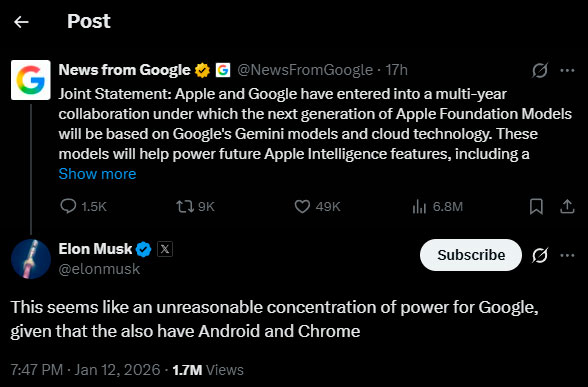
Reaction a Elon Musk others A joint announcement from Apple and Google It didn’t take long to get there. Hours after both companies confirmed that Gemini will be part of the next-generation technology core SiriMusk described the operation as “unreasonable concentration of power for Google”. A commentary published in X points to a well-known problem: the accumulation of infrastructure, models and distribution channels in the hands of the same actor.
Billed as a multi-year collaboration, the move by Apple and Google allows Gemini to support future Apple Intelligence features, including a more personalized Siri assistant expected this year. According to the information provided by both companies, the integration will not be limited to the voice assistant, but will be extended to other services as well, without details yet. Apple claims that processing will continue on devices and on Private Cloud Compute infrastructure with its own privacy standards. Still, the announcement marks a turning point: for the first time, Google’s models become the structural layer of the iPhone’s intelligent software.
Criticism of Musk does not arise out of nowhere. Managed by a businessman xAIdeveloper a Groka model that competes directly with the Gemini and OpenAI systems. From this position, his message makes a strategic reading: Google not only provides language models, but also controls Android, Chrome, and much of the global cloud infrastructure. The alliance with Apple, traditionally jealous of its technological independence, changes this historic balance.
The legal context itself adds layers of complexity. Last year, xAI sued Apple and OpenAI, accusing them of coordination “ensure your continued dominance” in the artificial intelligence market. The complaint, despite being publicly contested, has overcome attempts to file it and continues its legal process. In this respect, Musk’s reaction can also be seen as an extension of the conflict, now with Google as the central actor.
Apple, for its part, chose a cautious discourse. In a joint statement, the company simply reveals what the collaboration will enable “New Innovative Experience” for users, without specifying features or closed terms. The most advanced version of Siri is expected to be part of iOS 26.4, which is expected between March and April after several internal delays. Promised capabilities include a deeper understanding of the user’s personal context, awareness of what’s happening on the screen, and more granular controls within apps. Examples shown by Apple include flight or booking inquiries received from Mail and Messages, a demonstration of how far it wants to go with the integration.
The Apple-Google alliance is a departure from the previous narrative in which Cupertino sought to rely on multiple suppliers without giving up prominence. Until now, adding ChatGPT as an add-on to Siri was presented as a controlled discovery. Gemini, on the other hand, becomes part of the very foundation of the core models. For Google, this means privileged access to hundreds of millions of iOS devices, a terrain historically foreign to its mobile ecosystem.
From a regulatory perspective, Musk’s warning ties into a broader debate about concentration and technological dependency. In Europe, where Apple and Google are already under scrutiny, the deep integration of AI models could once again raise questions about effective competition and barriers to entry. While Apple insists it retains control over the final product, relying on external models creates an interdependence that’s hard to ignore.
The reaction of the market and other players in the sector is so far restrained. Neither Apple nor Google have publicly responded to Musk’s statements, and there are no immediate signs of a lawsuit. However, some analysts interpret the message as a preemptive warning, a way to mark the territory before the agreement fully materializes. Others will recall that in the past Musk has hinted at the possibility of launching his own phone, an idea that, if implemented, would put xAI in direct competition with the mobile duopoly.

The international context does not play in xAI’s favor either. Grok has been criticized and blocked in several countries after creating unauthorized images and sensitive content, including cases involving minors. Governments such as Indonesia and Malaysia have restricted access to the chatbot, and investigations have been launched that could lead to sanctions. That backdrop reduces Musk’s room for maneuver when he decries anti-competitive practices by third parties, but it doesn’t negate the questions he raises about the distribution of power in AI.
In contrast, Google is reaching an agreement with Apple while consolidating Gemini as an end-to-end platform integrated into search, productivity and now other operating systems. For Apple, this collaboration offers a fast track to closing the gap in generative capabilities compared to competitors that have advanced earlier. The balance between control, dependency and speed of innovation will be key in the coming months.
It remains to be seen whether Musk’s criticism will translate into concrete action or be diluted in the usual noise of disputes between the tech giants. The introduction of the new Siri, planned for spring, will be the first real measure of the alliance’s reach. From now on, the debate about the concentration of power, competition and technological sovereignty will intensify again, this time with the iPhone as one of the main scenarios.