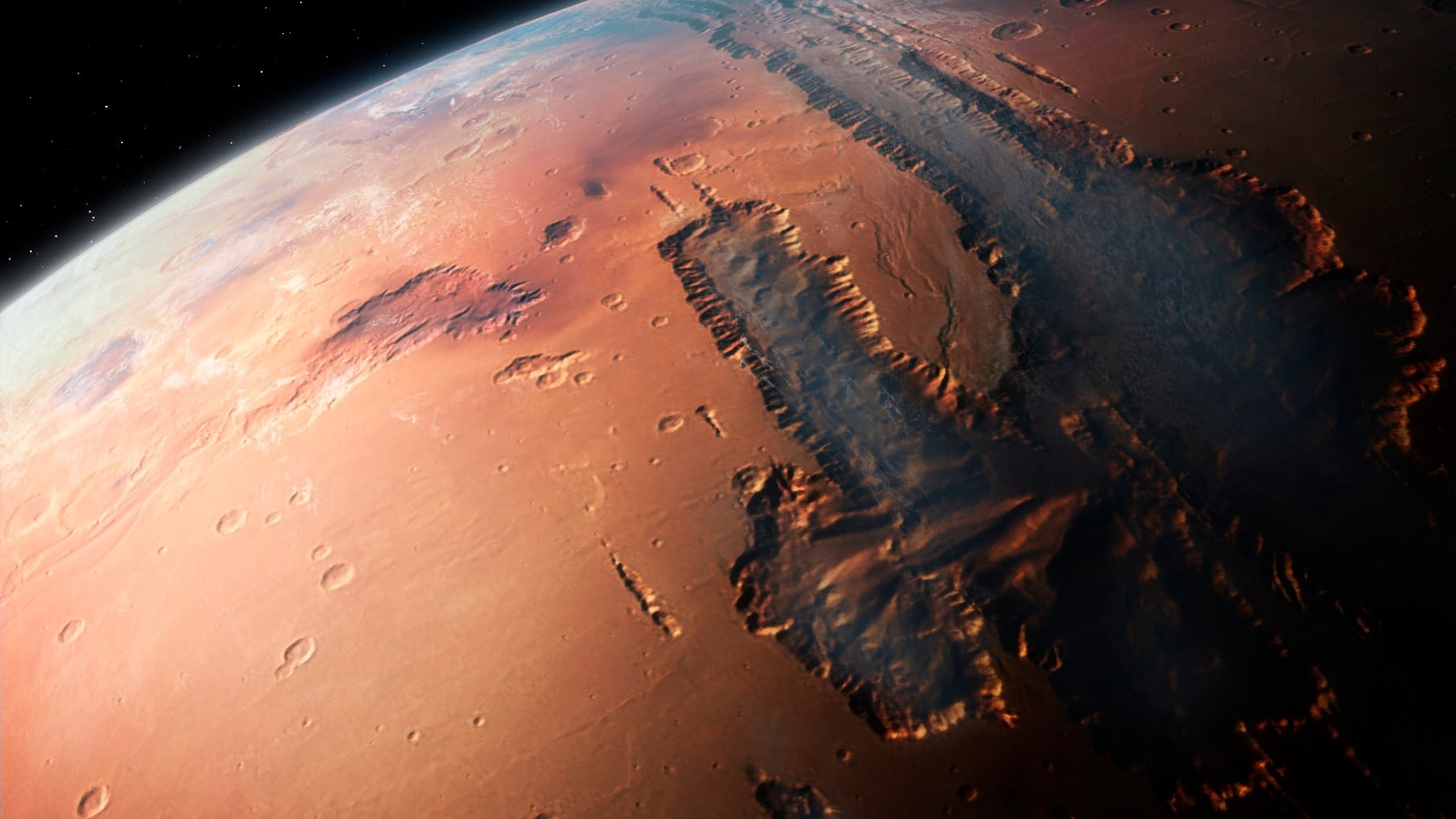
Marthathe so-called “red planet” is NASA’s next “goal” and the comparison between today’s images and those from the 1970s is confusing. In 1976, NASA’s Viking spacecraft photographed a “dark shadow” on the reddish surface of Mars; in 2024, the image of German HRSC Mars cameraplaced aboard ESA’s Mars Express spacecraft captured the same region in 2024, and you can clearly see the shadow spreading. According to German Aerospace Center (DLR) This “shadow” may consist of deposits of volcanic ash and sand, which are composed mainly of dark minerals such as olivine and pyroxene.
Mars is known for its volcanic past; in fact, the planet is home to the largest volcano in the solar system. He Olympus Mons Its height is about 22 kilometers, which makes it much larger than the largest volcano on Earth (Mauna Loa in Hawaii, height 4170 meters). According to the latest research, there are no active volcanoes on Mars today, but there are signs that the red planet is not completely geologically “dead”.
A dark “shadow” that spreads across Mars
In 2024 A high-resolution stereo camera of the Mars Express probefrom the European Space Agency (ESA), recorded a scene in which the Martian terrain appears to be split into two very different parts. On the one hand, there are light sands characteristic of the red planet; on the other, a dark area that spreads out as if it were a moving spot on the surface. This color variation has a known explanation: the presence of mafic minerals such as olivine and pyroxene, which form at high temperatures and are directly related to the intense volcanic activity of Mars in the past.
The most interesting thing for scientists is not the existence of this ash, but its apparent displacement. The first pictures of this region, taken in 1976 by the Viking probes, already showed a landscape different from the present one. Since then, the dark zone has gradually expanded over just a few decades. According to data collected by Live Science, some sectors of the southern rim have advanced up to 320 kilometers, equivalent to about 6.5 kilometers per year.
The origin of the phenomenon has not yet been clarified. The main hypothesis points to Action of the Martian windcapable of mobilizing small particles and redistributing them over large areas. However, there is also the possibility that the wind removes the lighter layer of dust, exposing the darker materials that already existed underneath.
The region where this phenomenon is observed is Utopia Planitia, a huge basin of approx. With a diameter of 3300 kilometers, it is located in the northern hemisphere of Mars. Its length is so great that it exceeds such deserts as the Sahara in length from north to south. Various studies show that there may have been a large ocean here in the past.
Mars Express captured a blanket of dark ash creeping across the Red Planet.
It spread over hundreds of kilometers in less than 50 years.
1/4 pic.twitter.com/vxz8cIvsGM
– ESA Science (@esascience) April 15, 2026
Organic molecules on the “red planet”
On the other hand, at the end of April 2026, NASA announced the discovery of seven organic molecules on the “red planet”. The rock specimen, named “Mary Anning 3” after the pioneering English paleontologist, comes from Mount Sharp, an area that once contained lakes and streams. Cycles of humidity contributed to the formation of clays capable of retaining organic compounds. Among them stands out the nitrogenous heterocycle, a molecular structure with nitrogen, which is considered key as a precursor to RNA and DNA.
“This finding is extremely important because these structures may be chemical precursors to more complex nitrogen-containing molecules,” said lead author Amy Williams of the University of Florida in Gainesville. “Nitrogen heterocycles have never before been found on the surface of Mars and have not been confirmed in Martian meteorites.”
“After years of laboratory work, the results are now in: a rock drilled and analyzed by NASA’s Curiosity rover in 2020 contains the most diverse collection of organic molecules ever found on the red planet. Of the 21 carbon-containing molecules identified in the sample, seven were first detected on Mars.
Scientists can’t know whether these organic molecules were created by biological or geological processes—both possibilities are viable—but their discovery once again confirms that ancient Mars needed the chemistry to support life. “What’s more, these molecules join a growing list of compounds known to persist in rocks even after billions of years of exposure to radiation, which can destroy these molecules over time.”