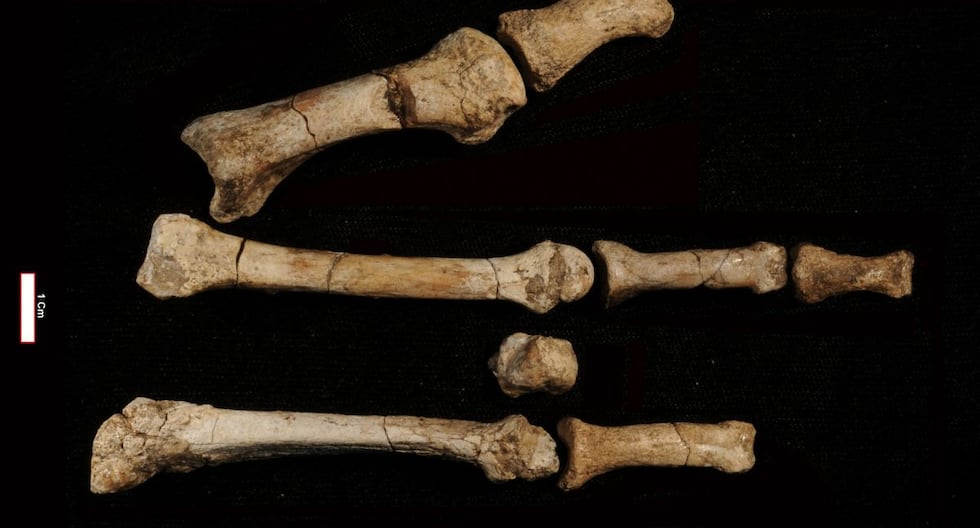
The mysterious foot fossilization found in Ethiopia testifies to the existence of a hitherto little-known human ancestor, a contemporary of the famous Lucy species.
MIRA: According to the study, the first kiss could date back 21 million years
Until now, Lucy’s species, Australopithecus afarensis, was thought to be the only human ancestor that lived in the region more than three million years ago.
However, this 2009 discovery in Burtela, northeastern Ethiopia, may even call into question Lucy’s status as a direct ancestor of “Homo sapiens,” according to a scientific study published Wednesday in the journal Nature.
The foot found does not belong to Lucy’s species, as she has an opposable toe similar to a big toe, which allows her to cling to tree branches like monkeys.
Scientists who discovered the bones of this limb in 2015 concluded the existence of a previously unknown hominid species, “Australopithecus deiiremeda”based on approximately 3.4 million year old jaws also found at Burtel.
Until now, the team could not say with certainty that the bones of this “Bourtele foot” belonged to this new species.
But in this study, published in Nature, scientists announce that new fossils, including a jaw with 12 teeth, found at the site, indicate that the foot was from “Australopithecus deyiremeda”.
“We have no doubt that Burtele’s foot belongs to the same species as these teeth and this jaw,” study lead author Johannes Haile-Selassie of the University of Arizona told AFP.
Ancestor of Homo sapiens?
Researchers have found new evidence of a link between this species and Homo sapiens.
This is evidenced by a scan of exposed teeth “Australopithecus deyiremeda” was more primitive than its relative Lucyaccording to the study. Their diet consisted mainly of leaves, fruits and nuts from trees.
Its prehensile thumb also suggests that this relative of Homo sapiens spent more time in trees.
These fingers played an important role in human evolution, for they testify that the man came out from behind the trees and began to walk with two legs.
The possible coexistence between “Australopithecus deyiremeda” and Lucy’s species continues to be a matter of debate among scientists.
New research shows that Australopithecus deyiremeda spent time in the forest, often in trees, while Australopithecus afarensis, like Lucy, was more on the ground, a difference that allowed them to coexist, researchers say.
This shows that “coexistence is deeply rooted in our origins,” notes Haile Selassie.
In search of roots
John McNab, an archaeologist specializing in the Paleolithic at the University of Southampton, welcomed the new research.
“There will always be skeptics, but I believe that these new findings, along with confirmation of previous ones, will help many researchers to better accept ‘Australopithecus deyiremeda,'” said the scientist, who was not involved in the Nature study.
This “adds a new element to the equation” in the search for the identity of our true ancestor, he says.
Lucy’s appearance remains the most important ancestor because her foot is closer to that of a humancompared to the more primitive “Australopithecus deyiremeda”, the two scientists admit.
But the discovery “raises the possibility that we may still find other species dating back to this period, as Australopithecines seem to have experimented with bipeds,” insists Haile-Selassie.
For a long time, Lucy, discovered in 1974, was considered the oldest human ancestor, but in 1994 she was dethroned by Ardi, a female “Ardipithecus ramidus” who lived 4.5 million years ago also in what is now Ethiopia.