For more than ten years, ChromeOS was a familiar presence in personal computing. Although it managed to gain a foothold in the education sector and the budget laptop market, it never posed a real threat to the hegemony of macOS and Windows in the mid- and high-end ranges. The reason was not the lack of competent hardware, but the software – the operating system, which, despite its merits, did not meet the powerful functionality and versatility required by advanced users. Google seems to be working on a replacement for Android: AluminumOS.
The above has led to rumors of a hypothetical ChromeOS replacement for Android. And what started as speculation: Google has revealed its own intentions during this year’s Snapdragon Summit. In addition, thanks to the corporate letter in the form of a job offer, is now available much more detailed information about what users can expect from this new incarnation of Android for the desktop.
What is known about AluminumOS
The information we’ve shown comes from a job offer for the position of Senior Product Manager for Android, Laptops and Tablets. Despite the fact that the vacancy appeared a couple of months ago and is no longer accepting new applications, then description positions confirmed that the Android desktop project is internally called Aluminum.
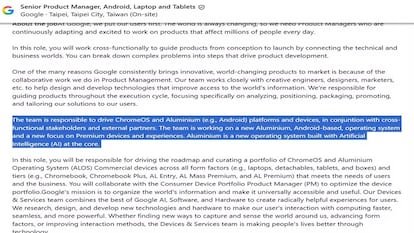
It is interesting that the Mountain View company chose the British spelling (Aluminium instead of the American Aluminum) for the code name of the project. While this may just be a linguistic quip, the job ad clearly mentions that this a new operating system built with artificial intelligence as the central core. This goal is not unique in this field, as Microsoft is moving towards the same horizon as Windows.
The job description does not specify an exact date when this occurs based on android will be widely available for desktop PCs, but it sheds light on the company’s long-term plan with the new AluminumOS. According to the listing, Google intends to eventually replace ChromeOS with this new system, but it plans to do so without disrupting business workflows.
Some important additional details
Although Google hasn’t made any official announcements regarding general availability, everything points to this being the next desktop operating system will not be compatible with all existing Chromebooks. If this scenario is confirmed, these unsupported devices should continue to receive security updates until their particular version of ChromeOS reaches the end of this new system.
It is noted that this development seems to be designed to take advantage of the new wave ARM processors coming to the PC market, such as the Snapdragon X Elite, which will allow Google to finally combine development efforts. This means that improvements to the Android core will directly benefit the desktop, and vice versa, eliminating the need for patches or virtual containers to run mobile apps on computers. In addition, the integration of artificial intelligence into the core of the system, as the project name and job description suggests, means that functions such as Twins They will not be simple additional programs, but will be part of the structure of the operating system.
The question everyone is asking is when we will be able to see this system in action. While Google hasn’t given an exact launch date, as you might expect, during this year’s Snapdragon Summit, Sameer Samath, head of Google’s Android ecosystem, confirmed that the new Android-based desktop operating system will available in 2026. This period of time gives the company enough leeway to polish the interface, ensure compatibility with the vast ecosystem of Android apps and, very importantly, convince developers to adapt their apps to big screen formats once and for all.