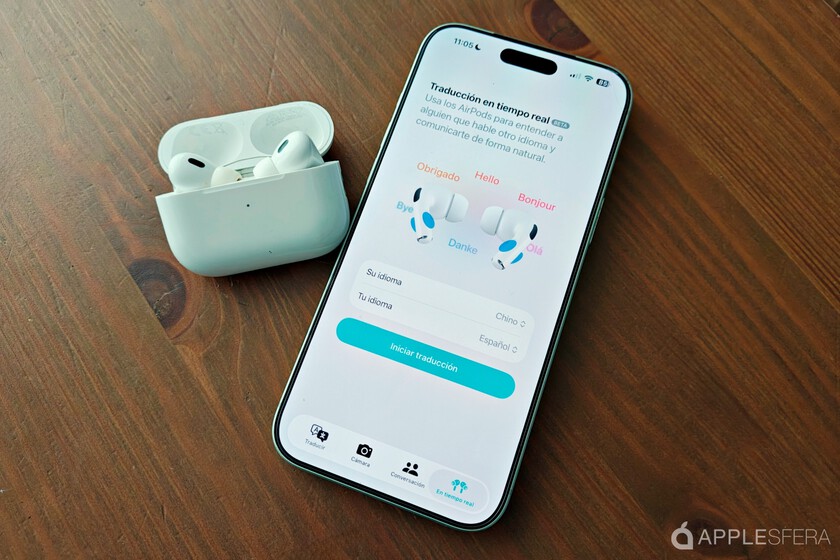
Traveling abroad and communicating with AirPods is the most typical and obvious use of the new real-time translation feature that debuted in iOS 26.2. And I, not expecting a trip outside of Spain, resigned myself to not being able to use this feature. Until I remembered it there are many other uses than it seems.
In the week since the update came out, I’ve done almost everything, and most of the time from the comfort of my home. And although it must be said that the translation is still not perfectI find it more useful than I thought.
A translation that can even be used to watch TV series
The first use that came to mind, and one that I may resort to in the future, is typical of a tech journalist and geek: see Apple’s keynote. Be careful, though, because AirPods don’t translate video that’s playing locally on the iPhone itself, but rather it has to be played from an external source. In this case, from my Mac’s speakers.
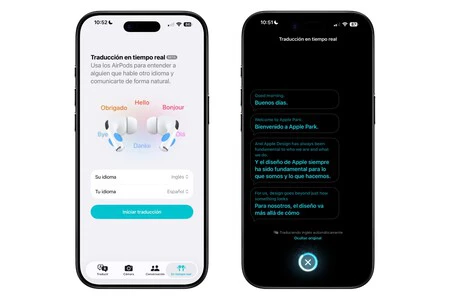
I was blown away by Tim Cook’s first and classic Good Morning, starting with the translation has very little latency. It’s not immediate, and actually there I saw that it can be varied to make it more natural. If what is said is a short phrase, and then there is a moment of transition to something else without anyone, then it translates almost instantly. But if it’s a somewhat longer speech, it’s like the system waits a bit longer to get more text to translate, and runs it often.
And since English is the universal language and the one in which Apple specializes the most, I wanted to test it with Chinese. And, besides, the non-native Chinese of my boss, Maria Gonzalez, who has been studying it for several years. At the last Xataka Awards, presenting the Legend of Xataka to Stella Lee, Maria was asked to start a conversation with Stella in Chinese, and I, who was in the theater at the time, did not understand a word.
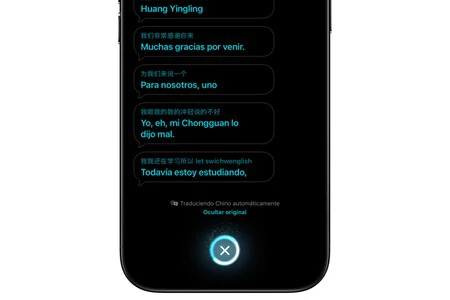
Now from home and with the translation function of AirPods, I put a video on the TV. The test turned out to be a bit of a disaster as there were too many words that didn’t make sense, but ended up being understandable thanks to the context. And it’s in such a special language, with a feature in beta and a non-native speaking the language, I was very surprised. And for the better. Although it shows that it is not perfect.

Authentic I was doing the fire test in Germanthe language you pull me out of Good morning and I’m already lost. A friend at the gym is German and although we usually speak Spanish, I wanted to do a test with him. Taking advantage of the fact that I had a compatible iPhone and AirPods, I asked each of us to speak our native language into the headphones.
The moment was somewhat dystopian, because despite the fact that it is the technology of the present and the future, it seemed strange. But for functional purposes, the result was excellent. I spoke Spanish, he spoke German, and each of us listened to the other speaking in his native language. It was a very interesting conversation about gastronomy and sports. Although I’m more of a tortilla and Madrid fan and he’s a German style fan and a Eintracht Frankfurt fan.
But the function is still not perfect
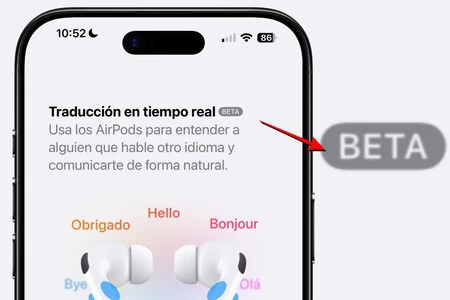
Although iOS 26.2 is already a public version for everyone, the translator function it’s still in betaas it appears in Translate. Overall it works very well and I think it’s pretty advanced, but being in beta is still reason enough to forgive certain issues that may arise. But there is, there is.
The first of them I have already mentioned before, though in passing. And that’s it There are still words that don’t translate very well.either because of pronunciation or speed, or because the word may have another similar word that confuses them.
Sometimes the problem is the other way around It literally translates the word, but it doesn’t have much context in Spanish. An example that caught my attention was “Eventually the company went bankrupt”, the most correct translation would be “Con el tiempo, la cuerpo quebrobro”. However, AirPods translated that to me as “Eventually the company went bankrupt.”
It’s true that “After all” is a literal translation of “Eventually”, but in this particular context the translation didn’t make much sense. And it also happened to me with my other expressions that sounded strangely Spanish.
The solution I envision is to introduce a language model that is able to translate conversations as literally as possible, but adapting certain terms and expressions from another language to sound appropriate in our own.
Also, and this is inevitable, even if the translation was perfect and instant, when it’s used with another person, one can’t help but feel kind of stupid. Maybe this is a personal assessment, but while I understand that the ultimate goal is to understand each other, in the end it’s about adding an artificial layer to something as natural as a conversation. But like all technological advances, I’m convinced it’s only a matter of time before it’s adapted and integrated so that it ends up being natural. And this feature is promising.
In Applesfera | Upgrade Your AirPods: A Step-by-Step Guide to Upgrading Your AirPods (2025)
In Applesfera | The new AirPods 5 are everything we think we know about Apple’s next headphones