
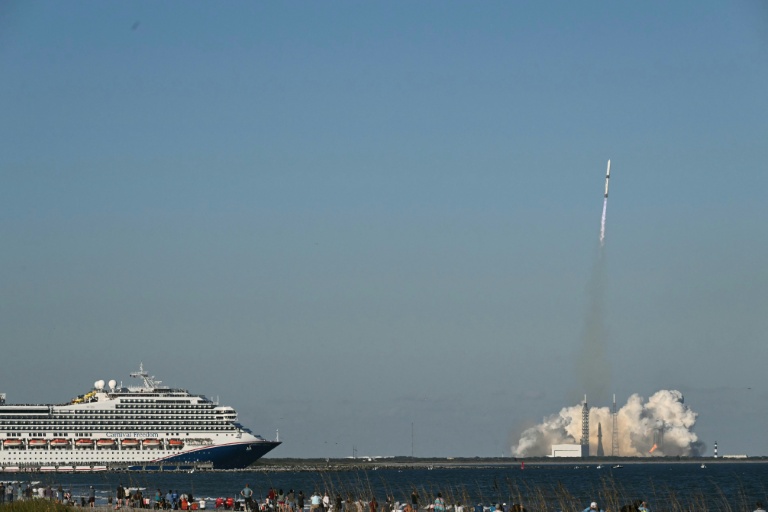
Blue Origin, owned by Amazon founder Jeff Bezos, successfully launched its New Glenn rocket for NASA’s Mars mission on Thursday and successfully recovered its launch vehicle, a major milestone in competition with Elon Musk’s SpaceX.
The launch of the powerful 98-meter-tall rocket had to be postponed twice over the past week: on Sunday due to bad weather on Earth, and on Wednesday due to unfavorable space weather conditions. But the wait was worth it.
“This is a historic day for Blue Origin,” Blue Origin Vice President Arianna Cornell said during a live webcast.
New Glenn took off from Cape Canaveral, Florida at 3:55 p.m. local time (20:55 GMT) with two NASA probes docked. Soon after, the company managed to land the propeller in a controlled manner on the platform in the sea to the applause and cheers of the employees.
Until then, only SpaceX managed to perform such a maneuver with an orbital-class rocket.
Blue Origin’s feat comes amid a growing rivalry between the two private space companies.
“Wow, that was fantastic!” Jared Isaacman, a close ally of Musk who was tapped by President Donald Trump to lead NASA, called out X as he congratulated Blue Origin.
Several SpaceX employees even praised their competitors. “Taking down an orbital missile is extremely difficult. Well done!” John Edwards, head of Falcon rocket launches, wrote in X.
“Congratulations to Jeff Bezos and the Blue Origin team!” Musk said on the same platform.
New Glenn’s first flight in January was also successful, with its payload reaching orbit and completing all tests. However, its fuel, which was supposed to be reusable, was lost during the descent.
With such success, Bezos, who wants to catch up with Musk, can accelerate the pace of his startups and reduce costs.
Both billionaires founded their space companies in the early 2000s, but Blue Origin has grown much more slowly than SpaceX, largely because of a more cautious technical approach.
Bezos is now looking to demonstrate that he is a serious contender, especially in the context of the growing competition surrounding NASA’s Artemis moon program.
NASA, which plans to send Americans back to the moon in the coming years, raised the possibility of cutting SpaceX, the industry leader, in October due to delays.
The news drew the ire of Tesla’s CEO and could benefit Bezos, who is also developing a lunar lander for NASA’s planned next mission.
In this context, the performance of the New Glenn rocket, which launched NASA’s Escapade science mission to Mars on Thursday, has been the subject of intense scrutiny.
If Blue Origin “successfully completes this mission, it will give NASA confidence,” George Nield, president of the company, which promotes private space activities, told AFP ahead of the launch.
Since Trump’s return to the White House, the US government has put considerable pressure on NASA to speed up its lunar program, which has suffered many complications and delays in recent years.
Sean Duffy, NASA’s acting administrator, has even spoken of a “second space race” between Washington and Beijing that also aims to reach the moon by 2030, following in the footsteps of the one between the US and the Soviet Union during the Cold War.
With the Artemis program, the Americans aim to establish a permanent human presence on the moon and prepare the ground for future missions to Mars. The probes launched by NASA on Thursday are expected to play a fundamental role in this project to better understand the red planet.
The Blue and Gold probes will be placed in a “safe parking” orbit to stay close to Earth and wait for the optimal moment to depart for Mars, where they are expected to arrive in 2027, NASA scientist Joseph Westlake explained Thursday.
(tagsToToTranslates)eeuu


