
Look! To the sky! Is it a bird? Is this a plane? no… This is Comet 3I/ATLASthe protagonist of the Earth’s public debate, despite the fact that it is approximately 300 million kilometers from our planet. The comet discovered this summer is not part of the solar system because its speed does not match the speed of objects orbiting the sun. Michael Coopers, an astrophysicist from the European Space Agency (ESA), talks to this medium to clarify the nature of the comet and explain why the space agencies launched the surveillance program track only 3I/ATLAS.
Q: What is 3I/ATLAS?
Answer: It is a comet that comes from another star system, it originates from another star. This is the third one we discovered. The first, 1I/ʻOumuamua, looked more like an asteroid, and the second, 2I/Barysov, looked more like ATLAS.
Q: What is the difference between a comet and an asteroid?
A: A comet, in this case ATLAS, formed outside of our system and moves on an elliptical, sometimes parabolic path and is a mixture of ice and dust that, as it approaches the Sun, evaporates the ice and forms a tail that always points in the opposite direction from the Sun due to the influence of the solar wind. An asteroid is an inert object, and most are found in the asteroid belt between Mars and Jupiter in more or less circular orbits.
Q: How is ATLAS different from the other two interstellar objects found?
A: It is an active comet, unlike Oumuamua, for which we have never directly detected any activity. Compared to Borisov, it is more similar, it is closer to the Sun, it is more active and we have more opportunities to study it; but it arrives with a greater speed and an eccentricity of 6, which means that it travels almost in a straight line. The interpretation of this is that it has been in space for a long time, that ATLAS is very old and that it has traveled for billions of years, the age of the solar system. These types of comets are a unique opportunity to closely study the conditions of other systems.
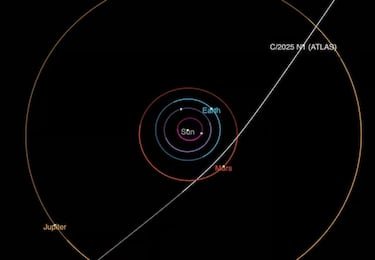
Q: When you entered perihelion, you had an amazing acceleration. How to explain it?
A: It has to do with the force of the reaction to the gases and dust coming out of the comet.
— Solar heat sublimates ice in the core (ice changes from a solid state to a gaseous state). The gas is released through cracks or jets from the surface. Each jet of gas exits in a specific direction, pushing the nucleus in the opposite direction, according to the principle of action and reaction—
Question: Why then is there so much interest in the comet?
A: Omuamua also generated a lot of interest because it was the first. The second brought a little less, perhaps because it coincided with the pandemic. But it’s something unique that we don’t see often, and that’s why there’s a lot of scientific and popular interest.
Q: Can it be learned through observation alone?
A: Yes, the only way to learn is by observation, usually from Earth. When Atlas passes perihelion close to Earth, we can see them from satellites such as ESA’s JUICE, which is on its way to Jupiter and is in a good position to observe ATLAS around perihelion.
Q: An observational campaign was activated solely to study this comet. Is this something common?
Answer: Yes, the International Asteroid Warning Network (IAWN), a UN organization led by NASA, has already conducted several campaigns aimed at protecting the planet from asteroids that are going to collide with Earth at some point. They conduct observational campaigns to predict the trajectory of objects.
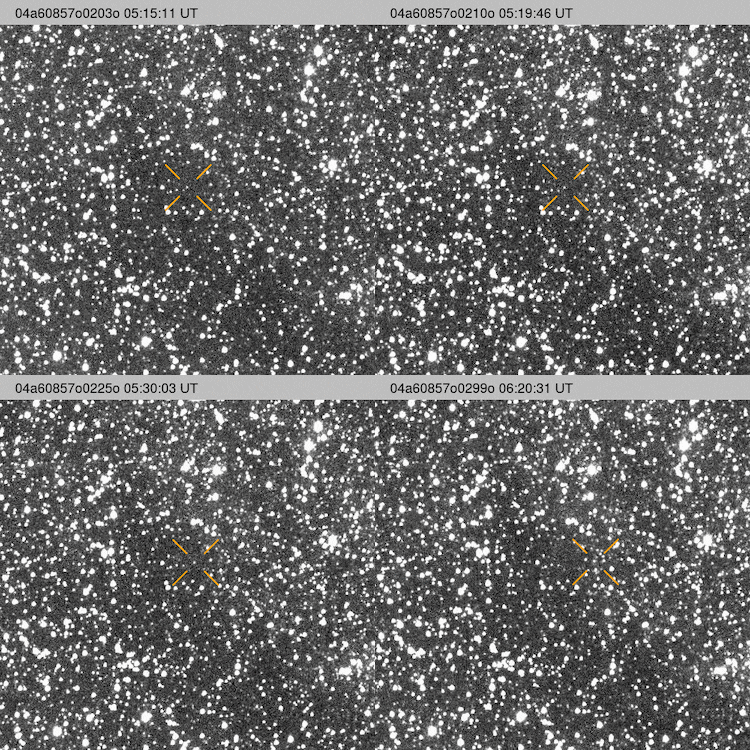
Question: Space agencies already knew that the comet did not pose a threat to Earth. Why then do they activate this surveillance campaign?
A: We know it’s not dangerous, and no planetary defense protocol has been activated, as was done with IR4, which had a 2% or 3% chance of hitting Earth. No protocol has been activated with ATLAS, just an observation campaign, because one day a comet may collide, and we are trying to work out that scenario, determine the trajectory as quickly as possible and see how accurate that data can be.
Q: What is expected of the surveillance campaign?
A: Get as much information as you can about its composition, size, and possibly physical characteristics. We are studying a fragment of how another system, ours, the solar system, was formed, the planets were formed through small bodies such as asteroids and comets, and the ones we see today are those that survived this stage of formation and did not remain attached to any planet. With comets like Atlas, we can see the same thing, but from other systems.
Q: Will we get better images with better resolution?
A: Something like that, now that it’s passing through perihelion, there won’t be enough resolution to resolve the core. But yes, we will get more information after the surveillance campaign. And now, too, when it comes out of perihelion.
“After the surveillance campaign, we will have more information”
Michael Kupers
Q: Has science become concerned with any discovery of a near-Earth object?
A: Sometimes asteroids are discovered that have a certain probability of hitting Earth, but I don’t think we’ve ever been seriously worried. For example, last year with IR4 the probability was no more than 2%. 20 years ago, the asteroid Apophis appeared, which will fly by the Earth, only 30 thousand kilometers away, approximately in 2029. When it was discovered, there was also some possibility of a collision, but a couple of days later, preliminary observations were found that showed it was not going to collide. But I don’t remember any serious concerns.
Q: In an interview, you said that if we ever found signs of extraterrestrial life, it would never be on a comet.
A: This is true because life cannot survive on a comet. Perhaps one day we will find microscopic life, or we may be able to connect with intelligent life around other stars. But I can’t imagine life coming to Earth on a comet.
Q: Why are there scientists who claim that 3I/ATLAS is alien technology?
A: It’s hard to answer that, these things seem very contrived to me, because if we take the observations, it’s a normal comet, even if it has different components, something that could be normal because it comes from another system. This is an ordinary comet, I see no basis for these theories. There is little here, perhaps there is a motivation to make a PR.
Q: Is it normal for a comet to have a lot of nickel like Atlas?
A: In general, from what we know about the composition, it is not very different from other comets in the solar system, but it stands out because it is rich in nickel, which is probably related to the components that were in the system where it formed.
Q: Is there any estimate of where the comet came from?
A: There is a certain idea because of his age, we think he comes from a certain region of the Milky Way, but we can’t say exactly where he comes from because he has spent a lot of time traveling in space. It is generally proven to have come from a star relatively close to the Sun. If it doesn’t, it’s almost impossible to know where it came from. It is many years and a long distance.
Q: What other programs are there for studying comets?
Related news
A: ESA is going to launch the Comet Interceptor mission in 2028 or 2029, which will be the first time we will be able to see a comet in the Solar System up close or even from outside an interstellar object. First you need to open the comet. The satellite is headed to the L2 point of the Lagrangian point, in a stable orbit, and when we detect the comet, it leaves the L2 point and goes towards the comet.
Your opinion matters! Comment on articles and subscribe to ours for free newsletter and to information notices in Art application or channel WhatsApp. Looking for licensed content? press here