
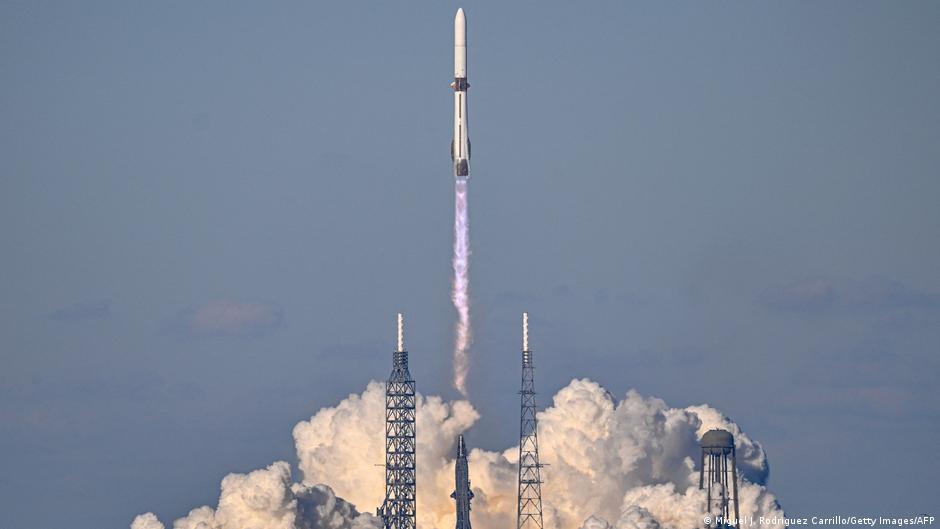
Blue Origin, Jeff Bezos’ company, successfully launched its New Glenn rocket on Thursday (11/13/2025) with two of NASA’s twin spacecraft bound for Mars and achieved a breakthrough by successfully landing its launch vehicle.
The launch was delayed for several days due to weather conditions both on Earth and in space, but the wait was worth it: the second flight of the Blue Origin rocket managed to recover fuel for reuse.
There were cheers at the launch center in Cape Canaveral, Florida, as the launch vehicle gracefully landed on a floating platform. Until Thursday, only Elon Musk’s SpaceX managed to perform such a maneuver with an orbital-class rocket.
Blue Origin’s achievement comes amid an intense rivalry between two private space companies owned by billionaires as the US space agency NASA recently opened a tender for a planned lunar mission.
Some SpaceX officials praised their rivals, including Musk himself: “Congratulations to @JeffBezos and the @BlueOrigin team!” he said in X.
The launch was delayed several times: Sunday for time on Earth and Wednesday for time in space.
Postponed due to solar storm
The second delay was due to “very high solar activity” that NASA said could affect or damage its spacecraft.
In addition, multiple technical glitches caused additional delays on Thursday, delays that Blue Origin did not explain. But at 3:55 p.m. (9:55 p.m. CET), New Glenn finally took off.
The 322-foot (98-meter) rocket is now on a mission to send NASA’s twin ESCAPADE spacecraft to Mars to study the climate history of the Red Planet, with the possible hope that it will be explored by humans.
There was another round of applause as the spacecraft was successfully deployed.
Blue and Gold should reach Mars in 2027
Joseph Westlake, a NASA heliophysicist, explained during a Thursday webcast how the twin spacecraft, named Blue and Gold, will first seek a “good quality, safe parking orbit” to take “space weather measurements here on Earth.”
Then, once the planets reach perfect alignment in the fall of 2026, the spacecraft will receive a push from Earth’s gravity and begin its journey to Mars, arriving in 2027.
This type of launch could allow for more frequent missions in the future, as they can be conducted outside the direct alignment window between Earth and Mars, which occurs roughly once every two years.
jc (afp, efe, reuters, ap)


