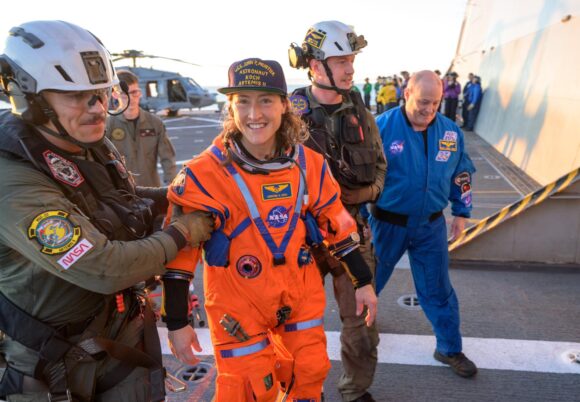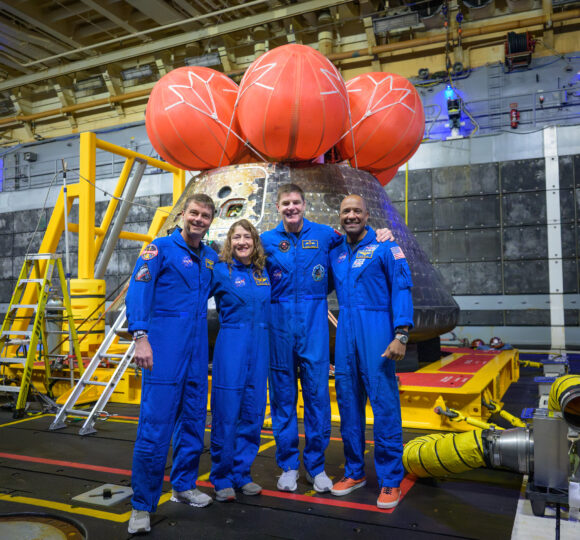
The Artemis II mission successfully ended with the Integrity capsule landing in the Pacific Ocean on April 11, 2026 at 00:07:27 UTC. Reid Wiseman, Victor Glover, Christina Koch, and Jeremy Hansen landed about 70 kilometers off the coast of North America (32.3ºN, 117.8ºW) and were picked up by the personnel of the USS John P. Murtha helicopter carrier. Thus ends the first mission to the moon in the 21st century, with a total duration of 9 days, 1 hour and 32 minutes (developed, however, during the ten days of the mission). Reid Wiseman, Victor Glover, Christina Koch and Jeremy Hansen have traveled a total of 1,117,659 kilometers and are the first humans to fly beyond Earth’s gravitational pull since Apollo 17 in December 1972, and the first humans to fly by the Moon since Apollo 13 in April 1970.
Previously, the return sequence ran without any noticeable problems. At 18:53 UTC, the European Service Module (ESM-2) performed its third return burn, or RTC-3 (Return trajectory correction 3), with a duration of 8 seconds and a Delta-V of only 1.3 m/s, sufficient for the capsule to land in the planned area. In contrast to the original trajectory, where only one of three correction burns was performed, on the return trip the Orion spacecraft performed three planned maneuvers (of which only RTC-3 was mandatory). To do this, the crew re-energized the Orion spacecraft’s control panel, and once complete, the four astronauts proceeded to assemble the cabin to set it up for entry and landing. The Orion system was then updated with TLC trajectory data (Target landing trajectory).
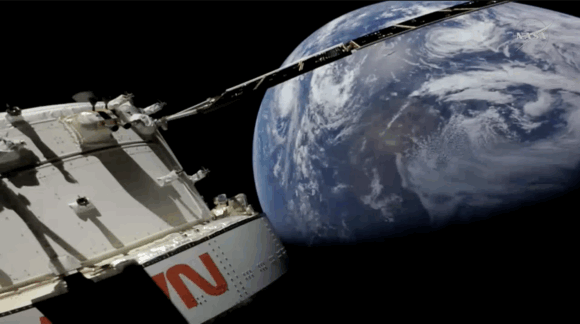
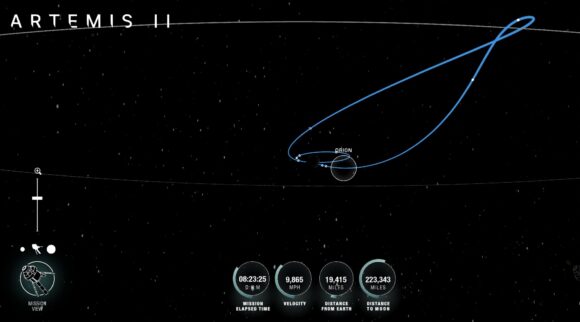
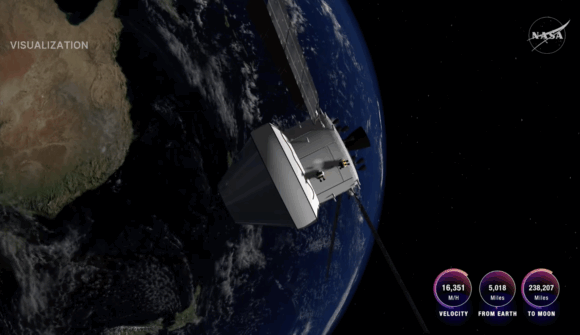
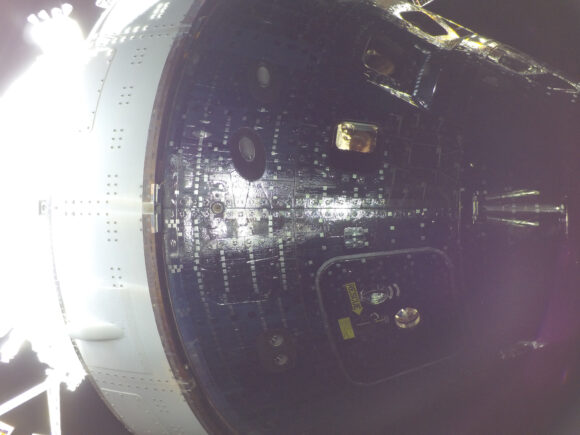
Three hours before docking, the craft was still 44,000 kilometers from Earth, but the distance was rapidly shrinking as speed increased. An hour and a half before entry, the crew finished donning their OCSS suits. At 23:33 UTC, with the already huge Earth beyond its windows, the European Service Module ESM-2 separated, disintegrating shortly during its re-entry over the South Pacific Ocean (25ºN, 135ºW). This ended the mission of the ESM-2 service module, which, although successful, was marred by leaks from the valves of the helium oxidizer boost system. A problem that didn’t matter much in the free return mission, but ESA will have to fix on Artemis IV, a mission that will require the ESM to leave lunar orbit. The separation revealed the Integrity heat shield for the first time (at 5.03 meters in diameter, the Orion spacecraft has the largest heat shield ever carried by a capsule).
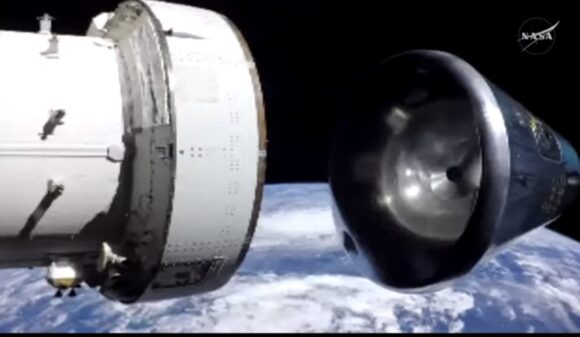
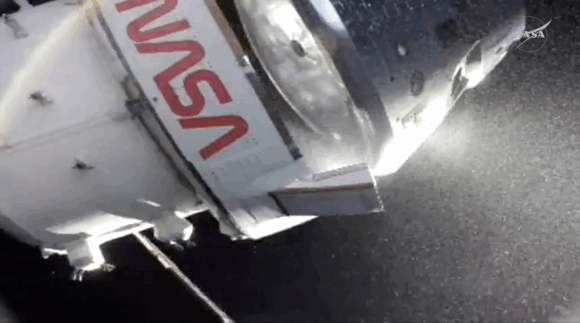
Since separation from ESM-2, all life support systems and electrical power depended on those provided by the capsule or command module CM (Command module). Precisely at 23:37 UTC, the capsule used its thrusters for 19 seconds to adjust its angle of attack for reentry, raising the rear of the craft and increasing its speed by 3 m/s. The Orion CM has MR-104G hydrazine engines rated at 712 newtons of thrust each (the ESM engines are twin engines, while the CM engines are single engines).
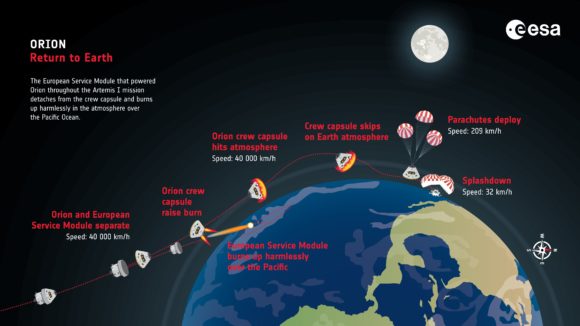
The re-entry profile of Integrity was steeper than that of Artemis I to avoid the excessive wear seen on the first lunar entry of the Orion spacecraft (and the third if we add the EFT-1 mission in 2014, although it entered at a slower speed and with a different heat shield design). As a result, the high-temperature part of the return was shortened from 20 to 13 minutes. Likewise, although technically double entry is still considered –skip re-entry— the two deceleration peaks were not as prominent as in Artemis I. For this mission, about 3.9 g was achieved in each peak. Remember that in a double entry, the ship first hits the atmosphere at near escape velocity, then climbs again a bit, and finally descends at a slower speed. This type of nuanced return has been accomplished by the Apollo missions, the Soviet 7K-L1 Zond spacecraft, the Chinese Chanye 5-T1, Chanye 5, and Chanye 6 lunar missions, and now the Orion spacecraft on Artemis I and II.
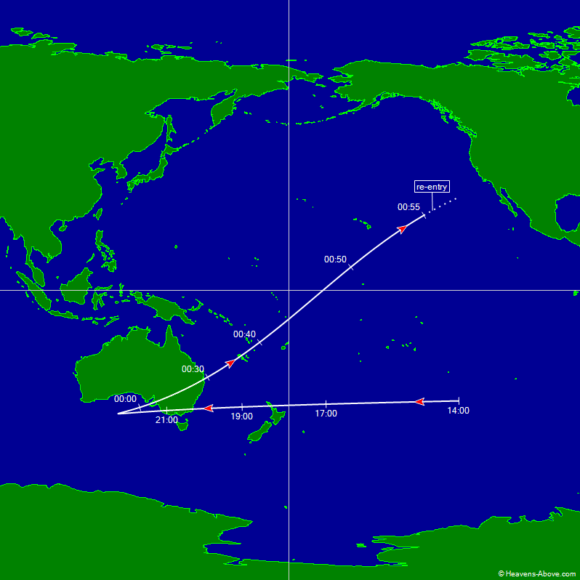
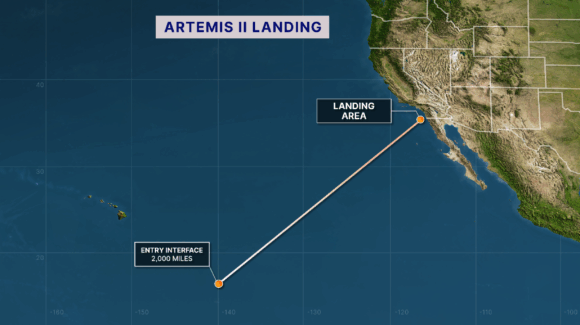
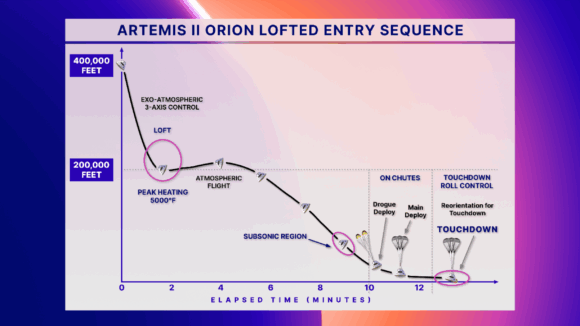
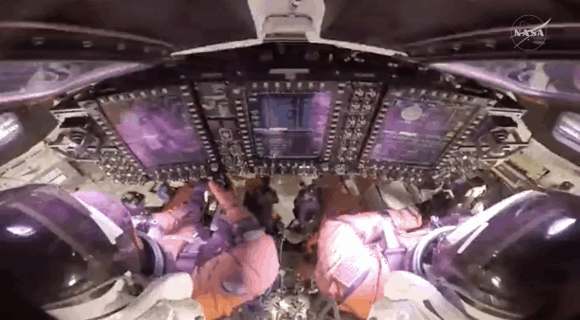
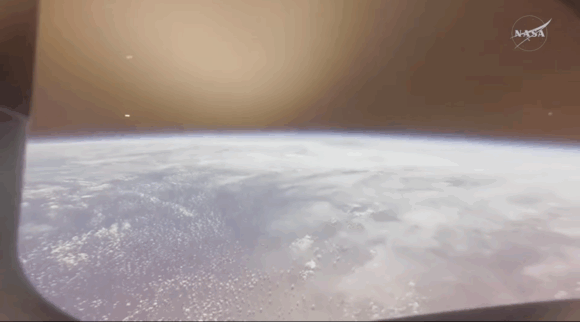
At 23:53 UTC, Integrity officially began its reentry at an altitude of 122 kilometers (when returning at a lower speed from low orbit, the distance to the boundary is 100 kilometers or less). Artemis II re-entered at a speed of 39,688 km/h, so it did not surpass the speed record set by Apollo 10 in 1969 (39,897 km/h), although it did surpass the speed of Artemis I (39,590 km/h). Integrity is the tenth manned spacecraft in history to enter the air at near escape velocity (maximum flight speed was Mach 32). The upside-down astronauts could see the Earth and the plasma forming around the capsule. This plasma will cause the communication to break for about five minutes. Integrity’s reentry trajectory was about 2,400 kilometers, during which the capsule rotated left and right around its main axis to improve the accuracy of the powered descent. The maximum temperature was reached at 23:54 UTC.
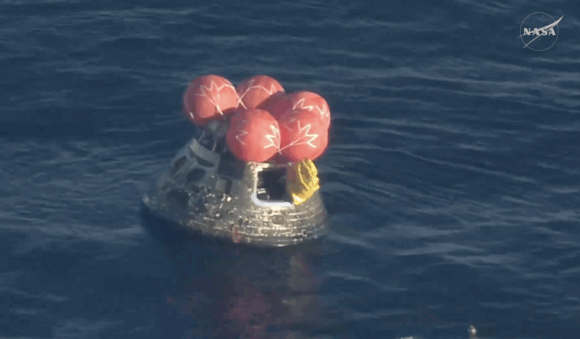
The thermal shield of the “Orion” ship consists of a lower and an upper thermal shield. The lower one, capable of withstanding 2760 ºC, is available formed 186 blocks of Avcoat ablation material (based on the material used in the Apollo spacecraft) attached to a titanium structure (each block has a unique shape). The frontal shield is formed 1,300 silicon dioxide tiles derived from those used in the space shuttle heat shield. The tiles are coated with a layer of aluminum to protect them, a layer that gives the capsule a shiny appearance, but which disappears when returned to the water, hence its dark color in the water. Starting with Artemis III, a different heat shield of more porous material will be used.
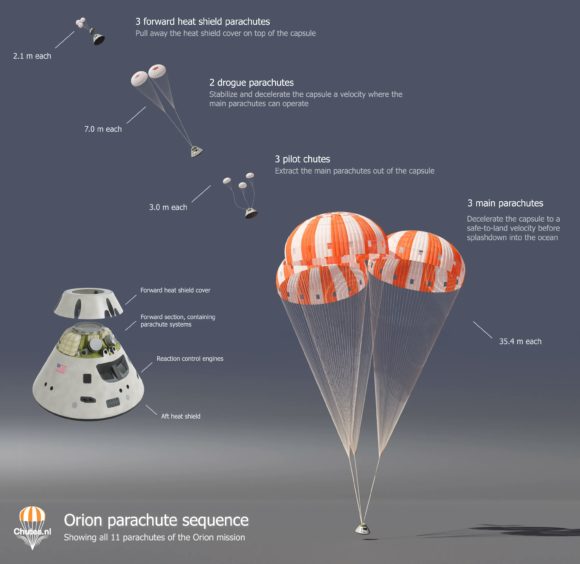
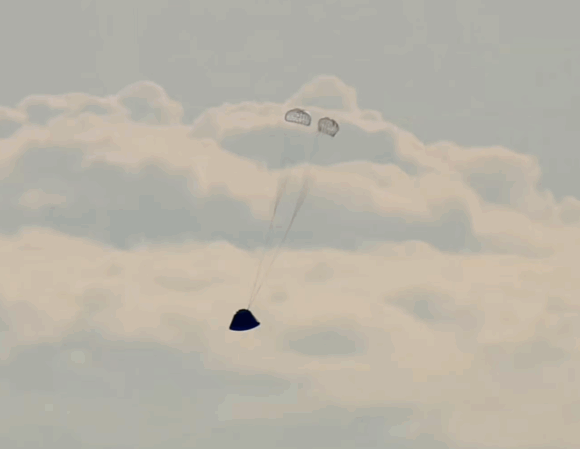
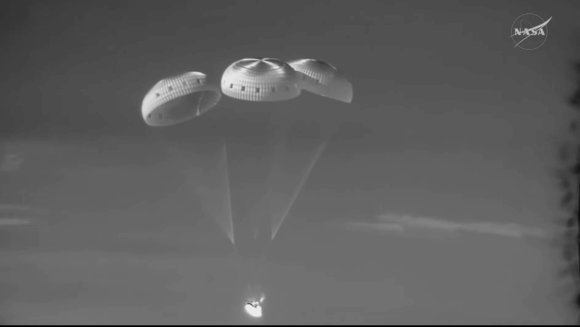
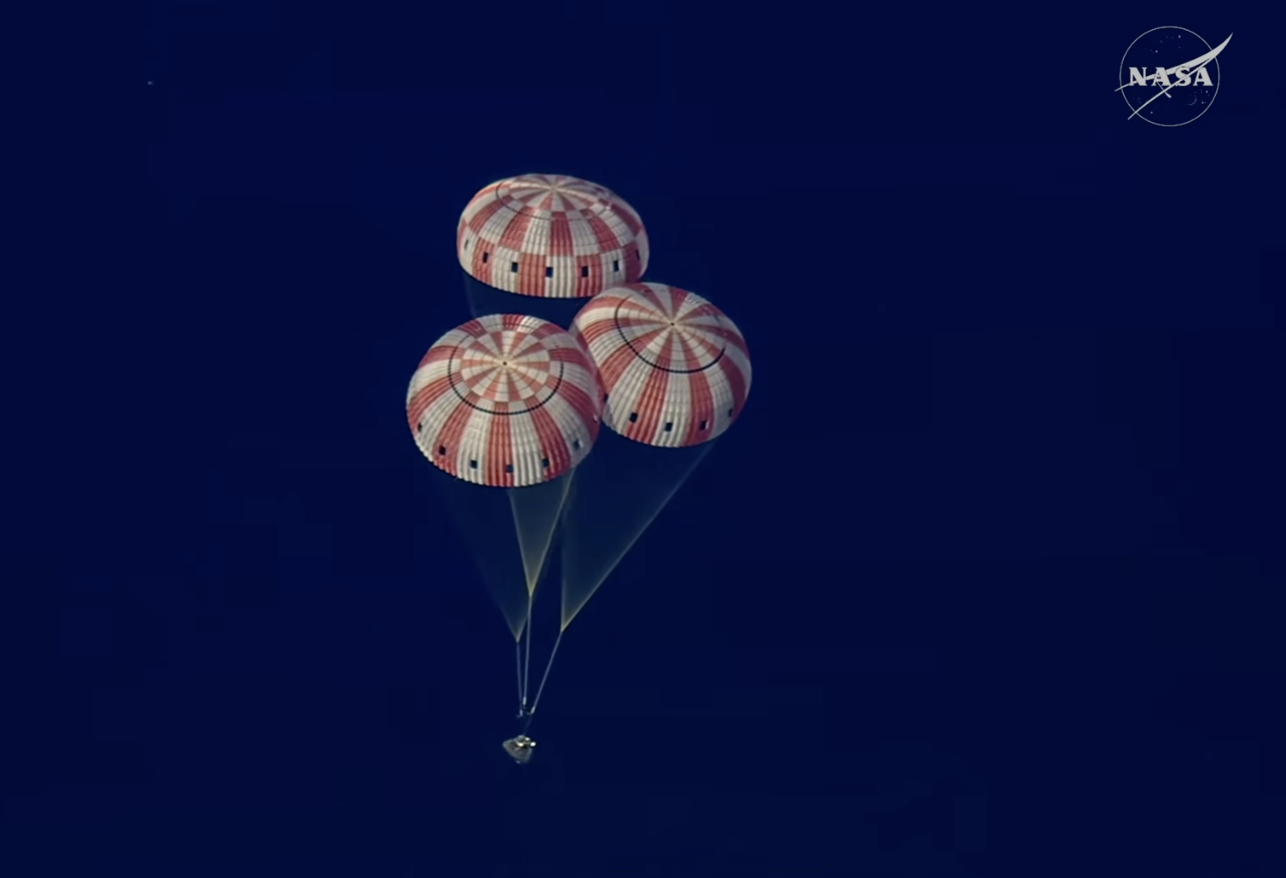
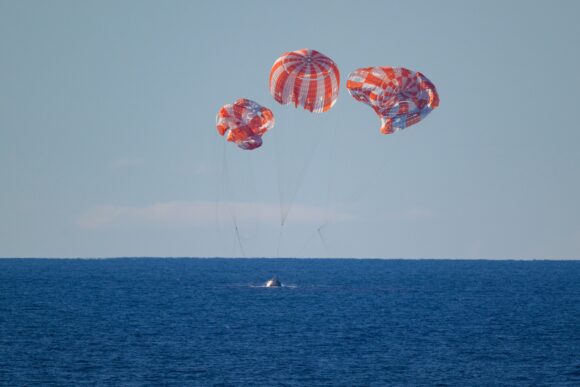
The capsule ejected the forward deck, exposing the top of the ship to begin deploying the parachutes. First, three small parachutes were deployed, separating the parachute covers. At an altitude of 6.7 kilometers at 00:03 UTC, two guide parachutes were deployed, which stabilized the capsule and reduced its speed to less than 220 km/h. Three other pilot parachutes were then deployed, responsible for retrieving the three main parachutes, which opened at 00:04 UTC at an altitude of just 1.8 kilometers (achieving a precision landing, but at the expense of spectators’ nerves). Landing took place at a speed of less than 30 km/h. Each main parachute is made of nylon and Kevlar and has a length of 67 meters, a diameter of 35 meters and a weight of 120 kg. During the descent, hydrazine was purged from the propulsion system to avoid causing problems for the astronauts and rescue teams.
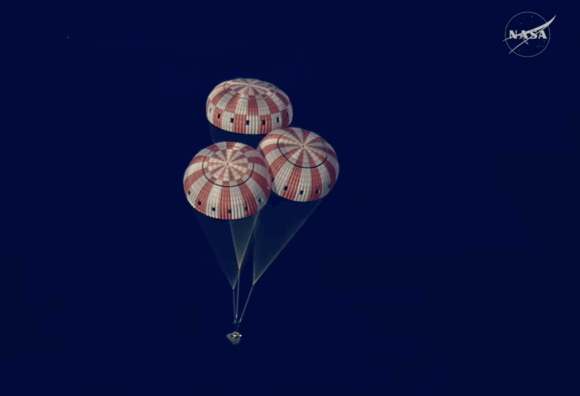
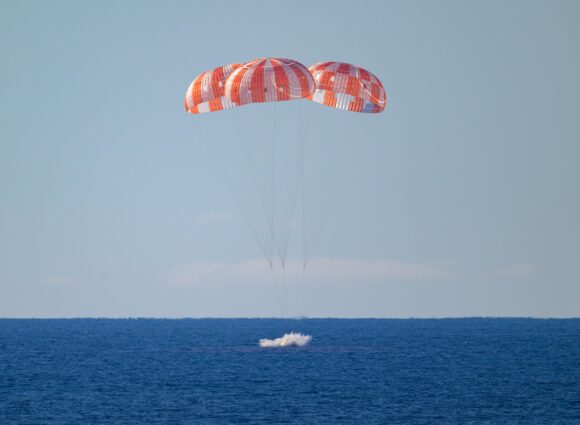
Once in the ocean, the capsule inflated five helium balloons of the CMUS system (Vertical crew system) so that the capsule does not float on its side or upside down. Fortunately, his intervention was not necessary, as the capsule remained in a normal position called stable 1, as in the days of Apollo (and the same as Artemis I). Speedboats carrying military and NASA personnel immediately approached, though they remained at a distance until the crew shut down all of Integrity’s systems, a process that took about fifteen minutes (to avoid accidentally activating any engines).
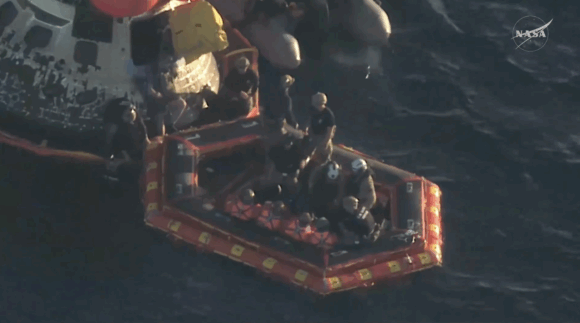
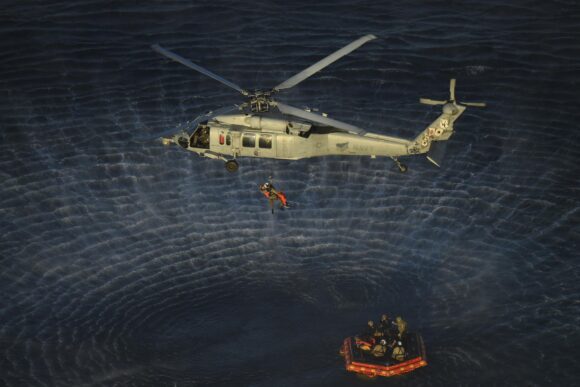
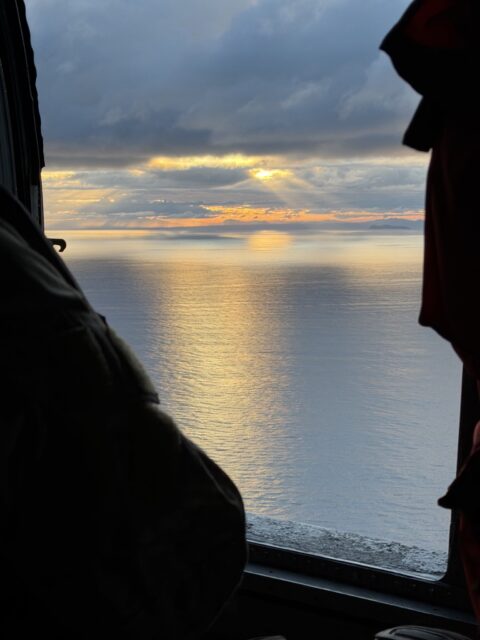
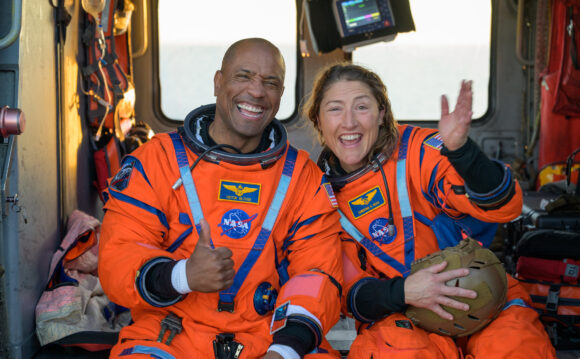
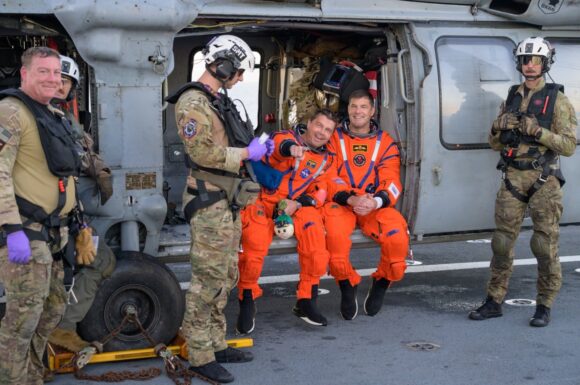
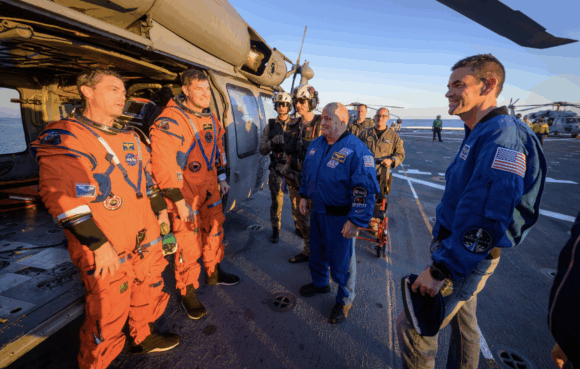
After 50 minutes, a boat approached the capsule and, opening a side hatch, four assistants entered to help the crew get out. Currents delayed US Navy divers from deploying buoyancy around the capsule, which was ready only an hour and ten minutes after landing. After the capsule was secured, the teams approached an inflatable raft called the “front porch” and the crew began to evacuate from the capsule to it (Christina Koch exited first, then Victor Glover and Jeremy Hansen, and finally Commander Reid Wiseman). A raft of four astronauts and US Navy equipment moved away from the capsule to allow the astronauts to lift off in pairs of Sikorsky MH-60 Seahawk helicopters (first Koch and Glover, then Wiseman and Hansen). Helicopters, from HSC-23 (Helicopter Marine Combat Squadron), landed on the deck of the USS John P. Murtha as the crew prepared the capsule for liftoff by the ship. Then the astronauts went to the San Diego Naval Air Station, and from there on a plane to Houston.
With the successful return of Artemis II, doubts about the viability of Orion’s heat shield have been dispelled, although, as we have said, a new design will be used starting with Artemis III (and in any case the condition of the shield will need to be studied in detail). Artemis II has been a total technical and media success for NASA, and undoubtedly brings back a program that has been subject to various criticisms and accumulated numerous delays. Artemis II demonstrated that the SLS rocket and Orion spacecraft were ready. Now the most difficult part of the program remains to be designed, launched and adjusted: the SpaceX and Blue Origin HLS lunar modules, which are still very immature. If NASA wants Artemis IV to land on the moon in 2028, it has a lot of work ahead of it.