image source, NASA
- author, Kathryn Heathwood
- Author Name, BBC World Service
Reading time: 7 min
After traveling further than any human before in history, one of the riskiest parts of Artemis II’s mission is yet to come: returning to Earth.
The Orion capsule is scheduled to land off the coast of San Diego, California around 8:00 p.m. Eastern time on Friday.
“I’ve actually been thinking about going back since April 3, 2023, when we were assigned this mission,” Artemis II pilot Victor Glover recently told reporters from space.
“I haven’t even begun to process everything we’ve been through… and going through the atmosphere riding a fireball is pretty shocking too,” he added.
Preparation
On their last full day in space, the crew prepared for the return to Earth, reviewing reentry and reentry procedures and trying on compression garments that can help prevent vertigo caused by re-entering Earth’s gravity.
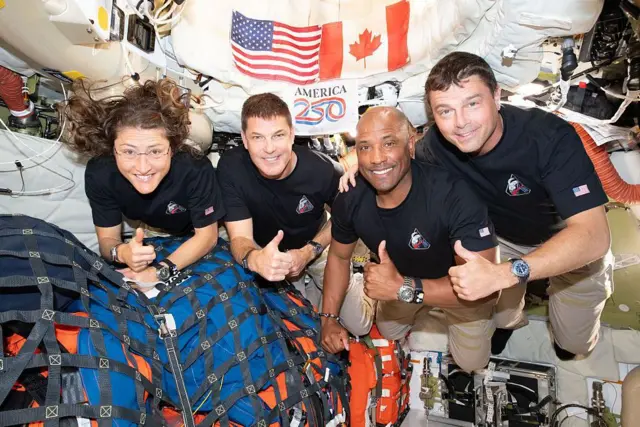
image source, NASA
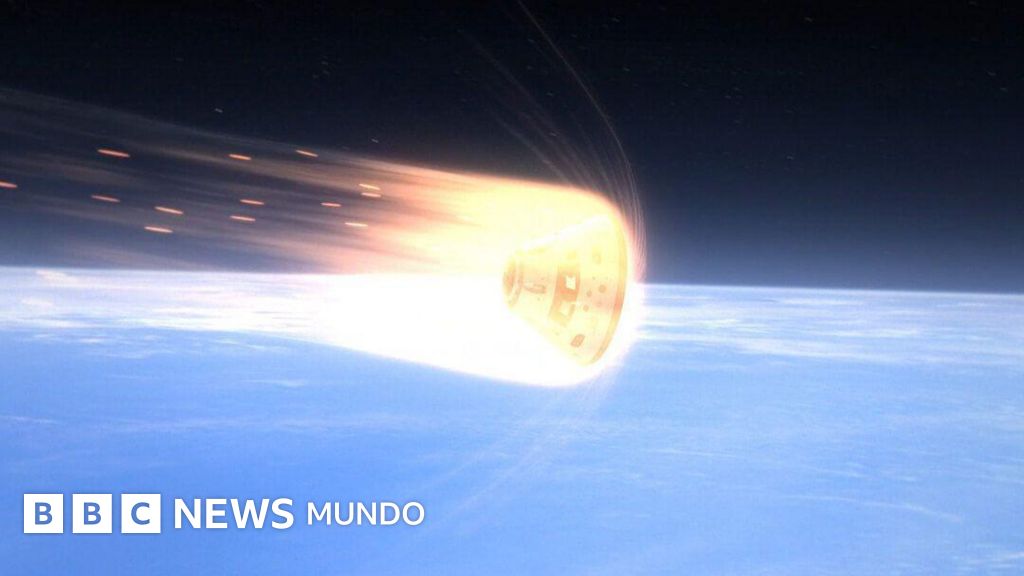
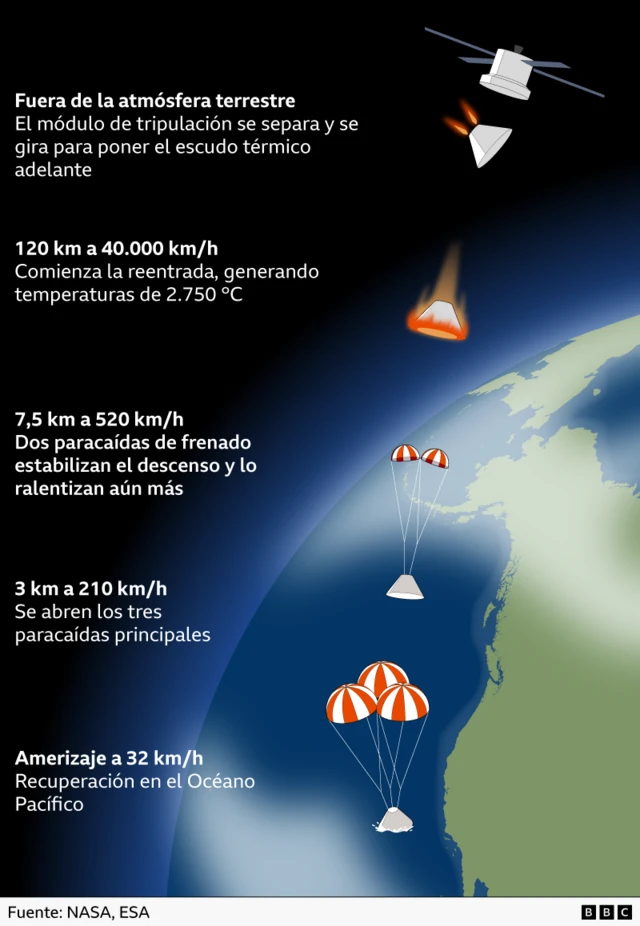
The crew module and service module will separate about 20 minutes before Orion reaches Earth’s upper atmosphere. The manned capsule will rotate so that its heat shield absorbs the effects of high temperatures and keeps the astronauts inside safe.
If necessary, the final trajectory correction maneuver will allow the flight angle to be fine-tuned approximately 16 1/2 minutes before re-entry.
The ship must come in at a very precise angle. Dr. Chris James, a senior lecturer at the Hypersonics Center at the University of Queensland in Australia, explains that there is an error, but it is very small: plus or minus one degree.
“When they reach the login interface, they want to make sure that the conditions are as expected,” says James.
The entry interface is the point at which a spacecraft passes from space into a planet’s upper atmosphere.
“If they enter at too high an altitude and the ship creates some aerodynamic lift, it can bounce and re-enter the atmosphere. Hence the need for extreme precision,” he emphasizes.
“Good things begin”
Rick Henfling, Artemis II’s flight supervisor, explained at a press conference Wednesday that Orion will make an entry at an altitude of 122 kilometers. “And that’s when the real good starts,” he said.
As it blasts through the atmosphere, Orion’s heat shield will be exposed to temperatures of about 2,700ºC, roughly half the temperature of the Sun’s surface.
The heat shield received particular attention after it was severely damaged during Artemis’s first unmanned mission. However, by adjusting the angle of return, engineers are confident that they have solved the problem.

image source, AFP via Getty Images
Henfling noted that only 13 minutes will pass from entering the atmosphere to landing the astronauts in the Pacific Ocean.
24 seconds after re-entry, the capsule is expected to lose contact with Earth completely for six minutes.
As a spacecraft blasts through the atmosphere, it heats the air to the point that electrons are released from the oxygen and nitrogen atoms, creating an electrically charged plasma that blocks radio signals, James explains.
According to Henfling, after this six-minute eclipse ends, Orion will be about 46 kilometers from the surface and will continue to descend at high speed.
“By that time, we will be several tens of kilometers from the landing site. And there our attention will be focused on deploying parachutes,” he explained.
Slow down
The spacecraft will pass through the Earth’s atmosphere at a speed of more than 40,000 kilometers per hour.
To slow down, James explains, the first step is to use the atmosphere as a brake.
The Orion capsule is designed to be non-aerodynamic, so it “literally hits the atmosphere like a flying brick and then uses the drag force of the atmosphere itself to slow down,” he explains.
At these speeds, James notes, the astronauts “will be shaking quite a bit.”
Although drones can enter the atmosphere in about a minute, withstanding forces of about 100 G, this is far more than a human can survive.
To make it more comfortable for the crew, entering at a certain angle can make the process take about five minutes instead of one, thereby reducing the overload force they are subjected to.
Once the ship has safely passed this stage, a series of parachutes will be deployed to further decelerate.
“There will be two pilot parachutes deployed. This will slow us down to about 200 miles per hour (322 kilometers per hour),” Henfling explained.
The pilot parachutes are designed to stabilize and slow the craft before the main parachutes deploy, which “will occur at an altitude of about 6,000 feet (1.8 kilometers) and slow the craft and its four passengers to a gentle descent of about 20 miles per hour (32 kilometers per hour) in the Pacific Ocean.”
Landing
A recovery team will be waiting for the astronauts near the coast of California.
The capsule can land vertically, upside down or on its side, and the bright orange airbags will inflate to help keep it upright and allow the crew to exit safely.
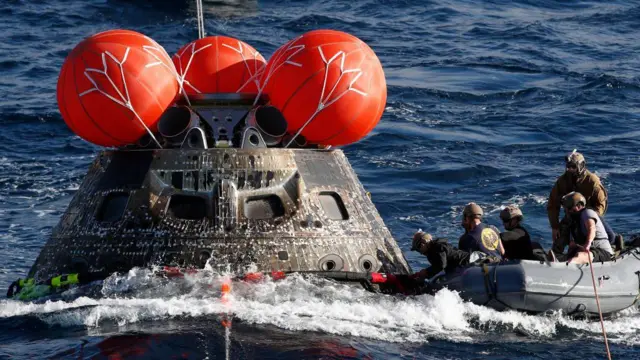
image source, Getty Images
Debbie Court, deputy director of the Orion program, said Wednesday: “We hope to recover the crew and get them to the medical bay within two hours of the crash.”
He estimates the astronauts will be back on land at the San Diego Naval Base within 24 hours of landing.
When the mission is accomplished, they will have their first opportunity to set foot on solid ground again and reflect on the journey of their lives.
They will join an exclusive group of 24 astronauts who have orbited the moon.
“This is the fastest human return to Earth in 50 years,” says James.
James emphasizes that NASA takes its mission of safely returning astronauts home very seriously.
“But there’s a part of me that will feel a lot more at peace when they’re back here on Earth,” he says.

Subscribe here to our new newsletter to receive a roundup of our best content of the week every Friday.
And remember you can get notifications in our app. Download the latest version and activate them.