
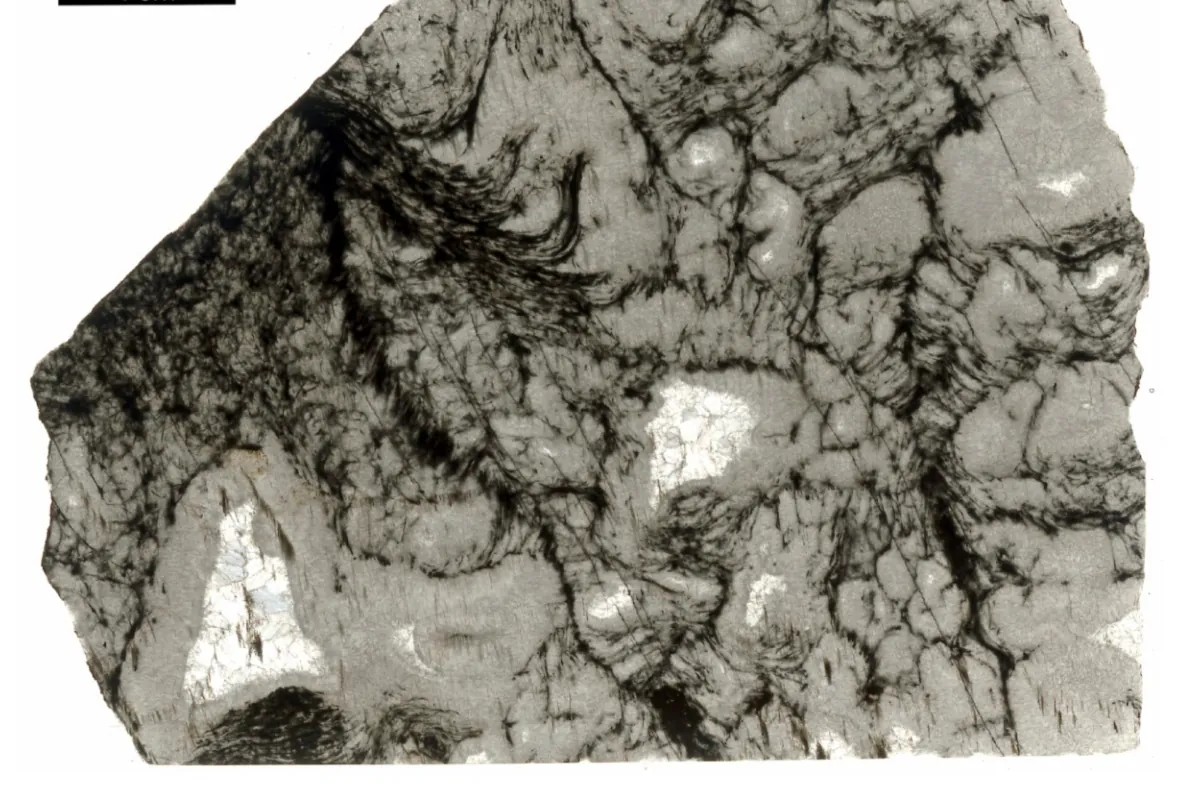
New research shows that life leaves more traces than anyone could imagine. A faint chemical whisper hidden deep in the rocks 3.3 billion years oldaudible only to those who are able to detect them. Scientists at the Carnegie Institution for Science in Washington (United States) applied a new method to detect chemical evidence of this early life in addition to molecular evidence that photosynthesis was already taking place 2.5 billion years ago (more than 800 million years earlier than documented).
Combining advanced chemical testing and artificial intelligence models, an interdisciplinary team from a North American institute and several affiliated universities analyzed more than 400 samplesincluding ancient sediments, fossils, modern plants and animals, and even meteorites. Their results have just been published in a journal Proceedings of the National Academy of Sciences (PNAS) and to demonstrate the feasibility of a method for detecting biological materials (including microbes, plants and animals) in rocks thousands of years after the disappearance of the original biomolecules. With the ability to distinguish them from materials of non-living origin (such as meteoritic or synthetic carbon) with an accuracy of more than 90%.
“This study represents a huge advance in our ability to decipher the oldest biological fingerprints on Earth,” said Robert Hazen, a research fellow at the Carnegie Institution and co-author of the study. “By combining these powerful chemical analyzes with machine learning, we can read those molecular ghosts left over from early life forms that still haunt us.” They whisper their secrets billions of years later“. Among the analyzed samples, the biological material of which was safely confirmed, there are The age of the deposits is 3.33 billion years from the Josefsdal site in South Africa. The oldest, previously obtained from the breed, had 1.7 billion years.
In addition, scientists have found molecular evidence that the process of photosynthesis (used by plants, algae, and many microorganisms) existed at least 2.5 billion years ago, as found in samples from the Gomohaan Formation, also in South Africa. The authors note that an understanding of when this process arose is the key to explaining how Earth’s atmosphere became enriched with oxygen, a fundamental milestone in the evolution of complex life forms, including humans.
Few molecular traces of the most primitive forms of life on our planet have come down to us. And those that were discovered are fragile; remains that have been buried and often burned into the earth’s crust before re-emerging through geological phenomena or excavation. The vicissitudes that often erase biomarkers that hold important clues for researchers. Thus, until now paleobiology has relied on fossils, the mineralized remains of cellular structures such as microbial mats and stromatolites, which have provided evidence of fossilized life up to 3.5 billion years ago, but without molecular information.
Finding these molecules presents an additional difficulty: most ancient breeds have been altered in such a way that all diagnostic biomolecules have been broken into countless fragments, too small and shared with little information. The most stable organic molecules derived from plasma membranes or certain metabolic processes have been found in sediments up to 1.7 billion years old.
Chemistry and AI
In this case, the team used a technique called pyrolysis-gas chromatography-mass spectrometry (Py-GC-MS) to release the chemical fragments that had entered each sample. Next, he used a specific type of model machine learning to generate hundreds of decision trees (a type of artificial intelligence predictive model), classify this data and extract hidden ecological and taxonomic patterns. The authors claim that this is the first study to combine Py-GC-MS and deep learning to identify biosignatures in rocks billions of years old.
“It’s the equivalent of a show thousands of puzzle pieces on the computer and ask if the original scene was a flower or a meteorite,” explains Hazen. “Instead of focusing on individual molecules, we’re looking for chemical patterns, and these patterns may exist in other parts of the universe.” abiotic organic mixtures, life produces several types of molecules in large quantities. Every chemical in a living cell has a function. That is why the authors believe that the distribution of biomolecular fragments found in ancient rocks holds key information about the evolution of life.
The model was trained to distinguish organic matter from the remains of meteorites or synthetic materials, which it achieved with an accuracy of up to 98%. The authors now say that the availability of larger and more diverse samples, especially more fossil animals and diverse abiotic materials, will help to refine the results and provide more complete information about each sample in the future. And they emphasize that it is a complementary method, not a replacement for traditional methods such as isotopic analysis or fossil morphology.
If its viability is confirmed, that is an important tool not only for the study of the origin of life on Earth, but also for the study of space, as the results suggest that machine learning applied to degraded organic matter could help solve many unknowns about the origin and evolution of life. For now, the team plans to refine their models, explore different types of machine learning, and test their approach on rocks from terrestrial deserts similar to those found on the surface of Mars.


