
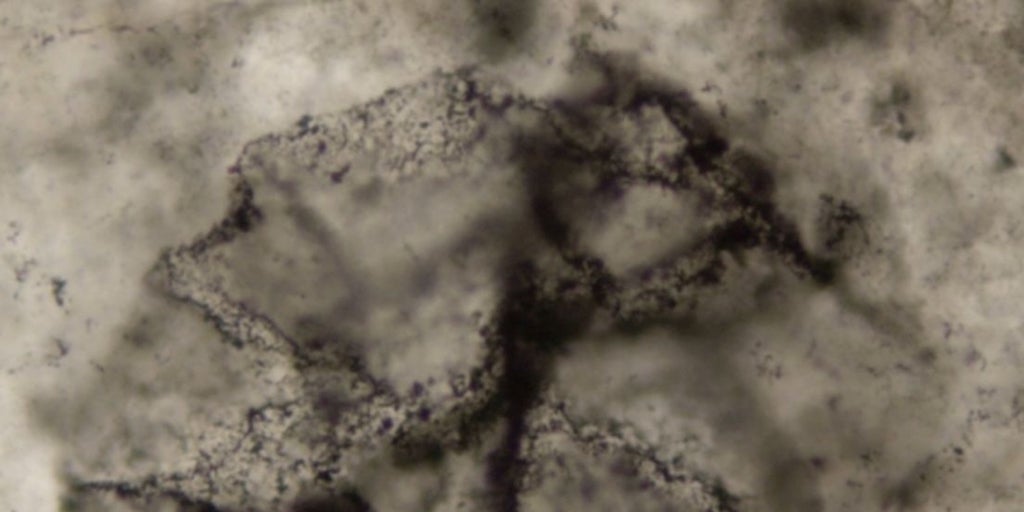
A new study, just published in the Proceedings of the National Academy of Sciences (PNAS), has just rewritten a fundamental chapter in the history of life on Earth. Combining the most advanced forensic chemistry with the power of artificial intelligence, … An international team of scientists has found chemical evidence of the presence of organisms in rocks more than 3.3 billion years old, doubling the time period in which we have been able to look for molecular traces until now. But there is more. These same traces, in fact, demonstrate that oxygen-producing photosynthesis, the biological engine that transformed our planet, appeared at least 800 million years earlier than previously thought.
The discovery, led by researchers at the Carnegie Institution for Science, is a veritable “manual” for astrobiologists, a detailed guide to finding life beyond Earth. Because if artificial intelligence is able to decipher the chemical “whispers” of life buried for billions of years in the earth’s crust, what stories can the rocks of Mars or the icy moon Europa tell us?
The work of paleobiologists can be compared to trying to read a document that was submerged in the sea, then burned, and then compressed by a giant “tectonic press.” Traditionally, their findings can be divided into direct fossils, microscopic organisms fossilized in rocks, and macroscopic structures such as stromatolites (mineralized mounds formed by microbial colonies); and geochemical evidence, such as signatures of carbon 12, an isotope of carbon that is associated with the metabolism of living things, found in very ancient rocks from Greenland.
The oldest stromatolites have provided convincing evidence for life around 3.5 billion years ago, and carbon-12 takes us back even further, having been found in Greenland in rocks 3.8 billion years old and even in very old zircons from 4.1 billion years ago. But these chemical signatures, while promising, are still circumstantial evidence and are often debated because of the possibility of abiotic (non-biological) processes generating them.
The third category of evidence
There is, however, a third category of evidence in which there have been huge gaps in the timeline so far. These are molecular biomarkers (organic molecules that undergo geological degradation, such as hopanoids or sterones) that have never been reliably traced in rocks older than 1.7 billion years. Immense pressure, heat, and the passage of geologic time (what experts call “deep time”) dismantle these fragile organic structures, breaking them into fragments too small and generic to be identified as biological.
And therein lies the first and most impressive advance of the new study. Researchers have indeed discovered a unique pattern of life in 3.33-billion-year-old rocks from the Josefsdal Chert Formation in South Africa. “Ancient life,” says Robert Hazen, a Carnegie senior fellow and co-author of the study, “leaves more than fossils; “It leaves a chemical echo.”
The finding not only extends the time window for studying biomarkers by more than a billion years, but provides solid molecular evidence that the organisms coexisted with the oldest stromatolites known in the fossil record. It can be said that the authors of the study managed to “hear” the “echo” that Hazen refers to, the echo of the oldest biochemistry on Earth.
Geochemistry and AI
To achieve this, L. Wong and Anirudh Prabhu, two of the paper’s more than thirty signatories, developed a methodology capable of significantly overcoming the limitations of traditional geochemistry: combining gas chromatography-pyrolysis mass spectrometry (Py-GC-MS) with machine learning.
Life, from algae to humans, consists of complex and specific organic molecules: proteins, DNA, lipids… But after billions of years of geological vicissitudes, these molecules disintegrate into billions of carbon fragments, often called “kerogen” or degraded organic material. These fragments are like the remains of ancient pottery: a traditional archaeologist can identify a piece only if he finds a large fragment with a recognizable pattern. But if you find only dust, you will never be able to tell whether it was a Greek vase or a Roman brick.
The Py-GC-MS works like a forensic machine that pyrolyzes (rapidly heats without oxygen) these rock fragments to release tiny trapped chemical fragments. The result is not the original molecules of life, but a “menu” of thousands of small hydrocarbon fragments. Fragments that are individually generic and cannot be reliably associated with any biological process.
And this is where artificial intelligence comes to the rescue. The scientists didn’t ask the AI to search for a specific molecule, but instead trained a machine learning model known as a “Random Forest” with more than 400 known examples, including modern animals and plants, recent fossils, meteorite rocks, and even synthetic laboratory organic compounds that mimicked the early Earth.
In this way, the AI learned to recognize the entire statistical picture of the “menu” of fragments. As Hazen explains, it’s like showing a computer thousands of puzzle pieces and asking whether the original scene was “a flower or a meteorite.” AI doesn’t need a big chunk to survive; It is only necessary that the set of all the broken parts matches what was originally a flower. Or a meteorite.
The result was impressive: the model was able to distinguish between biological and non-biological materials with an accuracy of more than 90%, reaching up to 98% in the most modern samples. And more importantly, by applying the studied model to the oldest rocks, it showed a high probability of the presence of life 3.33 billion years ago.
Oxygen mystery
Despite the impressive nature of this discovery, the research went much further, as it managed to determine the date of the beginning of photosynthesis, a biological process invented by primitive cyanobacteria, thanks to which the oxygen content in the atmosphere increased to completely rebuild the tree of life. As you know, photosynthesis involves the absorption of carbon dioxide (CO2) and water (H2O) and, using the energy of the Sun, the production of sugar and, very importantly, molecular oxygen (O2). But when exactly did photosynthesis begin?
Until now, although circumstantial evidence suggests that photosynthesis may have occurred very early in Earth’s history, preserved molecular traces of this process have only been found in relatively “young” rocks of about 1.7 billion years old. But a new AI-assisted method has identified molecular signatures of photosynthetic organisms in rocks from South Africa’s Gomohaan Formation that are much older, at least 2.52 billion years old. Which predates the chemical record of photosynthesis by more than 800 million years.
The discovery led researchers to ask a fundamental question: If life could produce molecular oxygen 2.52 billion years ago, why did Earth take so long to “oxidize” its atmosphere?
In fact, geology tells us that the so-called Great Oxidation (GEO), also known as the “Oxygen Catastrophe” because it caused the extinction of previous anaerobic organisms, tells us that O2 began to accumulate massively in the atmosphere approximately 2.3 billion years ago. But a new study shows that the biological ability to produce oxygen was already a fait accompli long before GEO. What happened during this time span of more than 200 million years?
A slow process
We can think of the first photosynthetic organisms as a tiny “faucet” trying to fill a giant bathtub (the ocean and the earth’s crust). But even though this faucet was “open” for hundreds of millions of years, producing oxygen without interruption, it did not accumulate because the “bath” had several open “drains”. Among them is the large amount of iron dissolved in the Archean ocean, which instantly reacted with oxygen to form the impressive banded iron formations (BIF), red deposits that are geological evidence of this process.
In addition, the early atmosphere was saturated with reducing gases such as methane and hydrogen sulfide, which reacted with O2 as soon as it was ejected. Finally, the Earth’s crust itself and high volcanism also acted as sinks, consuming oxygen to oxidize rocks and gases.
Thus, the new date of 2.52 billion years means that photosynthetic life worked hard to close these “geological drains” for a much longer period than previously thought, slowly setting the stage for the Great Oxygenation Event, the key moment that allowed the next evolution of complex life.
Life in other worlds
As co-author Kathy Maloney of Michigan State University, whose contributions included billion-year-old seaweed fossil samples from Canada to prepare the model, notes: “This innovative method helps us read the fossil record of deep time in a completely new way. And it could help in the search for life on other planets.”
In fact, one of the most powerful implications of this work is its potential application to astrobiology. Space missions to worlds with biological potential, such as Mars or the icy moons of the outer solar system (Europa or Enceladus), face the same problem: any trace of extraterrestrial life will almost certainly be a highly degraded molecular chemical signature damaged by radiation and altered by billions of years of planetary history.
Analytical instruments similar to Py-GC-MS have already been sent to Mars, but the problem has always been not the instrument itself, but the interpretation of its data. How do you distinguish simple organic fragments of a falling meteorite (non-biological material) from the remains of a real extinct Martian organism?
An artificial intelligence model created by Hazen and his team offers an answer. Indeed, we may be entering a new era of the search for extraterrestrial life, guided not by the hope of finding a recognizable fossil or a perfectly preserved biomolecule, but by the ability of an algorithm to recognize an unmistakable pattern of biology among the general “noise.” “The chemical patterns we discovered,” Hazen concludes, “could be true anywhere in the universe.”
Thus, the Earth itself, with its archaic rocks and vast history, has just become our best planetary laboratory, an inexhaustible training ground for artificial intelligence capable of “listening” for the first time to the chemical “echo” of microbes that lived 3.3 billion years ago.


