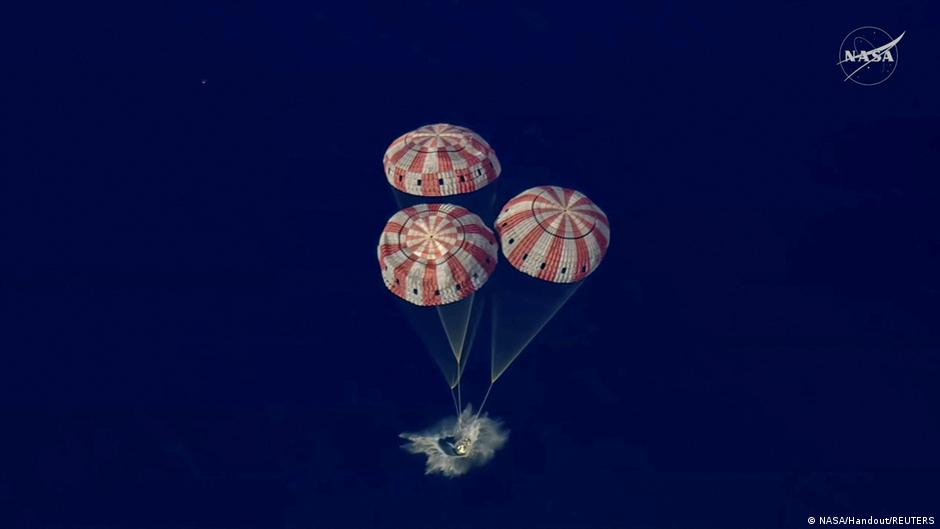
The Artemis II manned capsule, which completed a historic mission around the moon, landed this Friday (04/10/2026) off the coast of San Diego, California, using parachutes to reduce the speed of its free fall, which lasts about 14 minutes after re-entering the Earth’s atmosphere.
NASA, which called it a “perfect descent,” said in advance that divers would approach Orion first to assess the air and water around the craft and make sure the crew of Reid Wiseman, Christina Koch, Victor Glover and Jeremy Hansen were safe to exit.
The recovery of the astronauts, who the space agency initially reported to be in “excellent shape” in its remote assessment, will be conducted by US military and NASA personnel and will take between 30 and 45 minutes.
“Congratulations. Artemis II, mission accomplished,” NASA Administrator Jared Isaacman told X.
Artemis II thus ends a 10-day mission that launched from Florida on April 1, during which it orbited the moon without landing on it, marking the return of astronauts to its vicinity for the first time since 1972, during the Apollo program era.
During the descent, the four astronauts sustained speeds in excess of 40,000 kilometers per hour (about 24,661 miles per hour), while the spacecraft encountered extreme temperatures generated by friction with the Earth’s atmosphere, up to approximately 2,760 degrees Celsius (5,000 Fahrenheit).
“Reid, Victor, Christina and Jeremy did an extraordinary job. These talented astronauts inspired the world and represented their space agencies and countries (the US and Canada) as humanity’s ambassadors to the stars,” Isaacman added.
The maneuvers turned out “excellent”
NASA also said that so far all the maneuvers have gone “perfectly” without any problems on the ship.
The maneuver, which also included a six-minute communications blackout already scheduled after reaching the atmosphere, was a trial by fire to test the heat shield that protects the spacecraft and astronauts.
Artemis II re-entered Earth on a more direct trajectory than the unmanned Artemis I mission in 2022 to reduce the risk of heat shield damage threatening the four astronauts.
This time, the duration of the entry was about 14 minutes instead of 20, causing much less heat stress on the shield, according to NASA.
When the astronauts leave the ship, they will be taken to an inflatable platform, where two helicopters will pick them up and transfer them to the ship’s infirmary, to then undergo other medical examinations on the ground.
Meanwhile, Orion will be towed to the spacecraft for a return trip to the Kennedy Space Center in Florida, having traveled more than 1.1 million kilometers (694,481 miles).
mg (efe, afp)