If the discovery is confirmed, it will become a real revolution in the field of physics, forcing to modify the standard model of particle physics (this is a theory that accurately describes the fundamental structure of matter). In addition, it will have huge implications in cosmology when it comes to explaining the formation and evolution of galaxy clusters.
After carefully examining data collected over 15 years by NASA’s Fermi Space Gamma-ray Telescope on the Milky Way’s galactic halo, Japanese researchers say they have direct evidence of the elusive dark matter particles in the universe.
If the discovery is confirmed, it will become a real revolution in the field of physics, forcing to modify the standard model of particle physics (this is a theory that accurately describes the fundamental structure of matter). In addition, it will have huge implications in cosmology when it comes to explaining the formation and evolution of galaxy clusters.
This ground-breaking work was published in the journal Journal of Cosmology and Astroparticle Physics and its sole author is the Japanese astrophysicist Tamanori Totani.
Tatani claims that the energetic pattern found in his research may be the first direct evidence of so-called weakly interacting massive particles (WIMPs), although the scientific community is urging caution and independent verification before confirming a discovery that could change the current state of physics.
Invisible to any telescope
A widely accepted hypothesis is that dark matter consists of these elusive WIMPs, hundreds of times more massive than a proton and moving very slowly. Because they do not absorb or emit light and do not interact with any observable particles, they cannot be detected directly with optical instruments such as a telescope.
The Coma cluster (up to 1,000 galaxies detected) is the place in space where the first evidence of dark matter appeared. In 1930, the Swiss astronomer Fritz Zwicky noticed that these galaxies were moving too fast for the gravity produced by ordinary observable matter. They should have escaped the cluster, but instead they stayed together.
In other words, there wasn’t enough visible mass to hold that many galaxies together. The dark matter in the Coma cluster is so predominant that it makes up about 90% of the total mass.
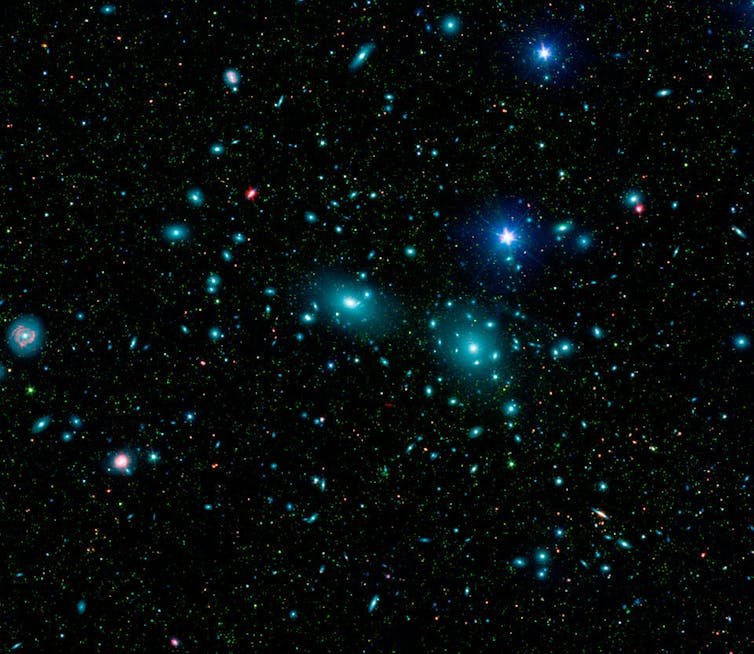
After these observations, Zwicky suggested that there could be an invisible form of matter that created the extra gravity that held these galaxies together. He called it “Dark matter” (German for “dark matter”).
Later, in the 1970s, the American astronomer Vera Rubin turned to this concept to explain the anomalous speed of stars at the outer edges of spiral galaxies. Today, although not all astronomers agree on the true nature of dark matter, its existence is widely accepted.
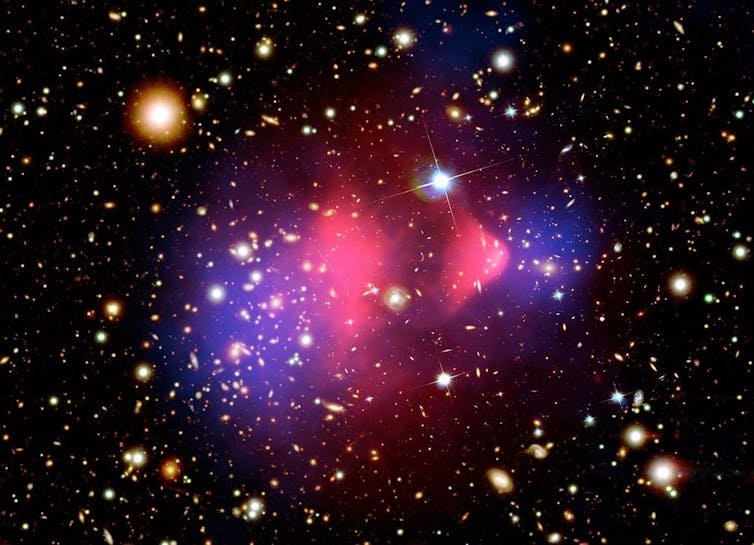
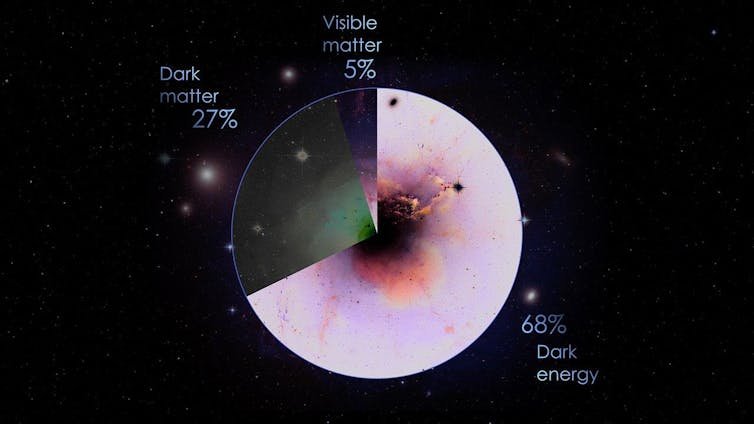
Dark matter makes up most of the mass of galaxies and galactic clusters. Astronomers estimate that visible matter makes up only about 5% of the universe, while dark matter makes up about 27%. The remaining 68% would correspond to dark energy and would be responsible for the accelerated expansion of the universe, although its exact nature is still unknown.
They emit a very energetic radiation when annihilated
As we mentioned earlier, these dark matter particles cannot be detected by any telescope because they neither emit nor absorb light at any wavelength. It should be asked now, how can they be detected by direct observation?
The good news is that when the hypothetical WIMPs interact, they will annihilate each other, producing high-energy radiation in the form of gamma rays. In fact, researchers are analyzing data from NASA’s Fermi Gamma-ray Telescope to look for signs of WIMPs interacting and annihilating each other. This is the case of the amazing research of the astronomer Tamanori Totani.
Therefore, the excess of high-energy gamma radiation in certain galactic regions may have its origin in the annihilation of dark matter particles and may be evidence for the existence of WIMPs. The question of conclusive proof or whether we are dealing with a speculative hypothesis is debatable.
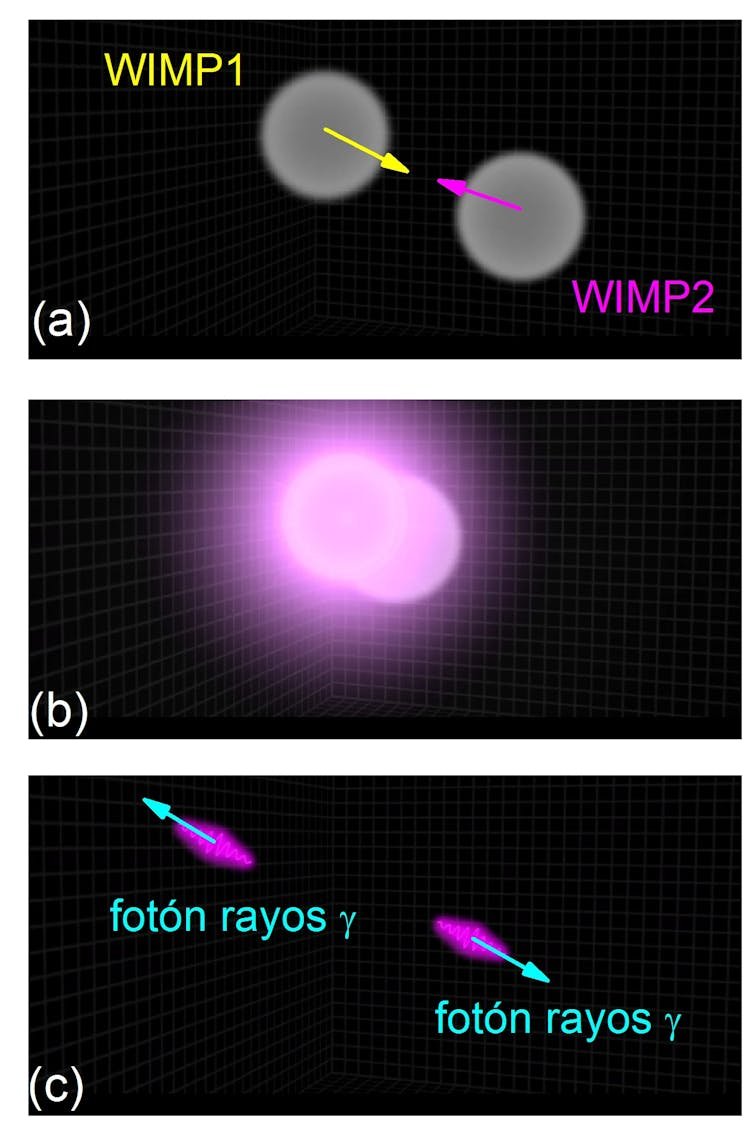
A signal that will confirm the existence of dark matter
In this new study, Totani analyzed data from the Milky Way halo, a spherical region of old stars that surrounds our galaxy and is thought to have a high concentration of dark matter.
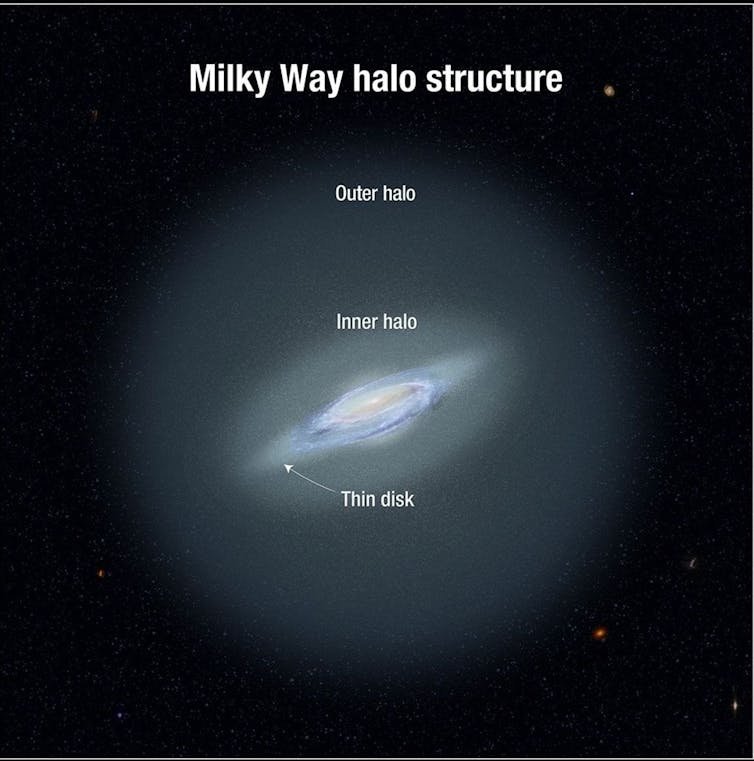
A detailed analysis of the data in this galactic region revealed an excess of high-energy gamma rays, about 20 gigaelectron volts (20 GeV). Moreover, the energy spectrum found is completely consistent with the theoretical prediction of WIMP annihilation, assuming that the particles have a mass of about 500 times that of a proton.
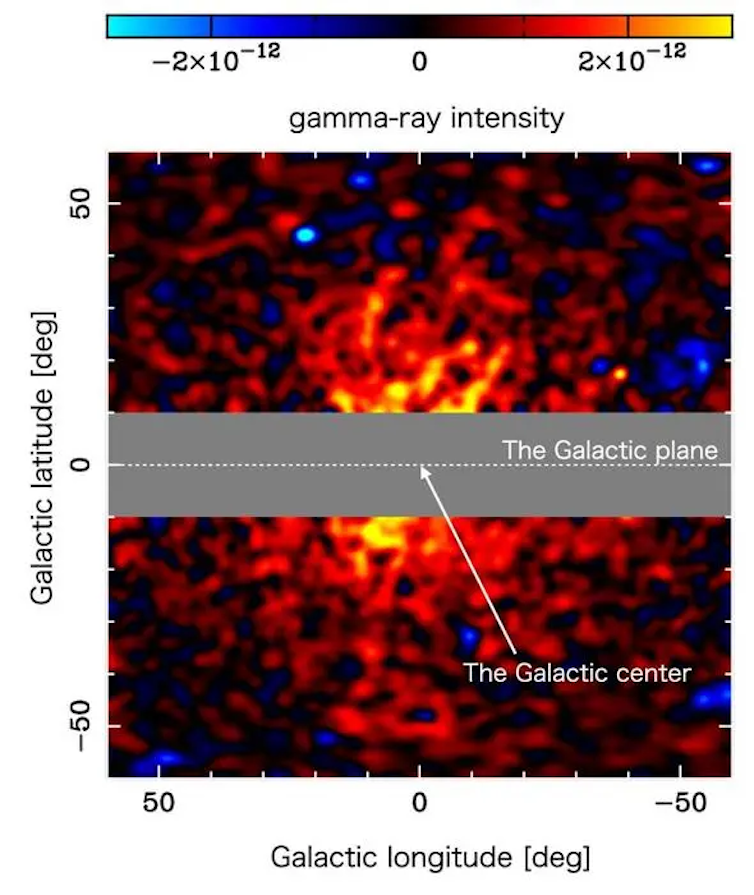
In the words of the author of the study: “We discovered gamma rays with extremely high energy, spreading in the form of a halo towards the center of the Milky Way. The gamma-ray emission component closely resembles the expected shape of a dark matter halo.’
Moreover, this very specific gamma-ray pattern is not easily explained by other alternative astronomical events, such as supernovae or rapidly rotating pulsars.
Tattani’s work is plausible evidence for gamma-ray emission from the annihilation of dark matter, although it is not without uncertainty and is far from entirely conclusive.
Caution is warranted in the face of these new findings
“Extraordinary claims require extraordinary evidence.” These words from Carl Sagan perfectly sum up how science should proceed in the face of revolutionary results such as those proposed in this new study of dark matter.
This new discovery is now entering a period of intensive study and verification by other research groups.
An independent analysis is needed to verify that this characteristic 20 GeV signal is associated with WIMP particles, likely in other dark matter-rich environments, such as dwarf galaxies in the Milky Way halo.
We’ll have to wait to see if this exciting work lays the groundwork for a definitive detection of the elusive “missing matter” that has so baffled astronomers in recent decades.
Oscar del Barca Navila, assistant professor. Faculty of Physics (field of optics), University of Murcia
This article was originally published on The Conversation. Read in the original.