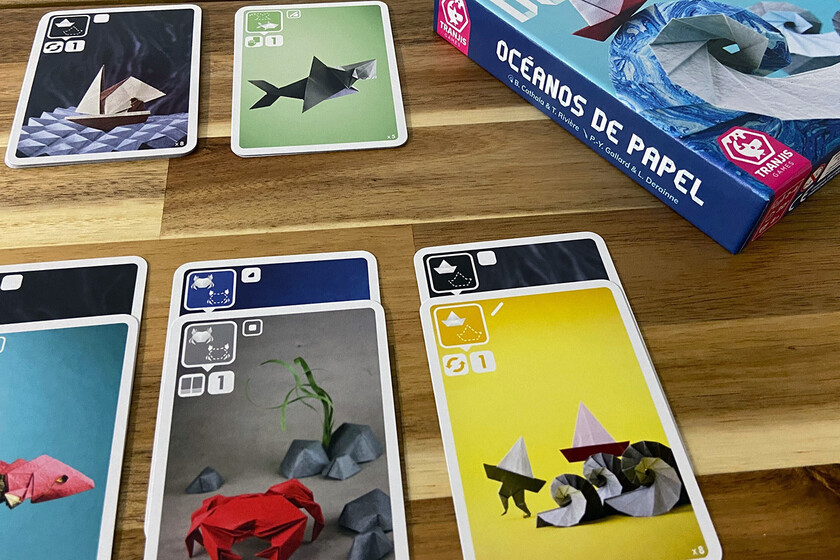
They got used to it with their family card games classics and with a thousand and one ideas to turn a Spanish or poker deck into just about any collection of mechanics you can think of, introducing any proposition that is out of the ordinary is a risky mission.
There are few variables that have managed to establish themselves outside of classic Uno, and I can talk about few things other than Love Letter or Exploding Kittens, but luckily the latest sensation of the genre has entered our games with surprising ease. Oceans of paper It has taken its rightful place among our regular games.
What are oceans of paper
Using the classic strategy of inviting us to accumulate points, in fact Oceans of paper It’s encouraged to combine different ideas more successfully than it might seem on paper (hehe). There’s color-coding, pick-stealing, risk-and-reward betting on the last turn, classic pair-making, special skills, and the always-effective family stacking.
A game within a game that inevitably ends up reminding you of one or another card game you remember fondly and, along with that, uses that nostalgia and earlier recognition to fit in seamlessly, no matter how diverse the group may be.
The fact that the rules are simple, despite their depth, and that the game builds gradually with a beginning that puts only one card in your hand, makes the game Oceans of paper be as accessible as possible. Starting with zero opportunities to score or turn the game quickly, everyone has an equal chance from the start and you can learn its mechanics little by little.
With a decent weight and origami-based art with nautical motifs that inevitably catch the eye, it’s clear that Oceans of paper flew off the shelves this summer.
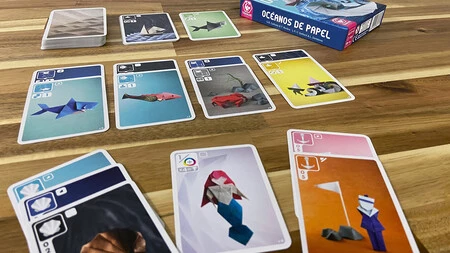

How to play Paper Oceans
The goal Oceans of paper is to accumulate points in three ways: by accumulating pairs of certain types, by accumulating families of other types, or by adding color bonuses when the opportunity arises. Most importantly, at the end of the round, we will add points to both the pairs of cards that we have dropped and those that are still in our hands.
After shuffling Oceans of paper and deal a card to each player, two discard piles are created from the first two cards of the draw deck. Next, our turn will allow us to draw a card (the top one from one of the two discard piles or the first two decks to keep one and discard the other), play one or more pairs of the same type by activating their abilities, or end the round if we wish.
If we take a pair of crabs we can look in the discard pile to see which card we are most interested in and draw it, if it’s a pair of boats we can play another turn, if it’s a pair of fish we draw a card from the deck , and if it’s a swimmer and a shark pair, we’ll draw a random card from the other teammate’s hand.
If we decide to end a round, we can do so by saying “Stop” and we all add up the points we have so far, or by saying “Last Chance” and letting the others play their last round in hopes of being the highest scorer points at the end, and the rest just add a bonus points based on the largest group of cards of a certain suit you have. If we fail and someone beats us, we only get points based on that color code.
Finally, in Oceans of paper There are some Mermaid shaped bonus cards that will give us extra color points from the highest to the lowest group depending on the Mermaids we have. If we manage to collect four of these sirens, we automatically win the game. Otherwise, the rounds continue until we reach 40, 35 or 30 points depending on whether we are playing with 2, 3 or 4 players.
In VidaExtra | This man quit his regular job at a bank to work at a game store, and with it, he changed the industry forever