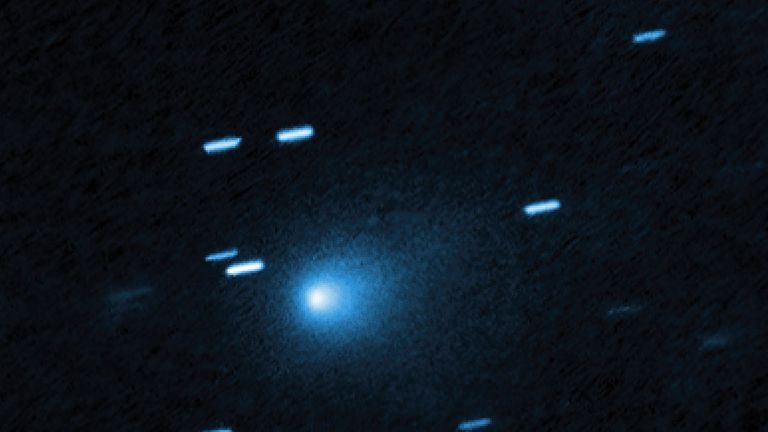
3I/Atlas made its closest approach to Earth on Friday morning. An interstellar object headed for the outer regions of the solar system to continue its journey through the Milky Way may be the oldest comet ever recorded. Its passage gave the scientific community an unprecedented opportunity to study the composition of bodies that form around stars other than the Sun.
The most favorable viewing window for the interstellar comet occurred on December 19, around midnight (Central Mexican Time) in the region corresponding to the constellation Leo. At that moment, the comet flew close to Regulus, the brightest star in this constellation, although at a distance of 274 million kilometers from Earth. Comparatively, The object was at a distance of about 700 times the average distance between the Earth and the Moonand also a range greater than that which normally separates our planet from Mars, estimated at about 225 million kilometers.

On December 19, the best window for observing the interstellar comet 3I/Atlas opened.
Although the comet came closest to the planet, direct observation and imaging was limited to the use of special instruments. According to NASA, the closest images of 3I/Atlas were obtained on October 3 by the Mars Reconnaissance Orbiter (MRO), when the body flew by at a distance of about 30.6 million kilometers from the red planet.
The so-called “interstellar explorer” was first detected on July 1 by the Asteroid Last Collision Alert System (ATLAS) located in Chile. Since then, its trajectory has been tracked by various telescopes and space observatories, including the James Webb Space Telescope, as well as various missions managed by agencies such as the National Aeronautics and Space Administration (NASA) and the European Space Agency (ESA).
3I/Atlas is the third object of interstellar origin identified in the Solar System, following the discovery of 1I/’Oumuamua in 2017 and Comet 2I/Borisov in 2019. Each of these findings has expanded knowledge of the variety of bodies moving between star systems and about the processes of planet formation outside our immediate space environment.
What is known about 3I/Atlas
However, the physical details of the comet remain limited. Its exact dimensions are still unknown, although observations made by the Hubble Space Telescope suggest that The 3I/Atlas core measures at least 440 meters and does not exceed 5.6 kilometers in diameter. Its trajectory indicates that the object originated in a region of the Milky Way that formed long before the Solar System, with an estimated age of nearly 4.6 billion years. This hypothesis is supported by the comet’s high speed, too fast to be captured by the Sun’s gravity, and by measurements indicating a hyperbolic trajectory, which confirms that it does not orbit the Sun.
When it was discovered in the middle of this year, the comet was moving at a speed of about 221,000 kilometers per hour. This value increased until it reached 246,000 kilometers per hour on October 29, at which time the closest approach to the Sun was recorded. From then on, its speed is expected to gradually decrease as it moves away from the star, until it regains a shape similar to its initial exit from the Solar System.
Even though 3I/Atlas is on its way out, astronomers will continue to monitor it. Since November 27, the International Asteroid Warning Network has been actively monitoring the comet, which is scheduled to end on January 27, 2026.
People who want to follow the trajectory of 3I/Atlas can do so through an interactive app Eyes on the Solar Systemsupported by NASA, allowing real-time visualization of the journey of this unique interstellar guest.
( tagsToTranslate ) space