
Virtual reality (VR) has not made enough of an impression on new generations all over the world, except in some countries where it is very poorly recognized. In Latin America, only Mexico and Brazil are excited about VR, with 17% in both countries.
The lack of enthusiasm for virtual reality boils down to online shopping or e-commerce, according to Statista. There is very little optimism, despite the fact that the survey was conducted until June 2023. The frustration comes from the fact that users or customers do not physically know the object they are seeing with this technology.
According to Statista, virtual reality is still not taking the world by storm
For Statista, VR can solve some aspects of e-commerce, such as virtual prediction of product usage in a simulated context. E-commerce giant Amazon recently invested in AI startup Anthropic, founded by former OpenAI employees.
E-commerce companies seem to be adapting to AI, the metaverse and VR, with Amazon being a prime example. The company will invest $4 billion in the acquisition of a stake in the start-up “Anthropic”, which will move all its software products to the Amazon Web Services (AWS) data center.
However, optimism about VR doesn’t seem to be improving, as Statista shows, which listed the most optimistic countries despite their low percentage: China at 21%, France, Brazil, Mexico and the US at 17% respectively. Meanwhile, South Africa has 15%, Spain 15% and South Korea 7%.
Read more: Differences between virtual, augmented, mixed and augmented reality
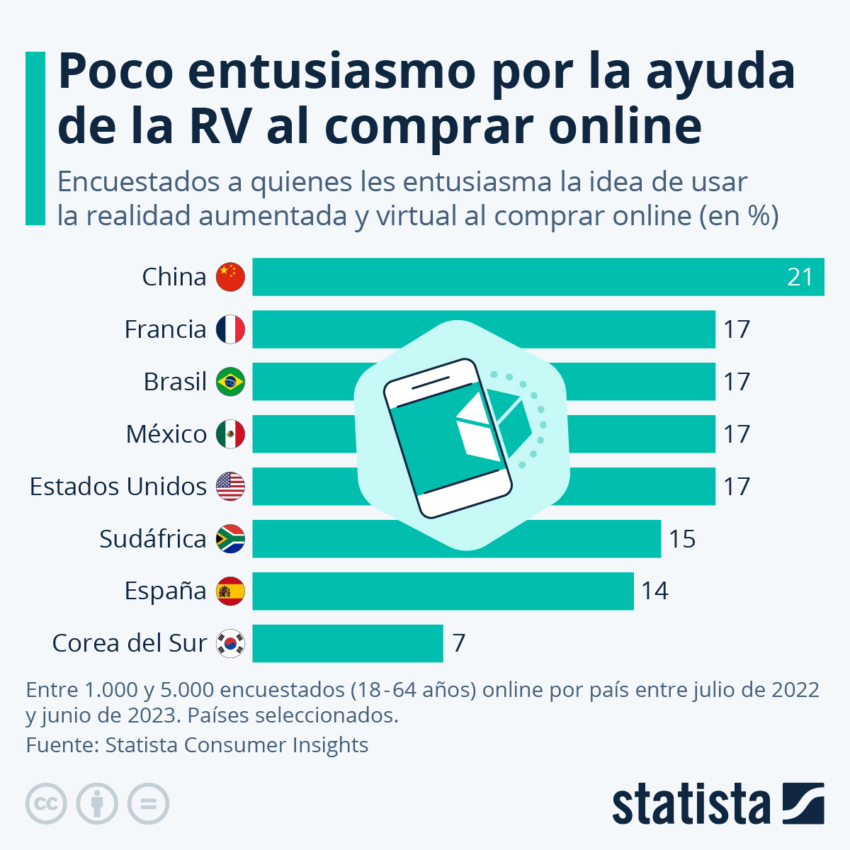 Virtual reality (VR) is only gaining enthusiasm in Mexico and Brazil in Latin America. Source: Statista
At the time, BeInCrypto reported that Apple’s meta universe would include a combination of full virtual reality and augmented reality (hence the name mixed reality) that would overlay digital information on top of real-world user experiences and would use a new operating system similar to the iPhone interface.
In addition to e-commerce, another industry that has adopted VR is medical, which is popular for its high degree of accuracy as a medical training tool. According to McKnights, VR can help simulate training scenarios in a simulated environment that looks “real.”
The medical industry that uses virtual reality the most
The medical industry believes that VR will reduce the complexity of the job and help increase the number of situations that paramedics may encounter. “Given the low effectiveness of traditional methods of teaching professional nursing skills, it can be difficult to motivate students.”
Read more: Metaverse, what is it and what is it for?
In Spanish, VR has been part of the educational offerings of universities. Months ago, the Complutense University of Madrid (UCM) partnered with Apple Coding Academy to offer certifications in the metaverse, virtual reality and augmented reality, and even a mixed reality training program.
The announcement follows the recent launch of Apple’s Vision Pro. Since then, students have been able to develop content for Apple’s new Vision Pro platform. The university and Apple Coding Academy will jointly distribute mixed reality content.


