The Artemis II crew—Americans Reid Wiseman, Victor Glover and Christina Koch, and Canadian Jeremy Hansen—return to Earth with heads full of images.
Another look at the hidden side of the moon
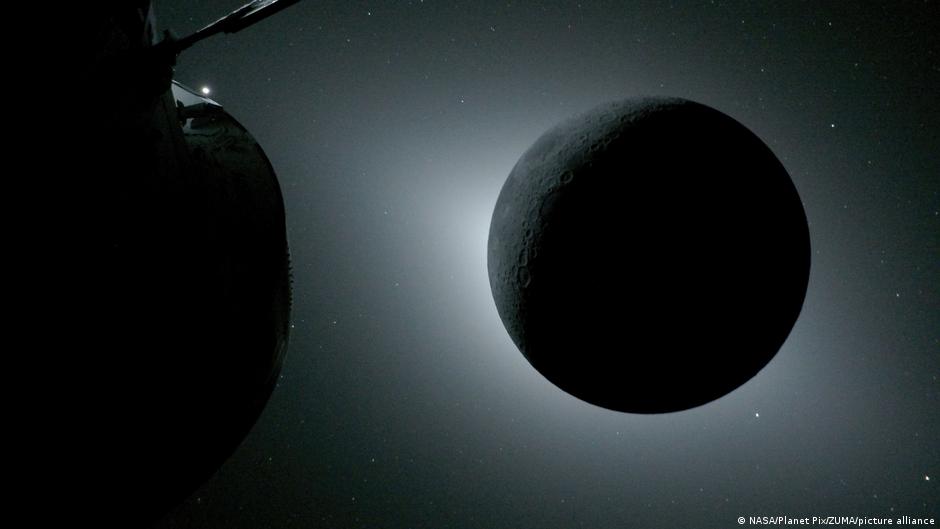
When the spacecraft reappeared after leaving the far side of the moon last Monday (04/06/2026), Glover tried to describe what he saw: “It was so bright, so brilliant, it looked out of place. The gray color of the moon and the black color of space seemed to go together.”
Koch put it another way: The moon became, he said, a “sponge of light” that “reflected light and lit up when the Earth came close enough” to the spacecraft’s field of vision.
Unlike the lunar gray usually found in textbooks, the astronauts noted that the lunar surface had muted tones with brown undertones. And that’s not all: Wiseman and Hansen also observed at least four flares caused by meteoroids hitting the lunar surface, while Koch observed how small particles of the lunar regolith appear to be lifted and suspended by electrostatic charges.
Glover also stopped in front of the Om Crater, a feature on the far side of the Moon that left him speechless for a few seconds. “I made some correlations and mentioned that it’s like seeing the Grand Canyon where you can see the different layers,” he said.
An eclipse not to be forgotten
Of all the things Wiseman had experienced, he chose the solar eclipse as the most difficult moment to assimilate. “Actually, I’m getting chills just thinking about it right now, my hands are sweating,” he admitted at a press conference from space.
No wonder: with this mission, humans again circled the moon for the first time in more than half a century, and also reached such a distance from Earth that astronauts had not reached before.
The mission launched last Wednesday (April 1, 2026) from Cape Canaveral aboard an Orion capsule mounted on a Space Launch System rocket. The capsule is scheduled to land this Friday in the Pacific Ocean off the coast of San Diego, where the USS John P. Murtha will be waiting for it.
“I’ll miss it”
As they prepare to return — putting away equipment, checking suits — the astronauts hint that they would prefer to extend the mission. Koch was blunt: Although they’ve been living in a small space for more than a week — and the toilet hasn’t completely flushed — she’s not sure she’s ready to go back.
“I’m going to miss being so close to so many people with a common goal,” he said. “We are close like brothers. It’s a privilege we will never have again.”
Glover also doesn’t seem to have landed yet, even though the Pacific Ocean is only two days away. “I haven’t even begun to realize what we’ve been through. I’ll be thinking and talking about it for the rest of my life.”
Hansen, a Canadian in the group, summed up his experience with the strength of a man who saw things “he never imagined.” And his conclusion is simple: “We live on a fragile planet in the void and emptiness of space. Our purpose as humans is to find joy and lift each other up. When you see it from here, that doesn’t change. It just confirms it.”
Re-entry, Glover said, will also be “something profound”: the moment the capsule will be surrounded by plasma as it passes through the atmosphere. But for now, it still needs to be experienced.