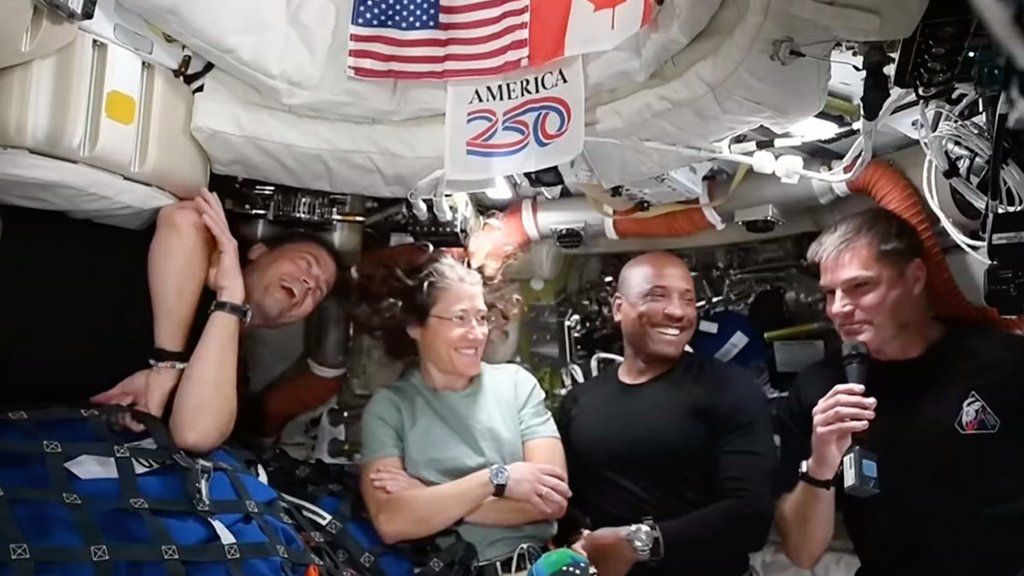
HOUSTON — As they neared Earth, the Artemis II astronauts pointed their lunar rover at the impending return of the “fireball” and reflected on their historic journey around the moon, describing it as surreal and profound.
At dawn on Thursday, the penultimate day of their flight, the first human lunar explorers in more than half a century were less than 240,000 kilometers (150,000 miles) from home and the odometer was counting down.
“We have to go back. There’s a lot of data that you’ve already seen, but all the good stuff comes back to us. There are many more photos, many more stories,” pilot Victor Glover said, adding that “passing through the atmosphere in a fireball is also important.”
Being cut off from all of humanity for nearly an hour while on the moon was especially “surreal,” according to Commander Reid Wiseman.
“Our brains have a lot to process … and that’s a real gift,” Wiseman said Wednesday night during the crew’s first news conference after takeoff.
While outside the moon on Monday, Wiseman, Glover, Christina Koch and Canadian Jeremy Hansen became the farthest humans in history, reaching a record 406,771 kilometers (252,756 miles) from Earth before heading back. When they passed from behind the Moon, they experienced a wonderful total solar eclipse as the star blocked the Sun from their view.
YOU MAY BE INTERESTED IN:
Glover noted that the April 1 launch from Florida reduced the amount of light on the far side of the moon, but the eclipse was a consolation prize “and one of the greatest gifts.”
Friday’s entry and plunge into the Pacific Ocean off the coast of San Diego — processes as dynamic and dangerous as takeoff — were now on everyone’s mind. An evacuation ship, the USS John P. Murtha, was already at sea, with a squadron of military aircraft and helicopters ready to join the operation.
This is the first time NASA and the Department of Defense have teamed up to return a crew to the Moon since Apollo 17 in 1972. Their Orion capsule will return at full speed, entering the atmosphere at an expected speed of 10,657 meters (34,965 feet) per second – or 38,367 km/h (23,840 mph) – not a record, but still dizzyingly fast.
Mission control will be closely monitoring how the capsule’s heat shield holds up. During Orion’s only uncrewed test flight to the Moon in 2022, said shield suffered much more damage than expected due to temperatures of 2,760 degrees Celsius (5,000 degrees Fahrenheit) on re-entry.
Instead of replacing Artemis II’s heat shield, which would have caused another long delay, NASA adjusted the capsule’s descent through the atmosphere to reduce exposure to the intense heat. Next year’s Artemis III mission and beyond will fly with redesigned heat shields.
Artemis III will allow astronauts to practice docking their capsule with one or two lunar landing modules in orbit around Earth. Artemis IV will attempt to land two astronauts near the moon’s south pole in 2028, setting the stage for what NASA hopes will be a permanent lunar base.
NASA officials declined to provide figures for the risk assessment of the nearly 10-day mission, acknowledging that launch and entry are the biggest threats.
“We’re in the final stages,” NASA’s Lakisha Hawkins said. “We’re coming to the end of the mission, and obviously getting the crew home and getting them to land safely is a big part of the risk ahead.”
_____________
NY1 News on WhatsApp. There, you’ll find the most up-to-date news about what’s happening in New York, as well as other stories about the rest of the country, Latin America and the world. Click this link to access the channel. We appreciate it in advance if you become one of our subscribers and express your reaction to what we post with emojis.