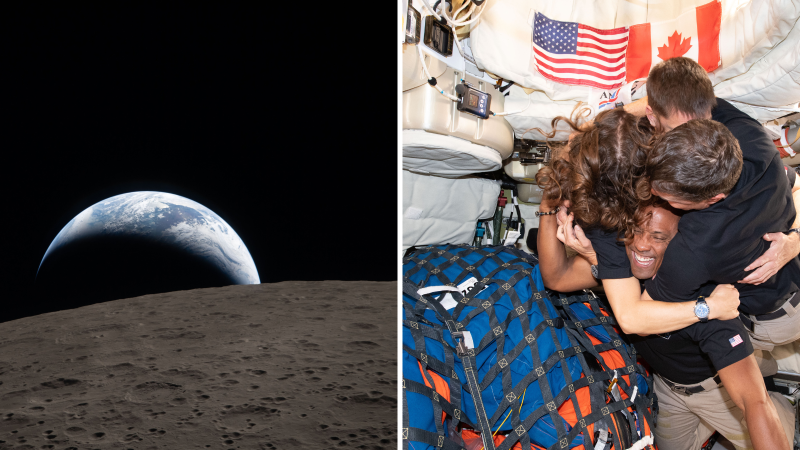
Astronauts aboard the Artemis II mission successfully landed off the coast of San Diego on April 10, completing a 10-day journey that brought them closer to the Moon and further than anyone in human history.
The trip — with NASA crew Reid Wiseman, Victor Glover and Christina Koch, and Canadian Space Agency astronaut Jeremy Hansen — marked the first time humans left Earth’s orbit since the Apollo 17 mission in 1972. And with Glover, Koch and Hansen on board, it also marked the first time a black astronaut, a female astronaut and a non-American astronaut, respectively, had ventured so far.
The mission marked the first crewed flight as part of NASA’s Artemis program: a long-term plan to return humans to the moon and eventually establish a lunar settlement.
According to NASA, the Artemis II mission surpassed the record set by Apollo 13 in 1970 by more than 6,400 km, reaching a “suspected” distance of 405,000 km from Earth.
During the closest approach to the moon’s cratered surface, the astronauts took pictures and described what they saw to the team at the flight control center on Earth.
The crew drew on lessons learned from training in the geological landscapes and lunar environments of places like Iceland to observe details about the shapes, textures and colors of impact craters and ancient lava flows on the Moon.