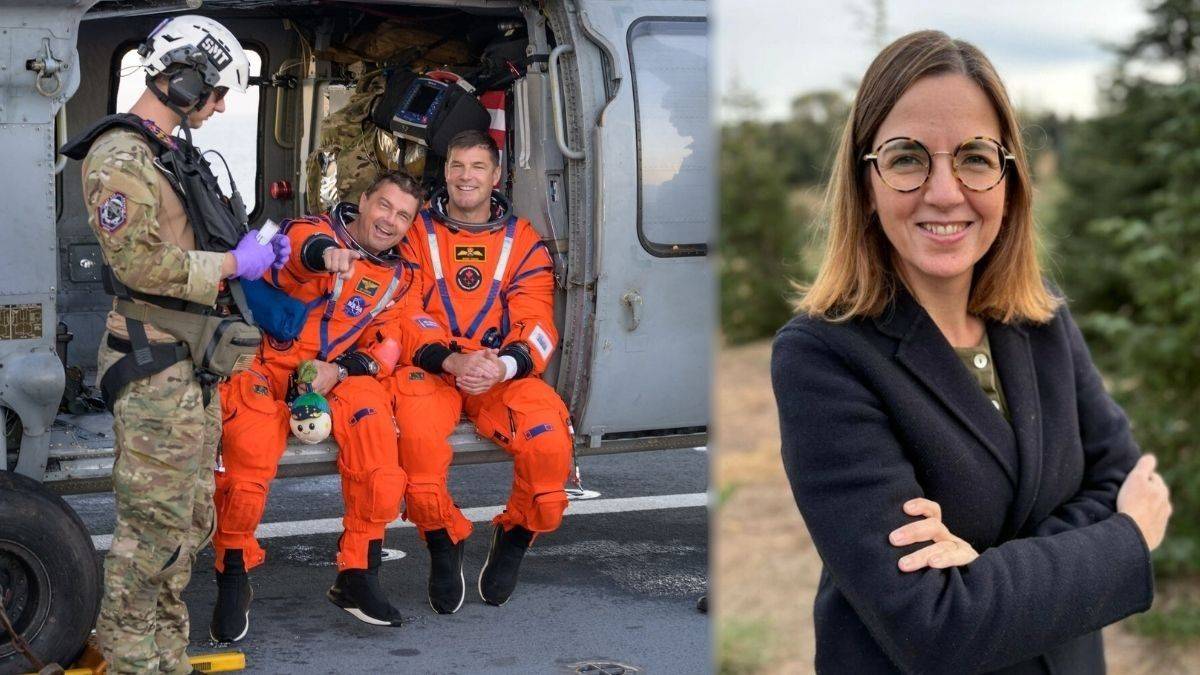
Return to Earth of the crew Artemis II after the mission ca ten days around the moonupdated the question again: what exactly happens to the human body when it leaves Earth’s gravity. In addition to the epic flight, being in microgravity exposes the body to a cascade of changes that affect the cardiovascular system, sleep, hormonal metabolism and, especially intensively, bones and muscles.

In this field, a rheumatologist Laia Guiffre Salafrom the German University Hospital Trias i Pujol in Badalona, UAB Associate Professor and Vice President Spanish Society for Research on Bone and Mineral Metabolism (SEIOMM)summarizes the scope of this phenomenon in an interview given by ConSalud.es: “In conditions of weightlessness, as happens with astronauts, changes at the cardiovascular, hormonal level (especially associated with the lack of a daily rhythm), sleep and musculoskeletal disordersIn this context, he adds, “marked loss of bone and muscle mass occurs.”
One of the first is muscle damage. As he explains, “this loss of muscle mass precedes the loss of bone mass and is more noticeable in the lower extremities, where it can reach 1% per month.” Even when astronauts follow training programs, the deterioration does not go away. “These individuals represent a noticeable loss of muscle mass and functioneven doing muscle-strengthening exercises,” she points out. In long-duration missions, about six months on space stations, “a loss of up to 15% of muscle mass and a 32% decrease in muscle strength have been described, although the expert cautions that “even on shorter spaceflights, there is also a loss of muscle mass and function.”

“In conditions of weightlessness, there are changes in the cardiovascular, hormonal system, sleep disorders and musculoskeletal system”
in the bonethe effect is also fast and persistent. “Astronauts have very noticeable bone loss; it happens linearly over time,” explains Dr. Guiffre Sala. Although the entire skeleton is exposed to no load, the loss is uneven. “Greater bone loss has been described in the lower extremities, particularly in the proximal femur, while bone mass in the upper extremities and skull may even increase.” The specialist clarifies that “ Loss of bone mass of the total femur was determined to be 1-1.5% per month of weightlessness.”, and that this deterioration “appears to be more marked at the level of endocortical bone, causing a marked loss of bone resistance (-2.5% per month)”.
One of the most worrying aspects is that the deterioration is much greater than expected physiological aging. The main reason, he emphasizes, is clear: “The main factor why astronauts can lose this amount of bone mass is weightlessness or the absence of weight.” The lack of mechanical stimulation alters the normal balance of the bone. “In conditions of no load (unloading) there is an uncoupling of bone remodeling with more bone resorption and less osteoformation.” The biological response also appears very quickly: “After 6-11 days, there is a change in the behavior of markers of bone remodeling. with an increase in resorption markers of approximately 7% per month,” says Dr. Guiffre Sala.
This change is not limited bone mineral density. The rheumatologist points to a broader biological process: “In conditions of weightlessness or weightlessness, there are also changes in the bone cells themselves (osteocyte apoptosis) and marked hormonal changes, partly due to the absence of a circadian rhythm in space.” Added to this is the effect on calcium. “This bone loss occurs at the expense of increased bone remodeling (increases resorption and decreases bone formation), resulting in noticeable changes in calcium metabolismwith a tendency to hypercalcemia, which is associated with hypercalciuria and the development of urolithiasis.”
WHAT IS RECOVERY?
The restorationAlso, it is far from immediately after returning to Earth. “After landing on Earth, the recovery of bone mass is slow, with recovery basal values 1-3 years after plantingalthough some people only partially regain bone mass.” It also describes how bone markers develop in this return: “After landing on Earth, resorption markers decrease rapidly, while formation markers initially increase and tend to decline. normalizes after 6 months“.
Even though astronauts perform intense daily exercise, the countermeasures still have limits. “They appear resistance exercise guidelines carried out inside space stations, they are not enough to replicate the ‘weight load’ that we do in gravity,” he says. investigation investigated the role of Art antiosteoporotic drugs. Dr. Guiffre Salo recalls that “prophylactic treatment with oral bisphosphonates (alendronic acid) along with exercise was associated with less loss of bone mass and bone quality in 18 astronauts who had been in space for nearly 6 months.” It also notes that experimental results with osteoprotegerin and antisclerostin in weightless animal models have shown significant increases in bone mass.
“Loss of bone and muscle mass may increase the risk of fractures during spaceflight and after landing on Earth”
The clinical significance of all this goes beyond the Earth’s orbit. The specialist insists that space should not be understood as an oddity detached from medical practice. “There are several of them clinical situations that are associated with the absence of loadfor example, the lack of exercise associated with a gross motor injury of the spinal cord, or people with hemiplegia as a consequence of cerebral vascular injury.” In these scenarios, there is also a marked loss of bone tissue. “In the case of a spinal cord injury, it can be even greater, reaching a loss of 40% of bone mass 2 years after the injury.”
Therefore, in his opinion, the question should be put the other way around. “We have models of the absence of charge on Earth that allow us to estimate the effects of weightlessness on the skeleton.” And he reinforces this idea by referring to therapeutic possibilities: “The study of mineral metabolism in other clinical situations associated with weightlessness allows us to understand the pathophysiology of bone and muscle loss in this clinical situation, and to make therapeutic approaches that are subsequently applied to the model of weightlessness.”
Thus, the problem is not only quantitative, but also functional and protective. “ loss of bone and muscle mass may increase the risk of fractures during spaceflight and after landing on Earth,” he warns. During the mission, he adds, “because of the weightlessness conditions that determine the loss of bone quantity and quality, and increased risk of direct injury during space flight“More fragile fractures may occur.” Space missions like Artemis II pose challenges beyond lunar exploration, such as developing knowledge to protect the human body when something as basic as weight disappears, and with it, the health of future astronauts.
*ConSalud content is prepared by journalists specializing in healthcare and approved by a committee of top-level experts. However, we encourage the reader to consult a healthcare professional for any health-related questions.